Companies Mentioned
Why It Matters
The mixed grain price action highlights how weather volatility and tight supply‑demand dynamics can swing farmer planting decisions and food‑price inflation, while Middle‑East and China‑U.S. tensions inject additional uncertainty into global commodity flows.
Key Takeaways
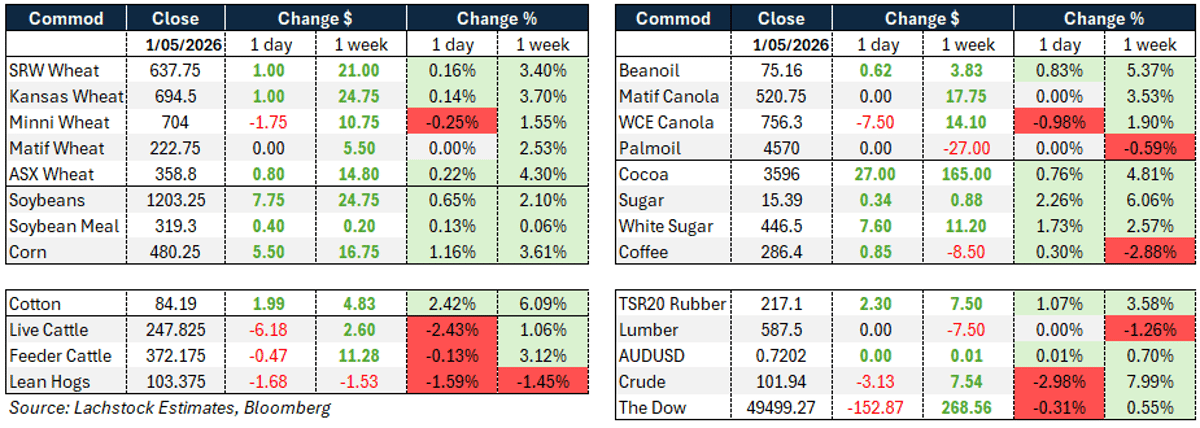
- •Wheat futures up 1 cent; rain failed to ease Kansas dryness.
- •Corn December contract gains 5.5 cents after USDA flash sale.
- •Soybeans cross $12/bushel, boosted by Trump‑Xi summit hopes.
- •Crude oil drops 3% amid Strait of Hormuz tensions.
- •Canadian canola margins ~USD 260/tonne, three times last year.
Pulse Analysis
The latest grain session underscores the fragile balance between weather‑driven supply constraints and market sentiment. In the U.S. wheat belt, recent showers in Colorado and western Kansas fell short of the precipitation needed to offset the lingering drought that threatens Hard Red Winter yields. As a result, Chicago July and Kansas City July wheat futures each nudged up a cent, while the Minneapolis curve weakened, leaving the market in a wait‑and‑see mode ahead of the Wheat Quality Conference on May 11. Traders are closely watching Kansas crop reports; any further setbacks could push prices higher, but the current modest gains suggest the market is pricing in only a limited upside.
Corn’s performance was the standout, with the December contract adding 5.5 cents after the USDA announced a flash sale of 148,240 t of corn. Coupled with ethanol consumption that topped forecasts—474.4 million bushels versus the expected 462.2 million—the grain complex received a bullish boost. Meanwhile, soybeans reclaimed the $12 per bushel psychological barrier, a level not seen since March, as investors priced in potential demand stimulus from the forthcoming Trump‑Xi summit. However, the USDA’s crush figure of 227.4 million bushels fell short of the 231.4 million estimate, tempering enthusiasm.
Geopolitical developments added another layer of complexity. President Trump’s “Project Freedom” to escort neutral ships through the Strait of Hormuz eased some oil‑price pressure, sending crude down roughly 3%, yet the risk of escalation remains high. China’s new blocking statute, allowing firms to ignore U.S. sanctions on Iranian‑linked refiners, signals a more confrontational stance that could disrupt energy trade. The ripple effect reached the Canadian dollar, which hit a seven‑week high, compressing canola margins to about C$350 per tonne—approximately USD 260 per tonne—still three times last year’s levels. These dynamics suggest that grain markets will stay sensitive to both weather patterns and geopolitical shifts in the weeks ahead.
Daily Market Wire 4 May 2026
Comments
Want to join the conversation?
Loading comments...