Commodities News and Headlines
  • All Technology
  • AI
  • Autonomy
  • B2B Growth
  • Big Data
  • BioTech
  • ClimateTech
  • Consumer Tech
  • Crypto
  • Cybersecurity
  • DevOps
  • Digital Marketing
  • Ecommerce
  • EdTech
  • Enterprise
  • FinTech
  • GovTech
  • Hardware
  • HealthTech
  • HRTech
  • LegalTech
  • Nanotech
  • PropTech
  • Quantum
  • Robotics
  • SaaS
  • SpaceTech
AllNewsDealsSocialBlogsVideosPodcastsDigests

Commodities Pulse

EMAIL DIGESTS

Daily

Every morning

Weekly

Sunday recap

NewsDealsSocialBlogsVideosPodcasts
CommoditiesNewsGRDC Update: Pulses a ‘Slow Burn’ as WA Seeks Wider Rotation
GRDC Update: Pulses a ‘Slow Burn’ as WA Seeks Wider Rotation
Commodities

GRDC Update: Pulses a ‘Slow Burn’ as WA Seeks Wider Rotation

•February 19, 2026
0
Grain Central
Grain Central•Feb 19, 2026

Why It Matters

Expanding pulse acreage can diversify WA’s cropping system, enhance soil health, and reduce reliance on synthetic nitrogen, offering growers resilience against price swings and disease pressure.

Key Takeaways

  • •WA pulse area remains under 1% of total harvest.
  • •Soil liming improves pulse establishment and nitrogen fixation.
  • •Multi‑year rotations boost profitability and reduce disease pressure.
  • •Breeding investment needed for WA‑specific pulse varieties.
  • •Market volatility requires on‑farm storage strategies.

Pulse Analysis

Western Australia’s grain belt has traditionally leaned on canola and cereals, with pulses occupying a fraction of the sown area. The 2026 GRDC Perth Update underscored a “slow‑burn” shift as growers, agronomists and marketers convened to discuss how pulses could reshape the region’s cropping matrix. A record 27 million‑tonne grain harvest still saw lupins at roughly 905 kt and other pulses at 120 kt, highlighting the gap between potential and current adoption. Yet rising fertilizer costs, tighter environmental regulations and consumer demand for protein‑rich foods are nudging producers toward legume diversification.

Scientific advances are turning that nudging into tangible gains. Researchers from the University of WA pointed to extensive liming and soil amelioration as key drivers of improved pulse establishment, especially on historically acidic sandplain soils. By integrating pulses into four‑year (sandplain) or eight‑year (better soils) rotation blocks, growers report higher overall profitability, reduced root‑lesion nematode pressure, and more flexible planting windows. The nitrogen‑fixing capacity of lupins, peas and lentils also lessens dependence on expensive bagged nitrogen, while breaking up cereal‑canola cycles curbs disease build‑up such as sclerotinia.

Despite agronomic promise, scaling pulse production hinges on genetics and market stability. InterGrain’s Dan Mullan warned that WA’s modest breeding pipelines lag behind cereal programs, leaving growers reliant on varieties not fully optimized for local climates. Targeted investment in WA‑specific pulse genetics could unlock further yield jumps and disease resistance. Meanwhile, price volatility—evident in lentil prices swinging from $925 to $650 per tonne—forces growers to adopt on‑farm storage and risk‑management tactics. Policymakers and industry bodies that support breeding funding, storage infrastructure, and export market diversification will be pivotal in converting the “slow burn” into a mainstream rotation component.

GRDC Update: Pulses a ‘slow burn’ as WA seeks wider rotation

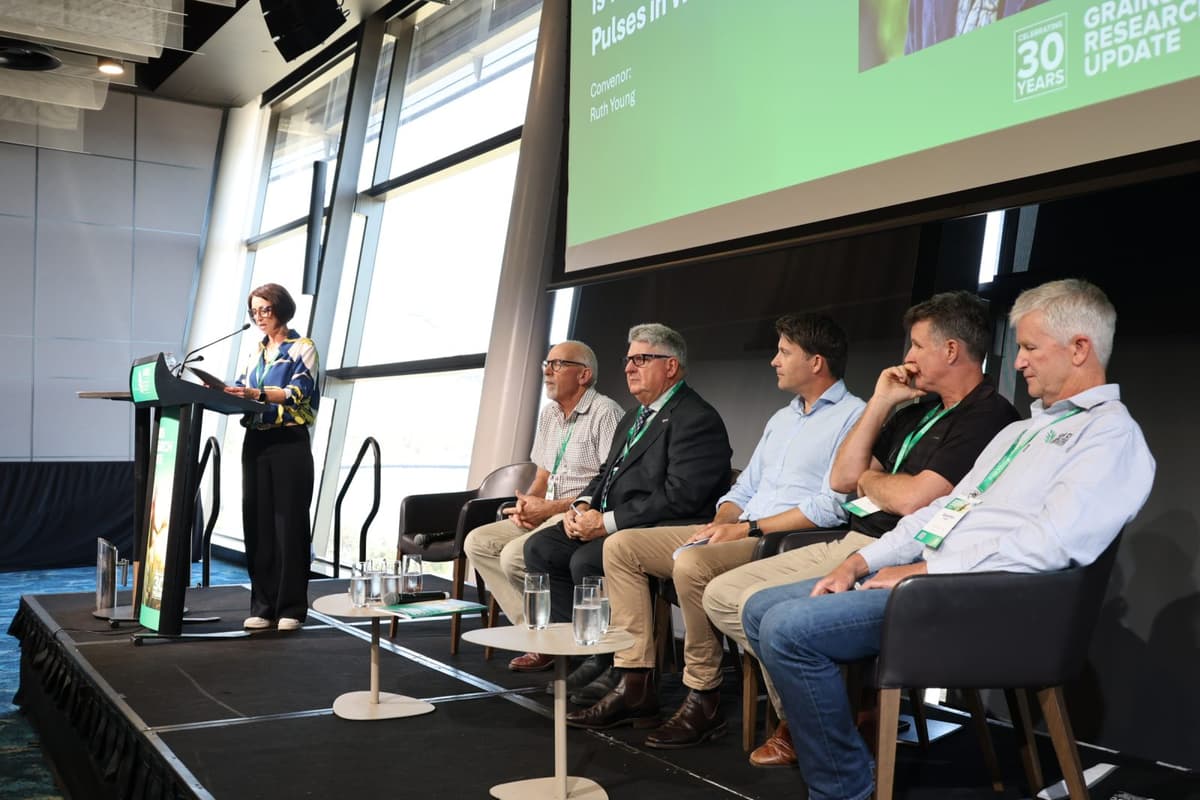
Pulse panel at 2026 GRDC Perth Update explores the future of pulses in WA

Ruth Young introduces the pulse panel at the 2026 GRDC Perth Update: SA grower Barry Mudge, marketing specialist Peter Wilson, Qld, InterGrain’s Dr Dan Mullan, agronomist and Moora grower Erin Cahill, and agronomist Quenten Knight.

A LOOK at figures from Western Australia’s record harvest of more than 27 million tonnes would indicate that the state’s growers held little interest in growing pulses.

According to Grain Industry Association of WA figures, lupins accounted for 905,000 t and other pulses 120,000 t collectively, compared with canola as WA’s No. 1 break crop on 4.37 Mt.

However, the Grains Research and Development Corporation’s 2026 Perth Update gave considerable time to pulses in Monday’s Legumes and Pulses session, and Tuesday’s panel which asked Is there a future for pulses in WA?

Monday’s session heard from esteemed University of WA researcher Professor Kadambot Siddique about what has limited WA pulse area, UWA PhD candidate Chloe Rout on canola‑lupin intercropping, and Grower Group Alliance’s Daniel Kidd on pulse development and extension.

The panel session brought grower, agronomic, and marketing experience to the fore, and was chaired by Calingiri grower Ruth Young, who with husband John is including lentils in their rotation.

“Why is it that pulses are suddenly all the talk in WA cropping circles,” Mrs Young asked in opening the session.

“Cropping rotations have narrowed, with legume pastures on the decline, along with increasing fertiliser costs and the push for greater sustainability, pulses are very much back on the agenda.

“The timing is right: we’ve got better varieties, we’re tackling soil acidity with lime and soil amelioration, and there are growers willing to push through the agronomic, harvesting, and marketing challenges to make a pulse phase very profitable in its own right.”

Valuable inclusion

The panel included experienced lentil grower Barry Mudge from Port Germein in South Australia, and WA agronomist and grower Erin Cahill from Moora in the central Wheatbelt.

“Will profitable pulses in WA be a game‑changer? I think we all know the answer to that is clearly ‘yes’,” Mr Cahill said.

“It might be a slow burn to get there, but I think hopefully with the tools we’ve got available, that’s possible.”

Mr Cahill pointed to the need for a longer‑term view when looking at both systems trials in WA, and on‑farm results.

“Historically, people have viewed pulses and profit in one or two‑year chunks, which I think is a pretty poor way to analyse the profitability of pulses and what they’re bringing to our rotations.

“When we began to view the rotation in four‑year blocks for our sandplain soils, and eight‑year blocks for our better‑type soils, we noticed ones that included a pulse had much better outcomes across that cycle.”

That included more profit and less risk, and enhancing “top‑end yields” in the rotation, with lupins traditionally the most common northern pulse, as well as field peas and lately lentils.

“I’ve seen this in my client group across a broad area.

“I think the big game‑changer for pulses in general has been the amount of liming and soil amelioration.”

Mr Cahill said that was promoting better crop establishment from dry sowing when compared to results of 10‑15 years ago, and rhizobium survival has “improved out of sight” as soils have become less acid.

“It’s no secret that canola and cereal yields have gone through the roof, but when you actually analyse the pulse yields in the last 10 years…it’s not uncommon now to see three and four‑tonne lupin crops on high‑rainfall sandplain, and that’s more consistent.

“Probably, 10 or 15 years ago, it rarely happened.”

“It’s not just about the N benefits; everyone focuses on pulse with N; we’ve all pushed crops really really hard with high rates of bagged N.

“I’ve never been shy about spending money on N, but we’ve never got the same results out of bagged nitrogen as what we’ve got following a pulse.

“I think part of that is the reduction of things like root‑lesion nematode.”

Mr Cahill said tight wheat‑canola or barley‑canola rotations in his area have seen the RLN populations build up.

“Now, unfortunately, we’re reaping the outcomes of that, so getting a good pulse in to break that up is having a big effect.”

Adding pulses to rotations has also widened the planting and harvesting windows, and herbicide choices, although plant‑back restrictions need to be considered with regard to some chemicals.

On disease, Mr Cahill said he thought sclerotinia would be as big a problem in the north as ascochyta and botrytis grey mould.

“We already have to manage sclerotinia aggressively in canola and lupins, and…what I learned last year is that lentils will be very much the same.”

Volatile pricing unavoidable

The panel, and questions from the floor, addressed the topic of volatile pricing, an issue which has not dented Mr Cahill’s enthusiasm for pulses as an inclusion in the rotation.

“Lentils were highly profitable in 2024 at $925 a tonne, and they were less profitable but still very profitable in 2025 at $650,” Mr Cahill said.

SA grower Barry Mudge added lentils to his wheat‑pasture‑legume rotation in the early 2000s to supplement the cereal and sheep income.

“Agronomically, it was terribly sound, but it’s very hard to make money out of it; when we have a good season, we need to kill the pig,” Mr Mudge said.

“Six hundred dollars a tonne for lentils doesn’t bother me; wheat at $300 a tonne does; my advice: you have to have storage.”

Pulse marketing veteran Peter Wilson said growers have “to learn to love volatility” as part of growing pulses, and storage can make that volatility work for the grower.

“Some of the trade aren’t happy about farmers storing grain; they’d rather they dropped everything at harvest time,” Mr Wilson said.

“Equally, growers are not happy about tariffs, particularly with regard to India, but on‑farm storage has been the counter to that from growers east of WA.”

Case for better genetics

On the breeding front, InterGrain chief operations officer Dan Mullan put forward the case of improved genetics.

“While some WA growers have made pulses work in their systems, they’re struggling…across large areas of Western Australia.”

“With relatively small breeding programs compared with cereals and canola, this is hardly surprising.

“It means there is greater potential there for increased genetic gains over time if we start to invest into improving those aspects.”

“If we’re to spread our breeding efforts too thinly, with too generalised goals, Western Australian growers will really just have to rely on adaptation of bred varieties, not the design of those varieties for WA conditions.”

InterGrain is jointly owned by GRDC and the WA Government, and its wheat and barley varieties have led to significant production gains for WA growers.

“From a breeding perspective, treating WA as a primary target environment…is going to be so critical; that will enable those compounding gains, not just incremental changes.

“We’ve got to be able to come together with researchers, breeders, all the way through the industry in order to bring it all together in concert…so that any gains on the genetic side can be realised in the paddock.”

Read Original Article
0

Comments

Want to join the conversation?

Loading comments...