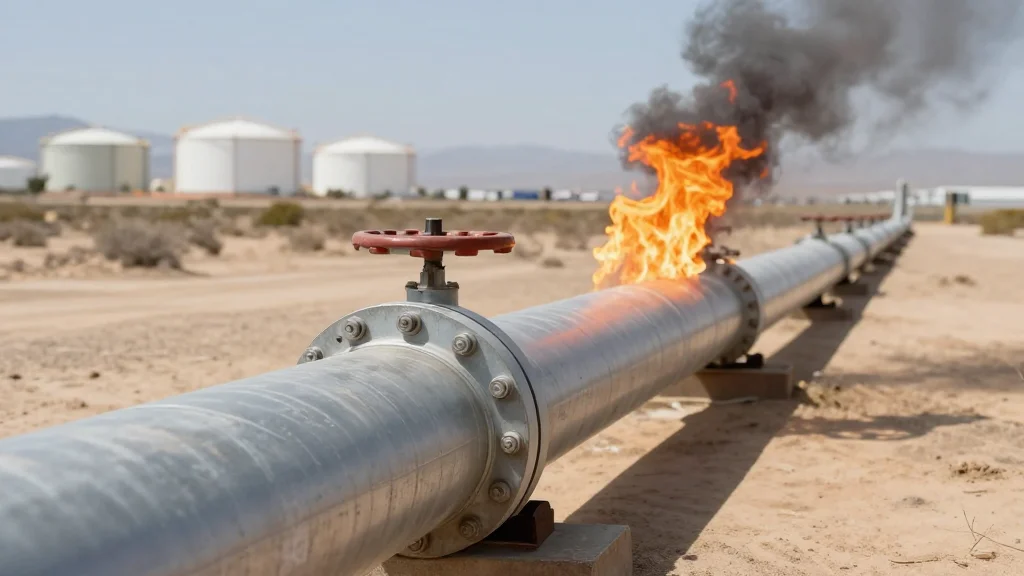
Permian-to-California Corridor Tightens, Sending SoCal Natural Gas Prices Higher
Why It Matters
Reduced pipeline capacity and rising summer demand are pushing West Coast gas prices above national benchmarks, tightening margins for utilities and industrial users. The price divergence signals broader supply‑demand imbalances that could influence investment in infrastructure and LNG projects.
Key Takeaways
- •EPNG line 1600 capacity cut to zero, removing ~575 MMcf/d.
- •SoCal Citygate spot price hit $3.585/MMBtu, highest since winter.
- •Border Ehrenberg price rose to $4.090/MMBtu, outpacing Citygate.
- •ECA LNG terminal draws up to 425 MMcf/d of Permian gas.
- •July forward at SoCal Citygate trades $3.99/MMBtu, $0.84 premium.
Pulse Analysis
The recent maintenance on El Paso Natural Gas’s Line 1600 has effectively removed roughly 575 MMcf/d of westbound capacity from the Permian‑to‑California corridor. By shutting down eight compressor stations from El Paso, Texas, through La Paz County, Arizona, the pipeline can no longer deliver cheap feed‑gas to the California border, forcing market participants to source gas from higher‑cost alternatives. This supply shock coincides with a seasonal uptick in temperature‑driven demand, amplifying the price impact on both the SoCal Citygate and Ehrenberg hubs.
Compounding the supply squeeze, the Energía Costa Azul (ECA) LNG terminal in Mexico began commercial operations in mid‑April, capable of pulling up to 425 MMcf/d from the same Permian pipeline network. The terminal’s feed‑gas appetite competes directly with West Coast utilities and power generators, which are already seeing a 580 Mcf/d increase in Pacific power demand for the first half of June. As regional temperatures climb into the 80s‑90s, demand forecasts from NatGasWeather suggest sustained pressure on western gas markets for the next nine days, reinforcing the upward price trajectory.
Market pricing now reflects these fundamentals: the July forward contract at SoCal Citygate averages $3.99/MMBtu, a $0.84 premium over the Henry Hub benchmark, while the summer average premium sits near $1.03. The El Paso‑Permian spread has turned positive, indicating that traders are pricing in tighter supply and higher downstream demand through year‑end. If pipeline repairs extend beyond the current schedule or if additional LNG projects come online, the price differential could widen further, prompting utilities to hedge more aggressively and potentially spurring investment in alternative supply routes or storage capacity.
Permian-to-California Corridor Tightens, Sending SoCal Natural Gas Prices Higher
Comments
Want to join the conversation?
Loading comments...