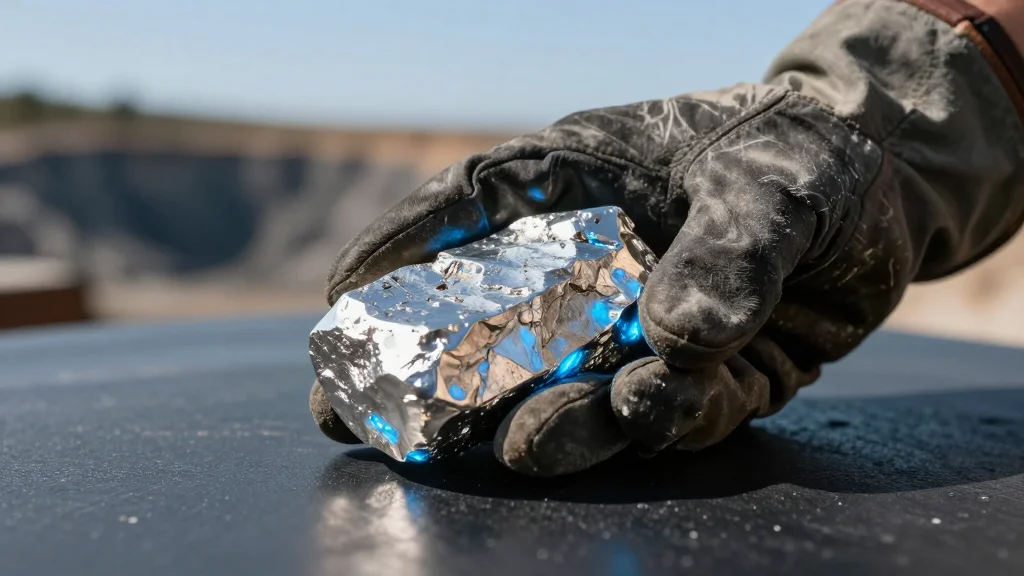
Rubidium: This Critical Mineral Goes for a Million Bucks a Tonne and Washington May Be Footing the Bill
Companies Mentioned
Why It Matters
Securing non‑Chinese rubidium reduces strategic vulnerability for US defense and high‑tech sectors, and opens a multi‑billion‑dollar market for emerging miners.
Key Takeaways
- •Delta Lithium identified 81,000t rubidium, worth billions at $1M/t
- •Iris Metals to declare first US JORC rubidium resource at Beecher
- •Everest Metals received $490k grant to develop direct rubidium extraction
- •US Defense Industrial Base lists Delta as potential rubidium supplier
- •Rubidium critical for atomic clocks, GPS, quantum computing, deep‑sea drilling
Pulse Analysis
Rubidium’s unique chemical properties make it indispensable for precision timing devices, satellite navigation and emerging quantum technologies. With a market price exceeding $1 million per tonne, the metal is far from a bulk commodity; its scarcity is amplified by China’s near‑monopoly on processing. This concentration has sparked concern among US defense planners, who rely on rubidium‑based components for atomic clocks that underpin GPS accuracy and secure communications. The strategic imperative is clear: diversify supply chains before geopolitical tensions or export controls disrupt critical defense and tech programs.
Australian explorers are moving quickly to fill the gap. Delta Lithium’s Mt Ida deposit in Western Australia hosts roughly 81,000 t of rubidium oxide, a resource that could generate billions in revenue if a reliable market emerges. The company’s recent inclusion on the US Defense Industrial Base Consortium signals serious intent to become a vetted supplier for military applications. Meanwhile, Iris Metals is poised to announce the first US‑based JORC‑compliant rubidium resource at the Beecher project in South Dakota, leveraging existing spodumene infrastructure to extract the metal as a by‑product. Everest Metals, backed by a $490,000 Australian government grant, is developing a proprietary direct‑extraction process at its Mt Edon pegmatite, aiming for commercial‑scale production by late 2026.
The broader market outlook hinges on translating rubidium’s niche uses into scalable demand. Beyond atomic clocks, the metal shows promise as a high‑pressure fluid in deep‑sea drilling, a potential substitute for cesium formate, and as a dopant in quantum computing hardware. However, commercial viability will depend on consistent metallurgical recovery rates, cost‑effective processing, and the ability to meet stringent purity specifications demanded by defense and aerospace customers. Investors watching the critical‑minerals space should monitor policy incentives, US government funding pipelines, and the progress of pilot plants, as these factors will determine whether rubidium evolves from a laboratory curiosity into a multi‑billion‑dollar export for Western miners.
Rubidium: This critical mineral goes for a million bucks a tonne and Washington may be footing the bill
Comments
Want to join the conversation?
Loading comments...