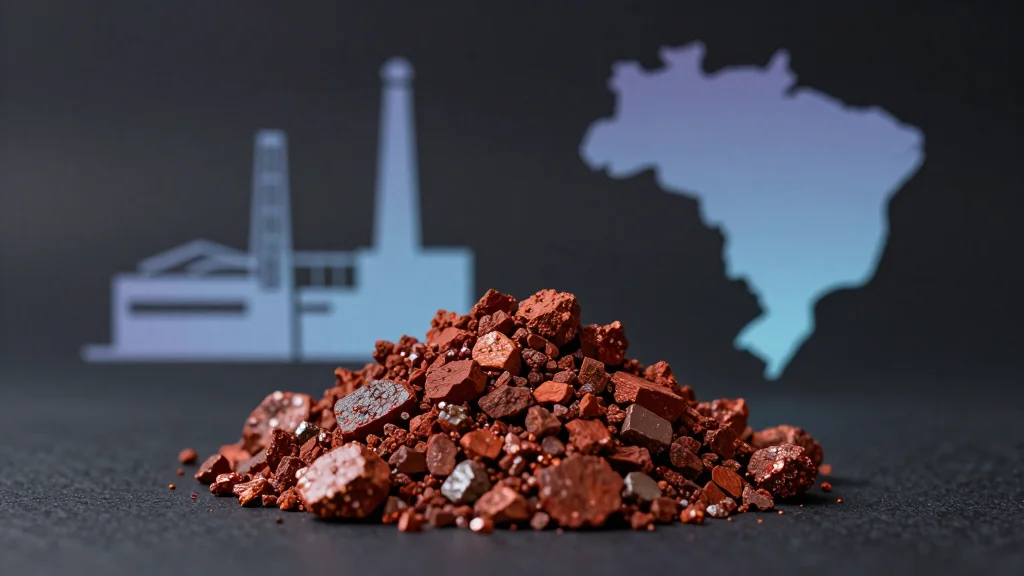
USA Rare Earth Surges 15% After $2.8 Billion Serra Verde Acquisition

Companies Mentioned
Why It Matters
The acquisition marks a rare‑earth supply‑chain shift that could lessen U.S. exposure to Chinese export controls and price manipulation. By securing a stable source of dysprosium, terbium and yttrium—elements essential for high‑efficiency motors and renewable‑energy technologies—the deal supports the United States’ clean‑energy and defense objectives. Beyond the immediate financial upside for USAR, the transaction signals growing private‑sector confidence in U.S. government financing mechanisms for strategic minerals. If the DFC‑backed model proves successful, it could catalyze additional investments in rare‑earth projects across the Americas, reshaping global commodity flows and potentially stabilizing prices for downstream manufacturers.
Key Takeaways
- •USA Rare Earth shares jumped 15% to $22.97 after announcing the $2.8 billion Serra Verde acquisition
- •Deal includes $300 million cash and 126.8 million newly issued USAR shares
- •Serra Verde’s Pela Ema mine produces dysprosium, terbium and yttrium, with 6,400 mt/yr capacity by 2027
- •U.S. International Development Finance Corp. provided $565 million financing and a 15‑year offtake agreement with price floors
- •Projected EBITDA from Serra Verde is $550‑$650 million annually, boosting USAR’s growth outlook
Pulse Analysis
USAR’s aggressive expansion into Brazil reflects a broader strategic pivot in the rare‑earth market. For the past decade, China has dominated the supply chain, leveraging its control to influence pricing and export policies. The U.S. government’s recent policy toolkit—ranging from tax incentives to direct financing—has created a fertile environment for domestic firms to chase overseas assets that can be integrated into a more resilient supply network.
From a market‑structure perspective, the acquisition could compress the already thin margin between producers and end‑users. By owning both the mine and processing facilities, USAR can capture more value upstream, potentially offering lower‑cost materials to battery and motor manufacturers. This vertical integration may also give the company leverage in negotiating future offtake contracts, especially as demand for electric‑vehicle motors and wind‑turbine generators accelerates.
However, the deal is not without risk. Rare‑earth processing is notoriously water‑intensive and environmentally sensitive, and Brazil’s regulatory landscape can be unpredictable. USAR will need to demonstrate robust environmental stewardship to avoid delays that could erode the projected EBITDA timeline. Additionally, geopolitical tensions—particularly any resurgence of U.S.–China trade friction—could impact the financing terms and market sentiment.
If USAR can successfully navigate these challenges, the Serra Verde acquisition could serve as a template for other U.S. firms seeking to secure critical‑mineral assets abroad, ultimately reshaping the global commodities map toward a more diversified and secure supply chain.
USA Rare Earth Surges 15% After $2.8 Billion Serra Verde Acquisition
Comments
Want to join the conversation?
Loading comments...