
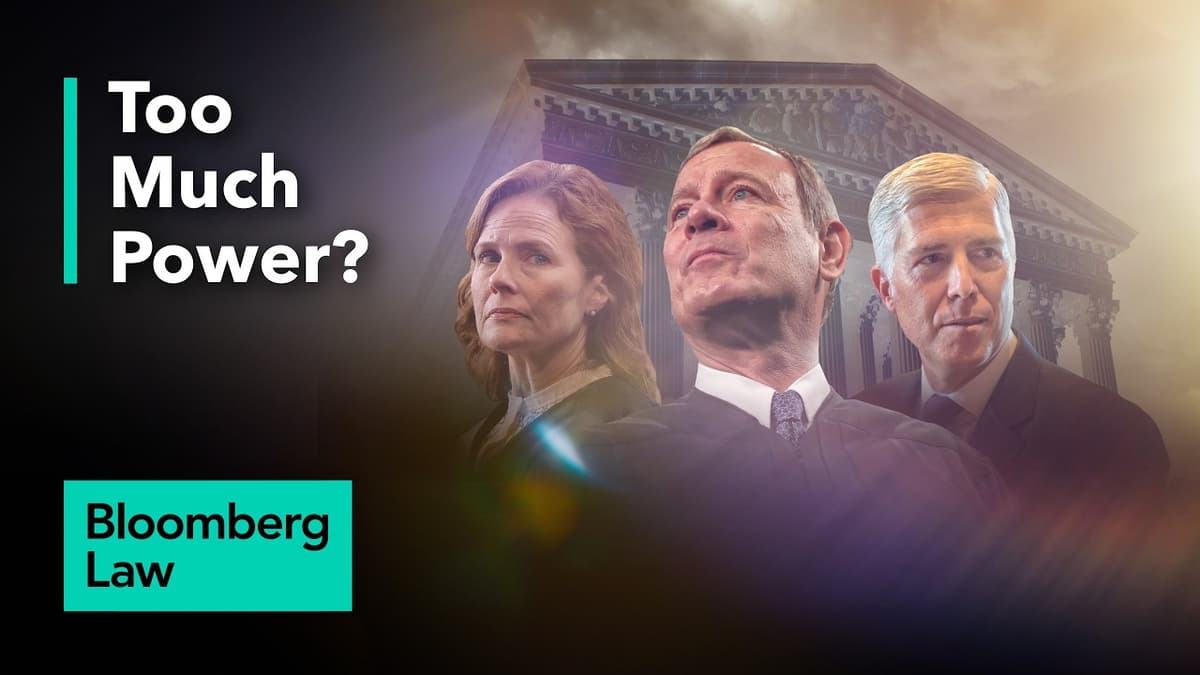
Has This Supreme Court Doctrine Made Judges Too Powerful?
The video examines the Supreme Court’s “major questions doctrine,” a legal principle that requires agencies to show clear congressional authorization before undertaking actions of vast economic or political significance. It has become a central tool in recent administrative‑law rulings and is now a frequent point of contention in oral arguments. The doctrine traces its intellectual roots to a 1986 law‑review critique of Chevron deference and to longstanding judicial practice of narrow statutory construction. The Court first articulated it in a majority opinion in West Virginia v. EPA (2022), rejecting the EPA’s authority to force coal‑plant closures. Since then, the justices have applied it to Biden‑era policies on student‑loan forgiveness, eviction moratoriums, and even to Trump’s tariff proposals, often striking down actions deemed “major” without explicit statutory backing. Justice Kavanaugh invoked the vivid metaphor that "Congress doesn’t hide elephants and mouse holes," emphasizing that sweeping powers should be unmistakably written into law. Justice Gorsuch warned agencies must point to "clear congressional authorization" for decisions of "vast economic and political significance." The split among the conservative bloc—only three of six applied the doctrine in the Trump tariff case—highlights its interpretive fluidity. By moving the gate‑keeping function from agencies to the judiciary, the doctrine reshapes the balance of power in Washington, creating uncertainty for regulated industries and prompting firms to reassess compliance strategies. Its persistence suggests future litigation will increasingly test the limits of agency authority, affecting sectors from energy to finance.

Structuring Your Board on Dashboard Legal
The video introduces Dashboard Legal’s customizable board system designed for law‑firm partners and legal directors who need a single source of truth for practice‑wide updates. By aggregating tasks, deadlines, client status, individual workloads and overall capacity in real time, the platform...

External Sharing with Dashboard Legal
Dashboard Legal’s new external‑sharing capability is positioned as a trust‑building tool for law firms, allowing clients to monitor case progress continuously rather than relying on periodic updates. By integrating structured workflows with a secure portal, every task, deadline, and milestone...

Bloomberg Law Expert Edge with Erin Webb
The video explains the Supreme Court’s growing reliance on its so‑called emergency, or “shadow,” docket – a stream of unsigned, expedited rulings that historically dealt only with procedural stays. Aaron Webb argues that these orders are now being used to...

Coke's $6 Billion Tax Penalty: How Transfer Pricing Works
The video examines Coca‑Cola’s $6 billion tax penalty stemming from a 2020 U.S. tax‑court ruling that the beverage giant under‑reported income on inter‑company transactions. The case highlights how transfer‑pricing disputes can balloon into multi‑billion‑dollar liabilities for multinational firms. Key insights include...

L&E Hurdles in 2026
The video outlines a three‑pronged regulatory shift that will reshape H‑1B hiring in 2026. A wage‑based allocation system, higher minimum wage thresholds, and a new sworn‑statement filing are slated to take effect, placing premium pay at the forefront of visa...