Video•Feb 27, 2026
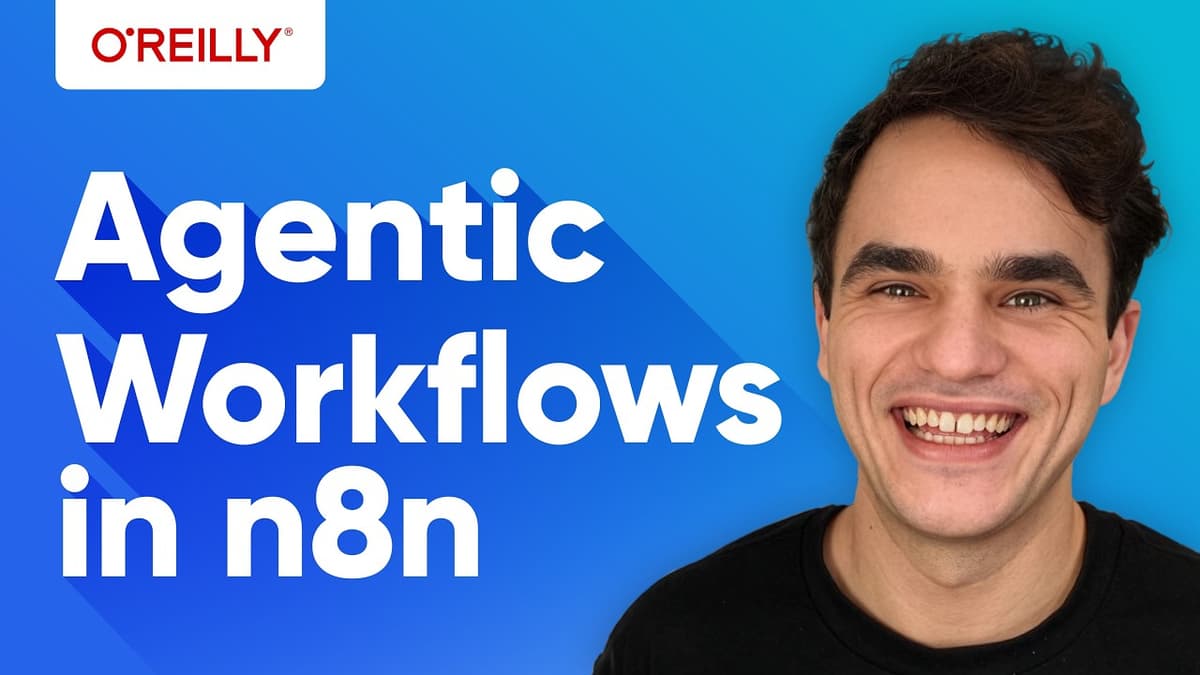
Identify, Scope, and Build an Agentic Workflow in N8n with Max Tkacz
The video walks viewers through building an AI‑driven, agentic workflow in n8n, starting with a live demo that automates a repetitive competitor‑monitoring task. Max Tkacz emphasizes a disciplined triage process—evaluating potential automations on time saved, feasibility, risk of damage, and the human joy‑or‑dread factor—before committing development effort. He introduces a practical “panic button” technique: whenever a manual step feels tedious, note it, estimate its time cost, and assess its automation viability. Applying this framework, he narrows a list of tasks (replying to comments, tracking competitors, distributing content) to the low‑risk, high‑value competitor‑watching use case, then scopes a V1 that scrapes LinkedIn posts, categorizes them with an LLM, and emails a summary. The walkthrough details constructing a reusable tool workflow: a trigger activated by another workflow, an Ampify actor to scrape LinkedIn, JavaScript‑style date expressions for dynamic windows, and an edit‑fields node to trim the payload. He then decouples this tool from an AI agent that runs on a weekly schedule, demonstrating how the agent can invoke the tool, process results, and send formatted Gmail notifications—illustrating modular design for future extensions. By modularizing the scraper as a standalone tool and the agent as a separate orchestrator, the approach enables rapid iteration, reuse across projects, and safe scaling of AI‑augmented automations. Organizations can thus capture insights faster, reduce manual overhead, and mitigate operational risk while maintaining flexibility for future workflow enhancements.
By O’Reilly Media

Video•Feb 18, 2026
How to Build Reliable AI at Scale: Insights From Addy Osmani
Addy Osmani, working to bridge Google DeepMind research with product and developer teams, urges builders to move beyond one-off demos toward production-ready AI systems. He frames development on a spectrum from “wild west” solo experiments to enterprise-grade setups with quality...
By O’Reilly Media

Video•Feb 18, 2026
"Something Big Is Happening": Addy Osmani and Tim O'Reilly on Matt Shumer's Viral AI Essay
Matt Shumer’s viral essay "Something Big Is Happening" argues that AI has reached a point where it can perform most technical work. In a live discussion, Google engineer Addy Osmani and industry veteran Tim O'Reilly dissect the claim, weighing its...
By O’Reilly Media
Video•Feb 11, 2026
Highlights From Software Architecture Superstream: Enterprise Architecture in the Age of AI
At the Software Architecture Superstream, leading architects discussed how AI is reshaping enterprise architecture. They highlighted the shift toward AI‑ready, code‑first designs that support continuous innovation while maintaining governance, security, and observability. Speakers covered architecture as code, agentic value streams,...
By O’Reilly Media
Video•Feb 10, 2026
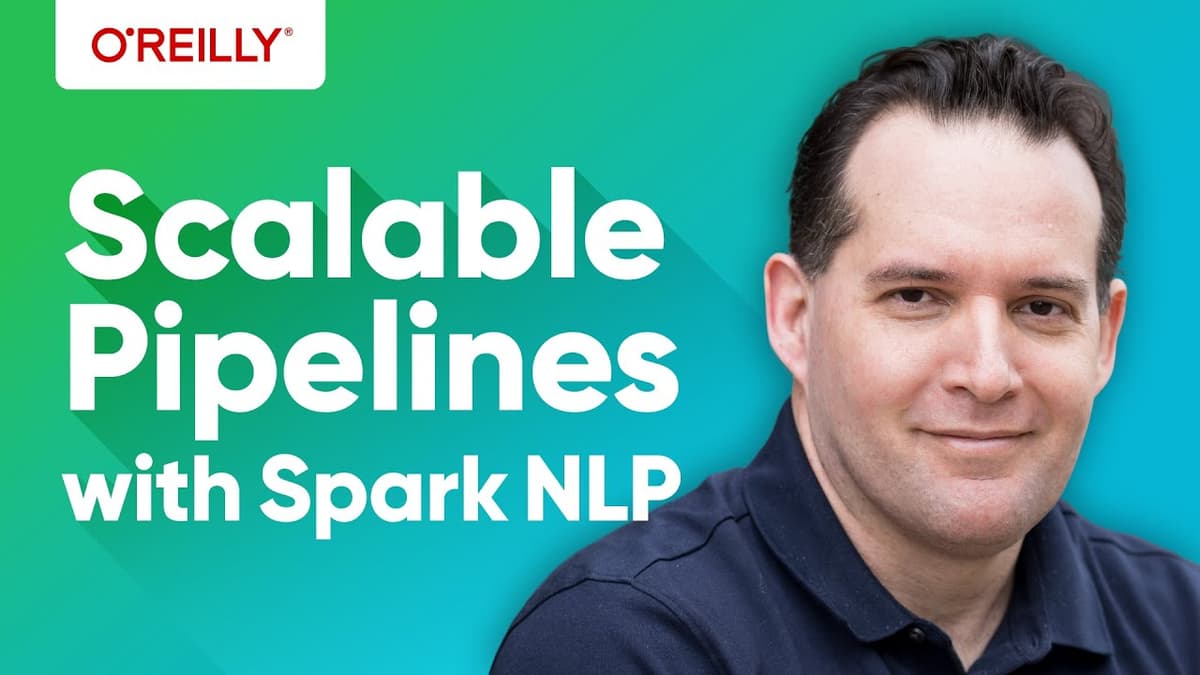
Building Scalable GenAI Inference Pipelines with Spark NLP with David Talby
David Talby of Pacific AI showcases Spark NLP, an Apache‑2.0 open‑source library that enables enterprise‑grade natural language processing at petabyte scale on standard Spark clusters. He highlights three core use cases: generating embeddings for retrieval‑augmented generation vector stores, performing batch...
By O’Reilly Media