Cyclical Weakness for Townhouse Construction
Why It Matters
The decline signals tightening housing affordability, pressuring builders and investors in the attached‑home segment. Understanding these trends helps developers adjust strategies and policymakers gauge the need for supportive housing policies.
Key Takeaways
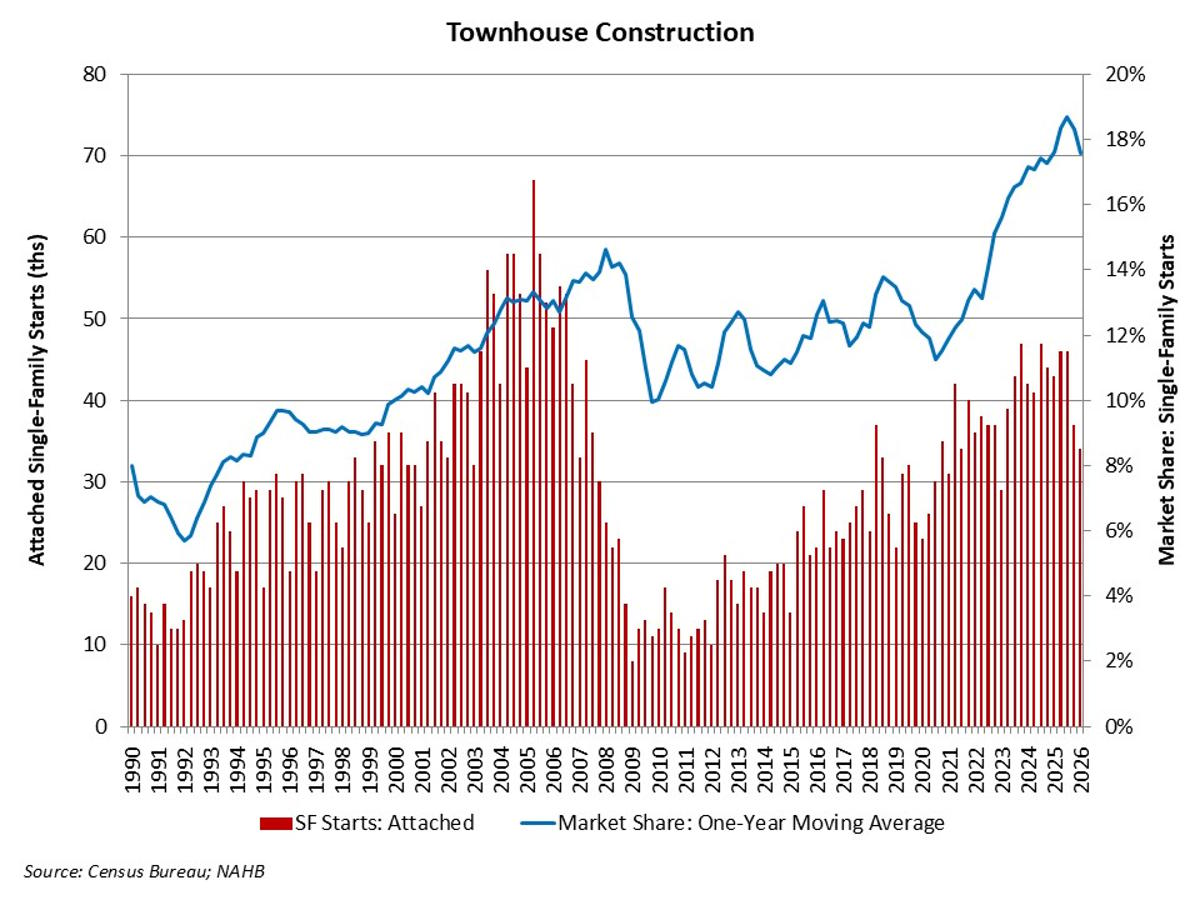
- •Q1 2026 attached starts fell 21% YoY to 34,000 units.
- •Four‑quarter total dropped 7% to 163,000 townhouses.
- •Market share slipped to 17.6%, below 2025 peak of 18.7%.
- •Townhouses represent 16% of single‑family starts in Q1 2026.
- •Long‑term demand stays strong for walkable, medium‑density neighborhoods.
Pulse Analysis
Affordability pressures are reshaping the U.S. housing market, and townhouse construction feels the strain. As mortgage rates hover near historic highs and inventory remains limited, prospective buyers are postponing purchases or shifting to rentals. This environment directly translates into a 21% drop in attached‑home starts in the first quarter of 2026, underscoring how sensitive the segment is to credit conditions and consumer confidence. Builders watching these signals are re‑evaluating land acquisition and pricing strategies to stay viable.
The market‑share trajectory of townhouses offers a deeper narrative. After a steady climb since the early 1990s, the share peaked at 14.6% in early 2008 and surged to an all‑time high of 18.7% in Q3 2025. Yet the latest one‑year moving average shows a retreat to 17.6%, reflecting both cyclical softness and a possible rebalancing after years of rapid growth. Compared with the broader single‑family sector, townhouses now account for roughly 16% of starts, a modest but meaningful slice that signals their role in diversifying housing supply.
Looking ahead, the outlook remains cautiously optimistic. Demographic trends—especially millennials and Gen Z seeking walkable urban villages—continue to fuel demand for medium‑density homes where zoning permits. Developers that can pair efficient design with flexible financing are positioned to capture this niche. Moreover, local governments encouraging mixed‑use zoning could unlock new sites, allowing townhouses to expand beyond traditional suburban footprints and meet the evolving preferences of homebuyers.
Cyclical Weakness for Townhouse Construction
Comments
Want to join the conversation?
Loading comments...