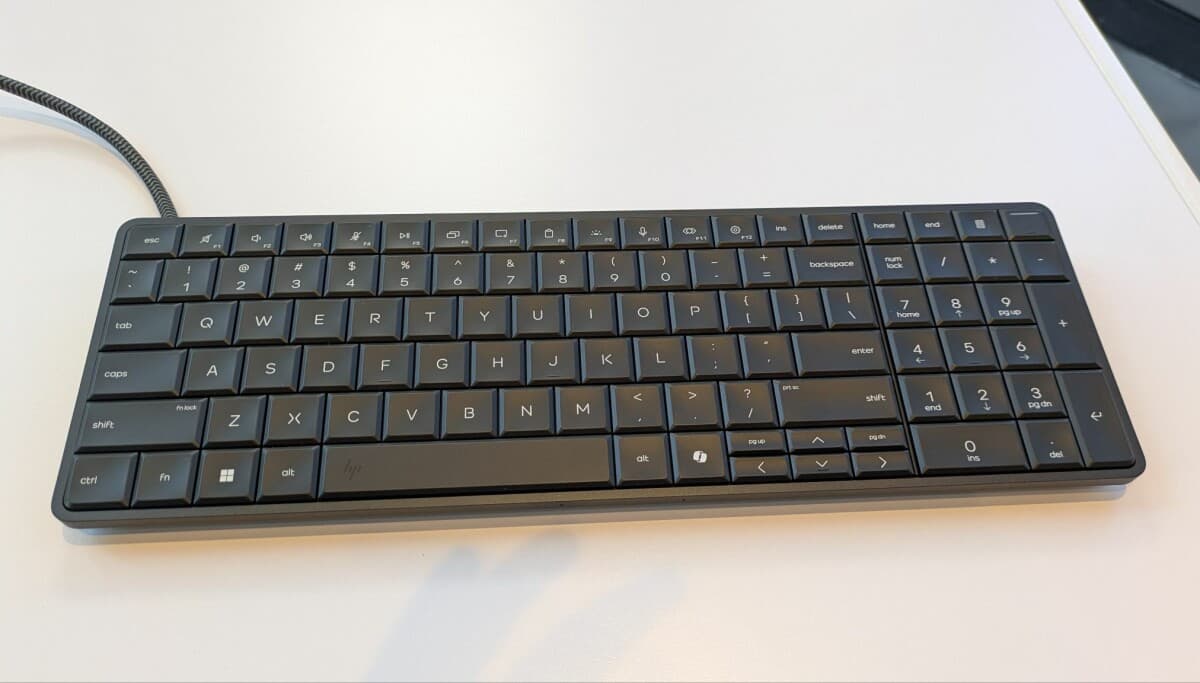
HP Stuffed a PC Into a Keyboard. We Took It for a Spin

Companies Mentioned
Why It Matters
The EliteBoard challenges the laptop’s dominance in corporate fleets, forcing IT leaders to weigh space‑saving hardware against higher cost and limited use cases.
Key Takeaways
- •HP EliteBoard G1a integrates a full PC into a 101‑key keyboard
- •Prices range from $1,499 for base model to $3,423 for top spec
- •Targeted at “dual deskers” and space‑constrained call centers
- •Uses USB4 for single‑cable power, video, and data docking
- •Offers HP Wolf Security subscription and local AI Copilot+ features
Pulse Analysis
The keyboard‑form‑factor isn’t new—Apple’s II and Commodore 64 famously housed computers inside their keys—but HP is reviving it for modern enterprises. By embedding a Ryzen AI processor, DDR5 memory and up to 2 TB of NVMe storage inside a portable 14‑by‑5‑inch chassis, HP hopes to create a niche for workers who shuttle between office and home desks. The device’s 1.49‑pound weight makes it lighter than most ultrabooks, and its built‑in fingerprint reader and lock slot address corporate security policies. HP’s inclusion of a three‑year Wolf Security subscription and Windows Copilot+ AI features further differentiates it from generic mini‑PCs.
Performance‑wise, the EliteBoard holds its own against traditional laptops. Benchmarks show single‑thread prime‑sieving speeds that outpace many thin clients, while multi‑threaded workloads lag behind high‑end ARM‑based laptops. The integrated NPU enables on‑device AI tasks such as local image generation and real‑time transcription, appealing to knowledge workers who need privacy‑first tools. However, the price point—starting at $1,499 and climbing above $3,000 for premium specs—exceeds comparable EliteBook laptops, which can be purchased for $1,300‑$1,800 with similar CPUs. Adding a USB‑C monitor (often $200‑$500) raises total cost of ownership, forcing IT departments to justify the expense against existing laptop or thin‑client solutions.
For enterprises, the EliteBoard presents a trade‑off between desk‑space efficiency and budgetary constraints. Call centers with cramped cubicles might appreciate the keyboard’s minimal footprint, yet many such operations prioritize low‑cost, replaceable hardware over high‑performance AI PCs. Meanwhile, “dual deskers” already rely on docking stations that make laptops nearly as compact as a keyboard. Adoption will likely hinge on whether organizations can leverage the device’s AI capabilities and security bundle to offset its premium price. If HP can secure bulk contracts and bundle monitors, the EliteBoard could carve out a modest but strategic role in the evolving landscape of corporate hardware provisioning.
HP stuffed a PC into a keyboard. We took it for a spin
Comments
Want to join the conversation?
Loading comments...