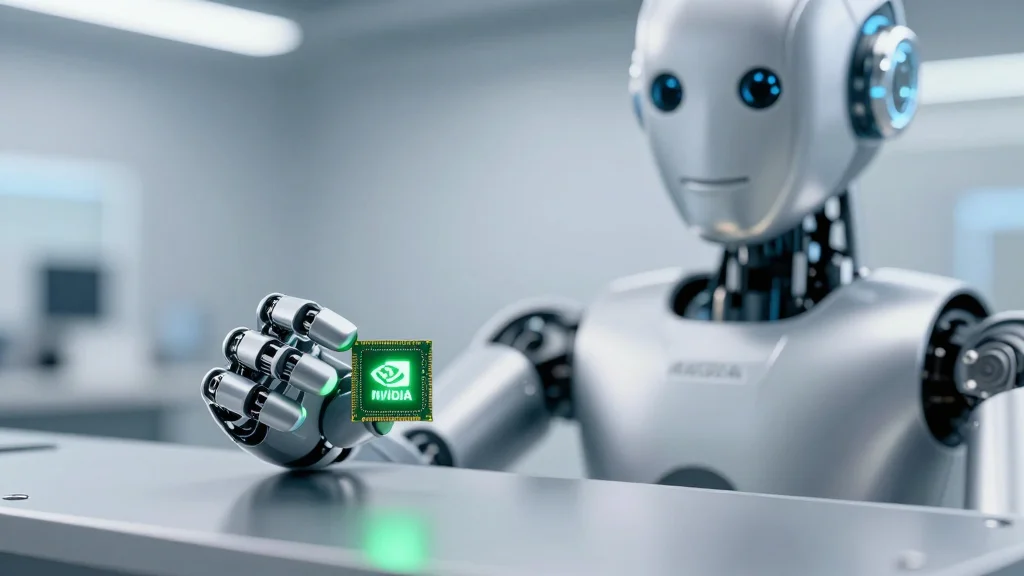
NVIDIA Teams with LG to Build AI‑powered Humanoid Robots in South Korea

Companies Mentioned
Why It Matters
The NVIDIA‑LG alliance bridges a critical gap between cutting‑edge AI hardware and consumer‑grade robotics, a segment that has struggled to achieve mass adoption. By providing LG with a private, high‑performance AI training pipeline, the partnership could accelerate the delivery of capable home robots that handle everyday chores, potentially unlocking a multi‑billion‑dollar market for personal automation. Moreover, the AI factory concept demonstrates how traditional manufacturing can be transformed into data‑driven, autonomous operations, setting a template for other conglomerates seeking to modernize legacy production lines. Beyond robotics, the deal deepens NVIDIA’s foothold in South Korea’s AI ecosystem, securing memory and component supply chains amid U.S.–China tensions. The collaboration may also spur competition among Korean chaebols to develop their own AI‑factory capabilities, intensifying the race for AI‑enabled smart factories across Asia and beyond.
Key Takeaways
- •NVIDIA and LG Group announced a joint AI factory and humanoid‑robot program on June 7
- •LG will integrate NVIDIA Isaac Sim, Isaac Lab and GR00T foundation model into its CLOiD home robot
- •The partnership gives LG dedicated GPU clusters and simulation tools, reducing reliance on public cloud AI services
- •LG plans to convert 29 factories in 14 countries to AI‑factory standards by 2030 using NVIDIA’s DSX platform
- •Financial terms were not disclosed, but the deal marks the deepest AI‑infrastructure collaboration between the two firms
Pulse Analysis
NVIDIA’s strategy of embedding its AI stack directly into partner ecosystems is reaching a new level of vertical integration with the LG deal. By moving beyond software licensing to co‑development of hardware, simulation environments and data‑generation facilities, NVIDIA is locking in long‑term demand for its GPUs and associated software. This mirrors its earlier moves with automotive OEMs and cloud providers, but the consumer‑robot angle is unique: it targets a market that has historically suffered from high costs and limited functionality. If LG can leverage the AI factory to mass‑produce affordable, capable robots, it could catalyze a wave of household automation that expands the addressable market for AI hardware.
From LG’s perspective, the partnership is a defensive play against rivals that are also courting NVIDIA’s technology. Samsung, for instance, has been developing its own robot platforms and has deep ties with other chipmakers. By securing a private AI training pipeline, LG safeguards its proprietary models and accelerates time‑to‑market, which is crucial in a space where software updates can quickly erode competitive advantage. The AI factory also dovetails with LG’s broader smart‑factory agenda, promising operational efficiencies that could improve margins across its diversified product lines.
Geopolitically, the collaboration underscores South Korea’s growing role as a hub for AI hardware and manufacturing. With U.S.–China tensions prompting firms to diversify supply chains, NVIDIA’s deepening ties with Korean conglomerates may help insulate its ecosystem from export restrictions. The partnership could also encourage other Korean firms to pursue similar AI‑factory models, potentially reshaping the global landscape of AI‑driven manufacturing and consumer robotics.
NVIDIA teams with LG to build AI‑powered humanoid robots in South Korea
Comments
Want to join the conversation?
Loading comments...