Video•Mar 11, 2026
Two Impossible Black Holes Just Crashed Into Each Other
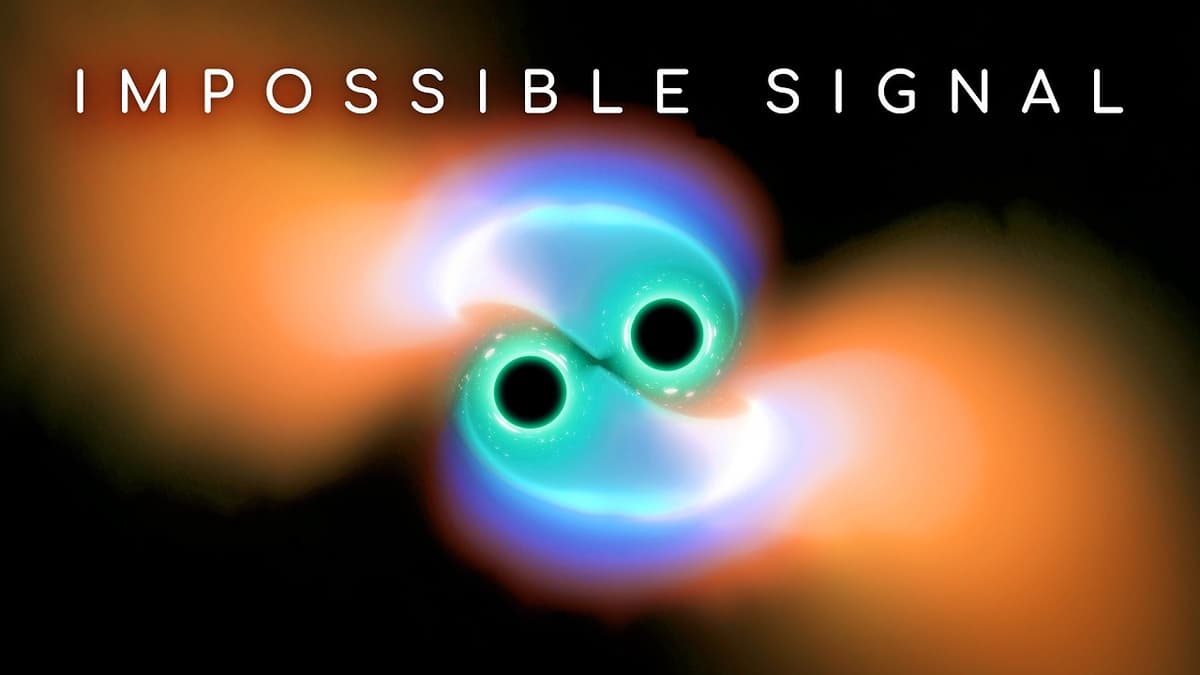
The video examines the groundbreaking LIGO detection of GW231123, a gravitational‑wave signal from two black holes that lie squarely inside the long‑standing “mass gap.” Occurring roughly 7 billion light‑years away, the event was captured on November 23, 2023 and immediately stood out as a ten‑second‑long, unusually loud blip that survived rigorous noise‑rejection tests.
Analysis of the waveform revealed the progenitor black holes to be about 103 and 137 times the Sun’s mass, each spinning at nearly the speed of light. Their merger produced a single remnant of 182‑251 solar masses and radiated the equivalent of 15 solar masses in pure gravitational‑wave energy—roughly 3 × 10⁴⁸ J, outshining all stellar output in the observable universe at that moment. The signal was dominated by the “ringdown” phase, allowing scientists to extract precise mass and spin parameters.
The discovery challenges conventional stellar‑evolution models, which predict a dearth of black holes between 50 and 130 solar masses. Researchers at the Flatiron Institute propose that strong magnetic fields in the collapsing cores of massive stars can both limit mass loss and impart rapid spin, creating gap‑mass black holes without requiring hierarchical mergers. Simulations demonstrated that magnetically driven jets can eject up to half the progenitor’s mass while delivering a natal kick that preserves binary binding.
If confirmed, these mechanisms will reshape our understanding of black‑hole formation pathways, expand the catalog of detectable intermediate‑mass mergers, and refine predictions for future gravitational‑wave observatories. The event underscores LIGO’s growing sensitivity and its role in probing physics beyond standard stellar‑collapse theory.