
GC2025 Insights: How Policies & Incentives Build Impact Economies
The podcast spotlights GSG Impact’s mission to build impact economies by shaping policies and incentives that channel capital toward measurable social and environmental outcomes. Elizabeth, a veteran of the Inter‑American Development Bank and UN, explains how the organization’s 43 national partners across 48 countries create local frameworks that attract domestic investors. Key insights include the power of a single policy win to unlock billions of dollars, the untapped potential of Asian pension funds, sovereign wealth, and family offices, and the central role of blended finance in offering varied return profiles to skeptical institutional investors. GSG emphasizes rigorous impact standards and disclosure to ensure legitimacy and measurable results. Elizabeth notes, “Assets under management for impact are tiny today; I hope they grow a hundredfold in ten years,” and adds, “Blended finance is our ticket to unlock more impact investing.” She cites the Dutch pension system’s $70 billion impact allocation as a model for other markets. The implications are clear: investors seeking scale must engage with policy makers, adopt transparent standards, and leverage blended structures. For emerging markets, aligning domestic capital with impact goals could transform financing landscapes and accelerate progress toward the Sustainable Development Goals.
07 - Designing Better Systems for Women’s Health: From Silence to Solutions
The AVPN Gender Agenda episode spotlights systemic gaps in women’s health across Asia, featuring Olivia Coates‑James of Luna/Good Period and Shruti Lohia Arora of India Roma Healthcare. Both discuss why women’s health remains siloed and how gender‑responsive solutions can be built. Key insights include...
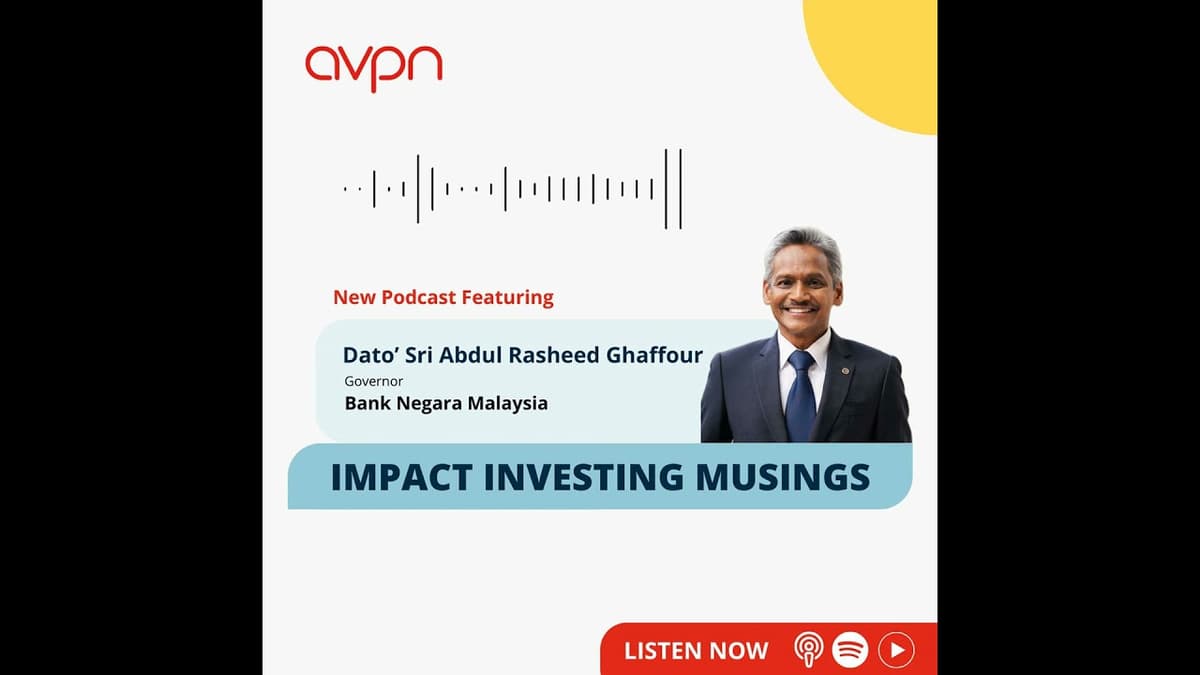
GC2025 Insights: Catalysing Asia’s Finance for People and Planet
The keynote delivered by Governor Tat Rashid at AVPN Global 2025 outlined a roadmap for mobilising Asia’s finance to power inclusive, resilient, and sustainable growth. He framed the challenge as moving from traditional industrial policy to “industrial co‑creation,” where governments,...