Brazil Patent Landscape
The UC Berkeley webcast highlighted Brazil’s rapidly evolving patent landscape, emphasizing a dramatic rise in litigation activity and the country’s growing importance for multinational innovators. Over the past decade, standard‑essential patent filings have exploded from a handful to roughly fifty per year, and the pool of patent litigators has expanded from a dozen to over seventy, reflecting Brazil’s shift from a commodity‑focused economy to a diversified, high‑tech consumer market. Key insights include Brazil’s unusually favorable preliminary injunction regime, which grants relief based on likelihood of success and urgency, and a markedly shortened timeline from filing to trial. The nation’s bifurcated court system separates validity and infringement matters, while judges—often lacking technical backgrounds—depend heavily on court‑appointed experts to interpret complex technologies. These procedural nuances, combined with limited discovery, demand strategic evidence management. Illustrative cases underscored the ecosystem’s maturity: Japanese firm IP Bridge secured a preliminary injunction against a major carmaker over 5G patents; a Brazilian tech company filed the first UPC‑style enforcement action against a German competitor; and Johnson & Johnson obtained a permanent injunction in a high‑profile dispute, highlighting the interplay between validity and infringement courts. Additionally, Brazil’s patent office recently issued AI‑focused examination guidelines, aligning its standards with the EPO and signaling readiness for emerging technologies. For businesses, these developments mean Brazil can no longer be ignored. Companies must craft litigation strategies that leverage swift injunctions, engage technical experts early, and monitor evolving AI patent criteria. The market’s growth and procedural distinctiveness present both opportunities for robust patent enforcement and challenges that require localized expertise.
Cox V. Sony Music:Refining Secondary (C) Liability Rules
The Berkeley Center webcast dissected the Supreme Court’s landmark ruling in Cox v. Sony Music, which reshapes secondary copyright liability. The Court unanimously overturned the Fourth Circuit’s material‑contribution‑with‑knowledge standard, holding that mere awareness of infringing users does not suffice for...
Internet & Computer Law Year in Review 2025-26— (Session 1) Overarching
The Berkeley Center for Law & Technology webcast, hosted by Wayne Stacy and Ian Ballon, serves as the definitive annual review for practitioners in internet and computer law. The two‑hour session compresses a three‑day curriculum, covering AI, IP, privacy, and...

28th Annual BTLJ-BCLT Spring Symposium: (Day 2, Panel 4)
The second panel of the 28th BTLJ‑BCLT Spring Symposium examined the rapidly evolving AI governance landscape in the United Kingdom and the European Union, highlighting legislative shifts, emerging regulatory frameworks, and their practical consequences for technology firms. Michael Veale outlined how...

AI as an Inventing Tool: Beyond Inventorship (Panel 3)
The panel examined AI’s expanding role as an inventing tool and its ripple effects on patent law, moving the conversation beyond who is listed as inventor. Professors Peter Lee and Ali Alemozafar highlighted how AI accelerates prior‑art searches, influences novelty...

AI as an Inventing Tool: AI’s Challenges to Patent Law – Inventorship (Panel 2)
The panel examined how AI tools upend the traditional notion of inventorship in patent law, focusing on the requirement that a natural person be named as inventor under the Paris Convention and U.S. statutes. Speakers highlighted that U.S. law, unlike copyright’s...

Talk I: Copyright Challenge – A Comparative Law View on Authorship
The inaugural Yuan Global Talk examined how generative AI challenges traditional copyright doctrines, contrasting recent rulings in China and the United States. Host Yuan Hao introduced the technology’s rapid rise and set the stage for a comparative legal analysis of...

Ethics of Wearable Technology: Privacy, PHI and IP Considerations
The session examined the growing ethical and legal challenges posed by wearable health technologies, focusing on privacy, personal health information (PHI), and intellectual‑property considerations. Speakers highlighted how these devices have evolved from simple pedometers to medical‑grade sensors that collect continuous...
US-UK On Fair Use
The webinar examined the rapidly evolving landscape of AI‑generated content and copyright law, centering on the landmark UK trial between Getty Images and Stability AI. The case, heard in the Patents Court—a specialist IP forum within the Chancery Division—originally featured...
California’s Cybersecurity Audit Rule
The Berkeley Center for Law & Technology hosted Jim Dempsey to explain California’s newly adopted cybersecurity audit rule, part of a broader package that also addresses automated decision‑making technology and risk assessments. Adopted on July 24 by the California Privacy Protection...

BCLT-Oregon Start-Up Series: (Session 5) Understanding Exclusivity Provisions
The Berkeley Center for Law & Technology hosted a webcast featuring Greenberg Traurig partners Brent Sokol and Alex Linhardt, dissecting exclusivity provisions in technology agreements. The session clarified how such clauses function, highlighted judicial interpretations that define their permissible scope, and outlined...
Welcome to UC Berkeley Center for Law & Technology!
Vince Juraliman, director of the Life Sciences Law and Policy Center at UC Berkeley’s Center for Law & Technology (BCLT), outlines the center’s mission to equip students, legal professionals, and the public with resources on technology law and policy. BCLT...
The Impact of Prosecution Length on Patent Litigation Outcomes
The Berkeley Center for Law and Technology webcast featured Baker Botts partner Matt Avery presenting a Harvard Tech Law Journal paper that examined how the length of patent prosecution—measured by the number of office actions before allowance—correlates with litigation outcomes....
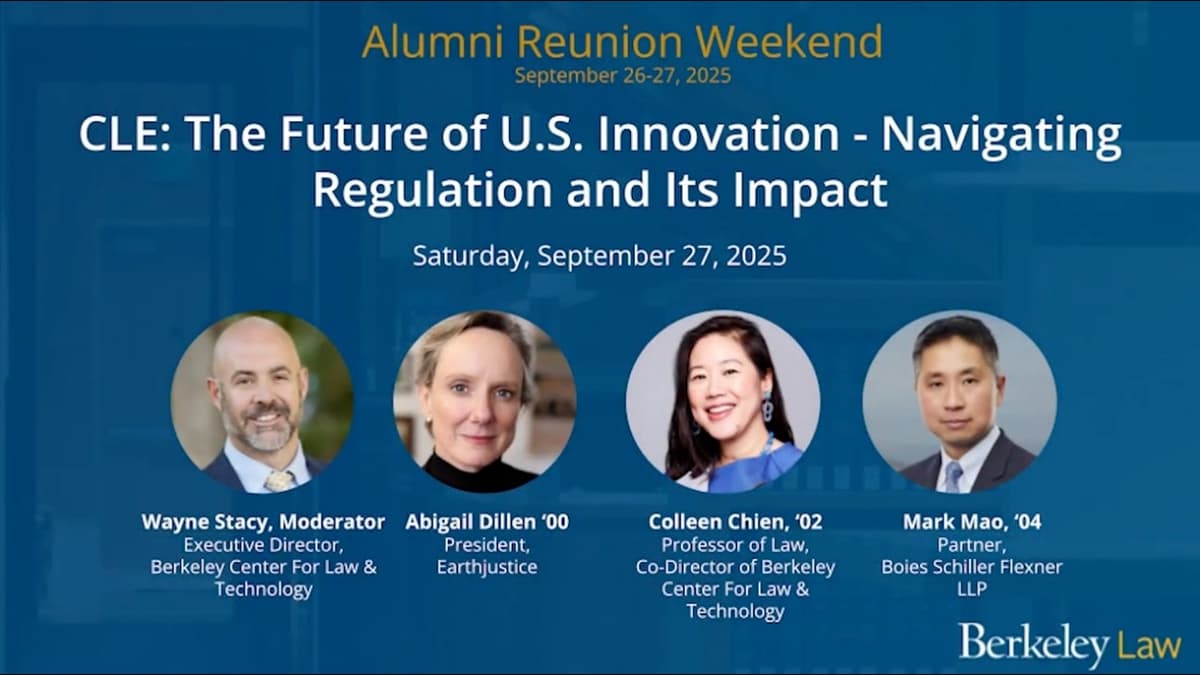
The Future of U.S. Innovation - Navigating Regulation and Its Impact
The panel convened by Berkeley Law’s Center for Law and Technology examined the intersecting forces shaping U.S. innovation—namely the power grid, semiconductor supply chains, and artificial intelligence—while probing how regulation will either enable or constrain progress. Speakers highlighted that electricity demand,...