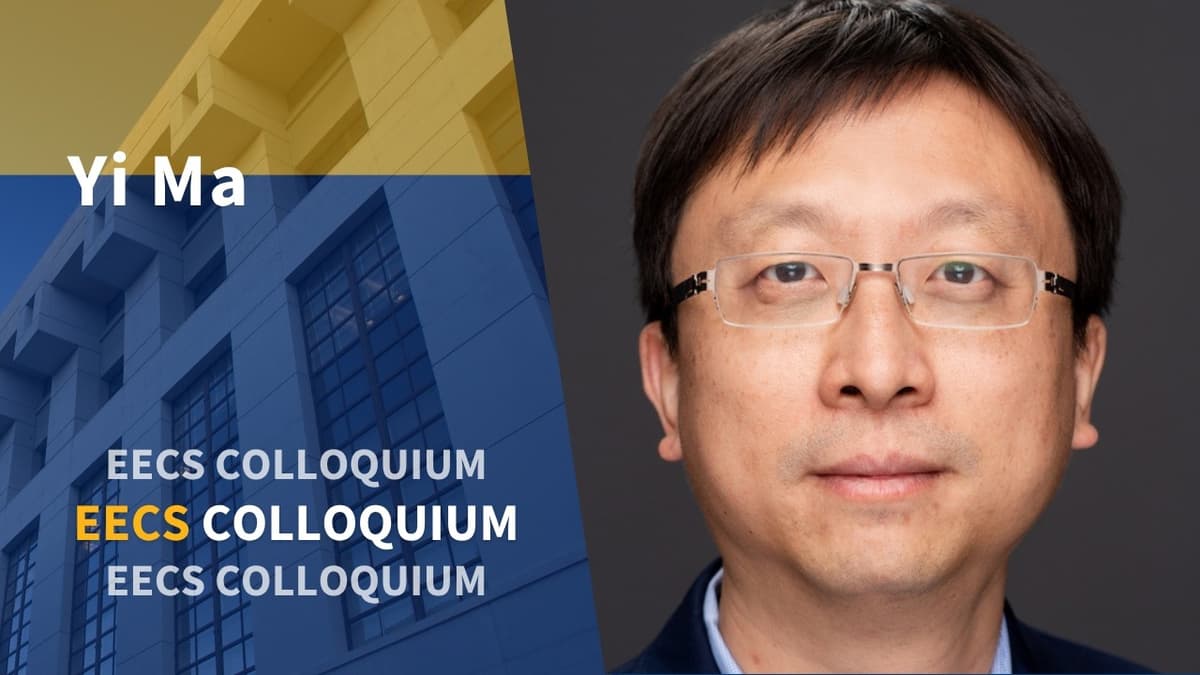
Yi Ma - Pursuing the Nature of Intelligence
Professor Yi Ma’s colloquium traced his trans‑Pacific career—from control theory to computer vision, machine learning, and leadership at Microsoft Research Asia—culminating in a deep‑thinking exploration of what intelligence truly is. He framed the current AI boom as a moment where dazzling empirical successes of deep networks have outpaced our theoretical understanding, prompting a call to move beyond trial‑and‑error tricks toward deductive, principle‑driven explanations. Ma highlighted several core insights: deep learning’s myriad tricks (dropout, batch‑norm, ReLU) are largely phenomenological; the field has been dominated by inductive, data‑driven methods, yet a shift to deductive reasoning could reveal underlying laws. He introduced a biological analogy—phylogenetic intelligence (evolutionary, DNA‑encoded) versus ontogenetic intelligence (individual learning, embodied AI)—suggesting that today’s large language models resemble inherited genetic codes, while embodied agents embody the learning‑through‑experience paradigm. Memorable quotes punctuated the talk: “To understand something, we must create it from first principles,” echoing Feynman, and the striking line, “Just as entropy increases universally, life’s basic law is to structure itself against entropy.” He traced intelligence’s lineage from DNA’s early information storage, through the emergence of eyes and brains, to language and abstract mathematics, underscoring how each milestone reshaped knowledge acquisition. The implications are clear for researchers and industry: a renewed emphasis on principled theory could steer AI toward more robust, adaptable systems, reducing reliance on brittle empirical hacks. Embracing ontogenetic, embodied approaches may yield agents that learn continuously, better mirroring natural intelligence and ultimately delivering safer, more generalizable technologies.
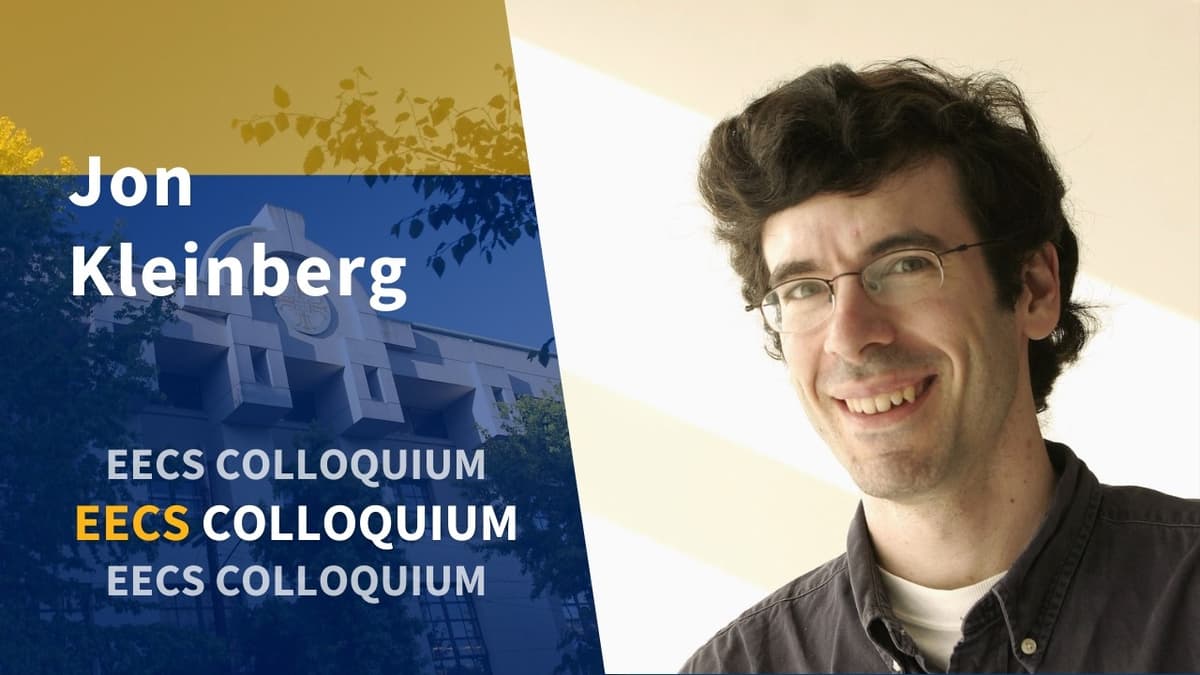
Jon Kleinberg - Formal Models of Language Generation
Jon Kleinberg’s talk explores a theoretical foundation for large language models by shifting focus from probabilistic prediction to the core task of language generation. He argues that instead of asking what distribution a model should learn, researchers should define the...

Hannes Bajohr - Making Worlds in Novels and LLMs
The talk by Hannes Bajohr explores how large language models (LLMs) and novels both construct "worlds" through sequential text generation. He begins by referencing recent research that treats navigation in Manhattan as a deterministic finite automaton, showing that LLMs can learn...

Genevieve Smith - What Gets Encoded: AI, Inequity, and Alternative Technological Futures
Genevieve Smith, founder of the Responsible AI Initiative at Berkeley’s AI Lab, delivered a talk titled “What Gets Encoded: AI, Inequity, and Alternative Technological Futures.” She argued that AI systems are not neutral; they embed existing social hierarchies and can...