
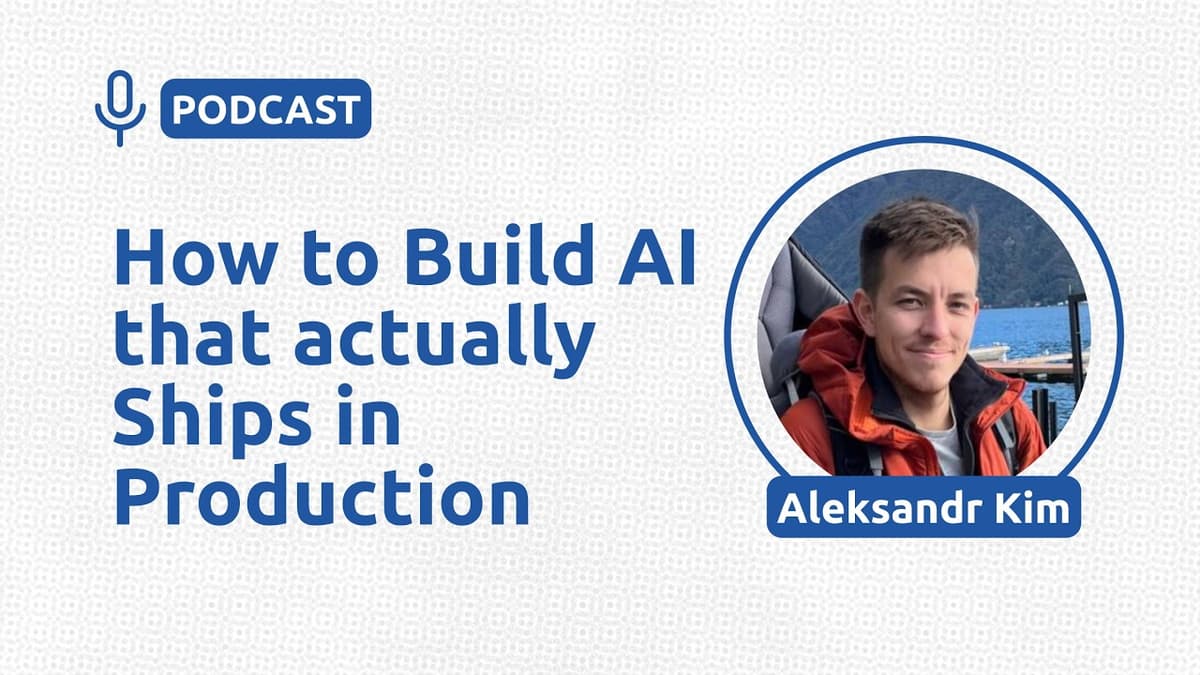
How to Build AI that Actually Ships in Production - Aleksandr Kim
The conversation centers on AI engineering—specifically, how to move sophisticated models from prototype to production at scale. Alexander Kim, a senior data scientist at Intuit, shares his journey from fine‑tuning a BERT model for cybersecurity to building AI‑driven automation tools for QuickBooks, illustrating the evolving toolkit but consistent mindset required for real‑world impact. Kim emphasizes that aligning machine‑learning metrics with business outcomes is essential. In a support‑ticket classification project, he reframed a 200‑category problem to focus on the 20 actionable categories, then introduced a conditional‑recall metric tied to automation rate, ultimately cutting support costs by 20%. He repeats that “great ML metrics, zero business impact” is a common pitfall, and that the model itself is rarely the win. A memorable anecdote involves a planned chatbot POC that proved to be a nice‑to‑have feature. By listening to analysts, Kim pivoted to an automation pipeline that aggregates data, generates insights, and pushes them to Slack, saving executives roughly 30 hours per week. He notes that success is measured through concrete usage and time‑saved rather than superficial user feedback. The takeaway for enterprises is clear: AI projects must start with a business problem, choose metrics that reflect operational goals, and remain flexible enough to pivot when the data reveals a more valuable use case. This disciplined approach turns experimental AI into reliable, revenue‑generating products.
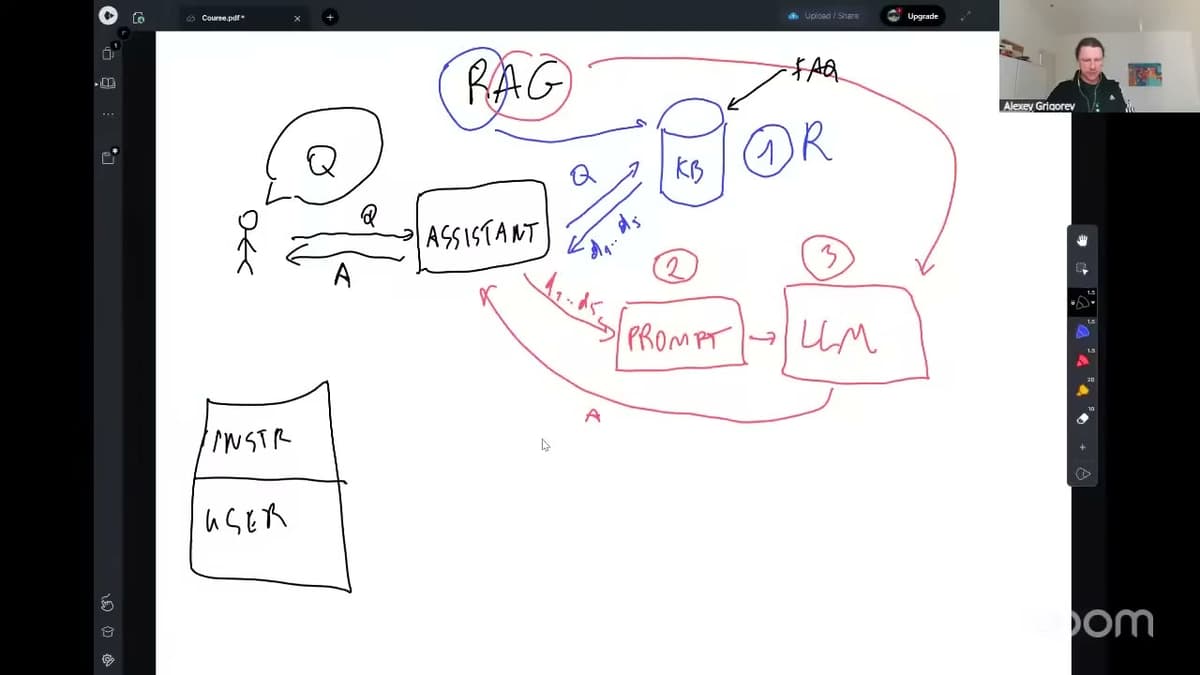
LLM Zoomcamp 1.6 — Building a Prompt
The video walks through the second stage of the Zoomcamp LLM pipeline—building the prompt that will feed the language model. After retrieving relevant course‑related documents, the instructor explains how to transform those results into a readable context string and combine...
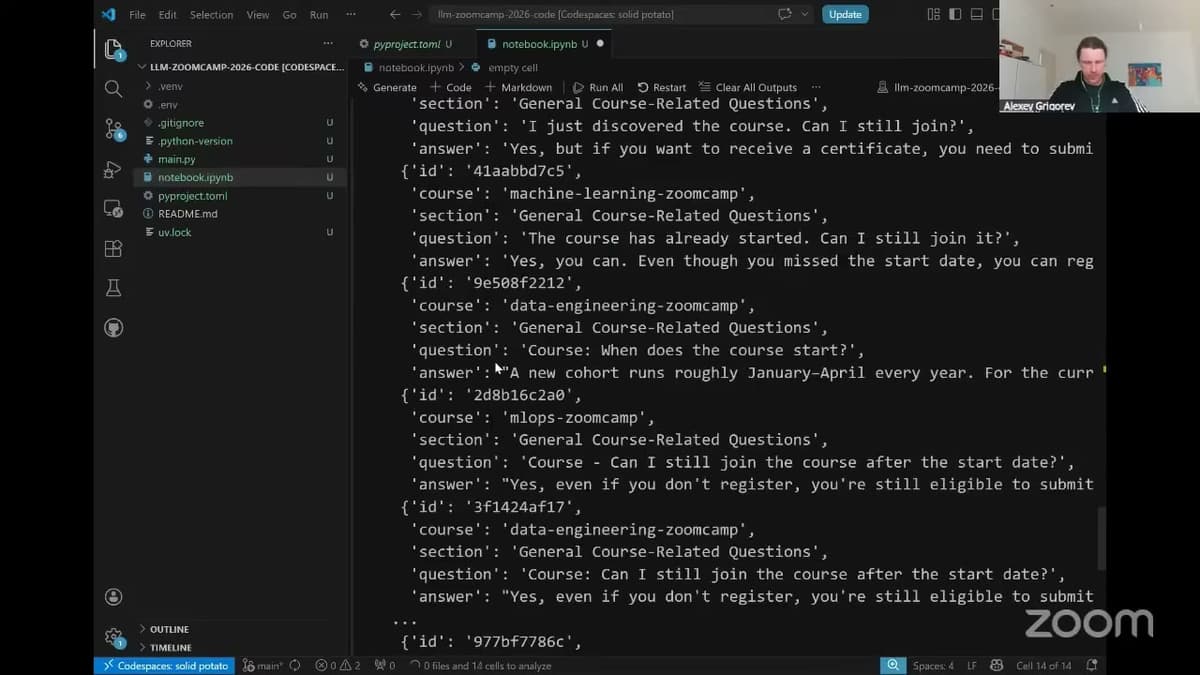
LLM Zoomcamp 1.5 — Search
The video walks through adding a search layer to the LLM Zoomcamp 1.5 project, showing how to index a 1,100‑document FAQ set so that queries can retrieve relevant passages before invoking a large language model. Because sending the entire corpus to...
LLM Zoomcamp 1.1 — Introduction
The video opens the LLM Zoomcamp 1.1 series by framing large language models (LLMs) as the engine behind today’s AI boom, noting that tools like ChatGPT have become as familiar to the public as Google. The instructor skips basic definitions,...
From RAG to AI Agents: Function Calling and Tool Use - Alexey Grigorev
The session introduces the shift from traditional Retrieval‑Augmented Generation (RAG) – called RAC in the course – toward AI agents that can call functions and use tools dynamically. Hosted as part of the free LLM Zoom Camp, the presenter walks...
Vector Databases: Embeddings, Semantic Search, and Hybrid Retrieval - Alexey Grigorev
The session walks through building a FAQ chatbot for the LLM Zoom Camp, focusing on vector databases, embeddings, semantic search, and hybrid retrieval. It serves as a standalone workshop within a larger course on real‑world LLM applications. Key insights include the...
From Notebook to Production: Building End-to-End AI Systems - Mariano Semelman
The interview centers on Mariano Semelman’s work building end‑to‑end AI solutions for OLX’s marketplace, where the team automates media creation to help sellers list items more effectively. By leveraging generative models, the platform can turn a static image set into...
Evaluating AI Coding Agents with TeamCity and SWE-Bench - Ernst Haagsman
The session introduced SWE‑bench, a benchmark that measures software‑development AI agents by feeding them authentic GitHub issues and checking whether they can produce correct fixes. Ernst Haagsman, JetBrains product manager, demonstrated how their AI assistant, Juni, can generate unit tests,...
Competitions: Beyond the Kaggle Leaderboard - Tatiana Gabruseva
Tatiana Gabruseva’s talk “Competitions: Beyond the Kaggle Leaderboard” was streamed by DataTalks.Club, highlighting alternative data‑science contests, collaborative strategies, and real‑world impact. The session was accompanied by a suite of community resources, including a Slack network, event calendar, and open‑source course...

Understanding the AI Engineer Role - Nasser Qadri
The video titled "Understanding the AI Engineer Role – Nasser Qadri" promises an overview of the AI engineer career but delivers a brief motivational monologue instead of technical content. Throughout the clip, Qadri emphasizes personal progress, perseverance, and self‑belief, urging viewers...

Inside the AI Engineer Role: Tools, Skills, and Career Path - Ruslan Shchuchkin
The live session hosted by Data Club featured Ruslan Shchuchkin, an AI engineer at Finance Guru, who walked the audience through the emerging discipline of AI engineering, the tools that power it, and the career path that led him from...

From Zero to Billion Row Analytics with Exasol Personal
The video walks through a hands‑on workshop where the presenter builds a data pipeline capable of processing one billion prescription records from the UK’s GP prescribing dataset, using Exasol Personal, a free version of the in‑memory columnar analytical database. He explains...
Context Engineering for Agentic Hybrid Applications - Ivan Potapov, Tobias Lindenbauer
Ivan Potapov and Tobias Lindenbauer presented a new research paper, “Context Engineering for Agentic Hybrid Applications,” now available on arXiv (2508.21433). The work proposes systematic methods for shaping prompts and external data to improve the reliability of autonomous AI agents...
From APIs to Warehouses: AI-Assisted Data Ingestion with Dlt - Aashish Nair
The workshop, led by Ashish Nair of dlt Hub, introduced an AI‑assisted approach to ingesting data from public APIs into analytical warehouses using the open‑source dlt Python library. Over a 90‑minute session, participants saw how dlt abstracts the typical ETL...
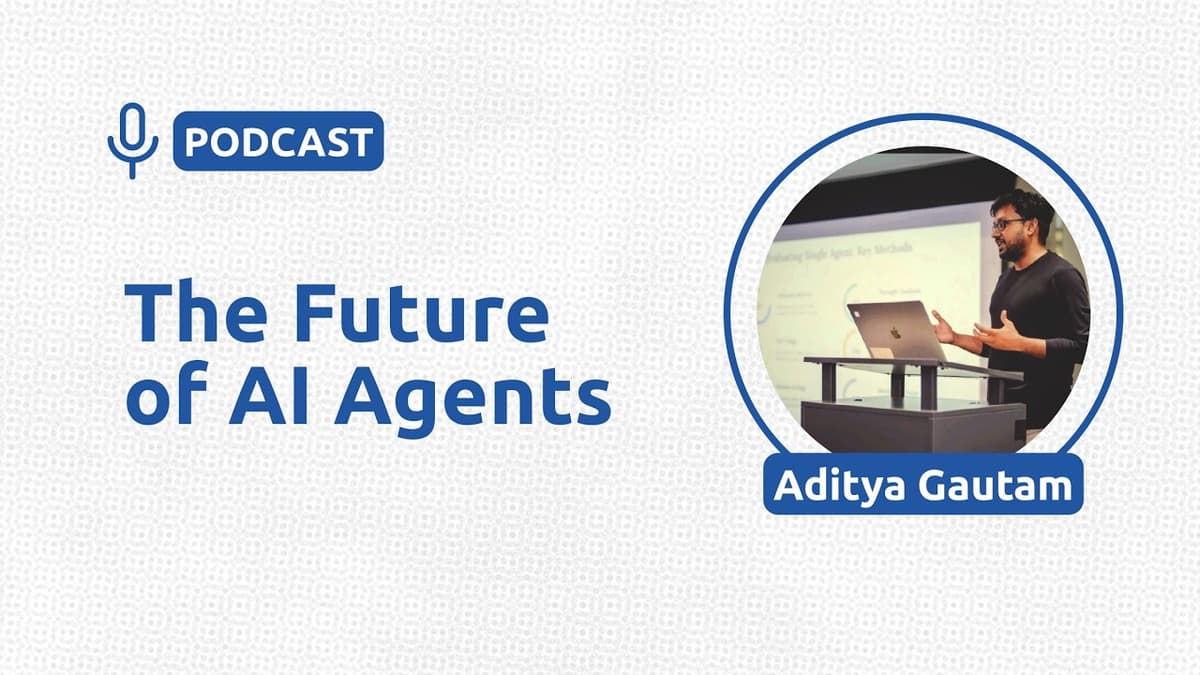
The Future of AI Agents - Aditya Gautam
The Data Talks Club interview spotlights Aditya Gautam, a veteran AI researcher who has moved from embedded engineering at Qualcomm to roles at Google, Meta, and startups. He discusses the accelerating AI revolution, the rise of multi‑agent systems, and how...