
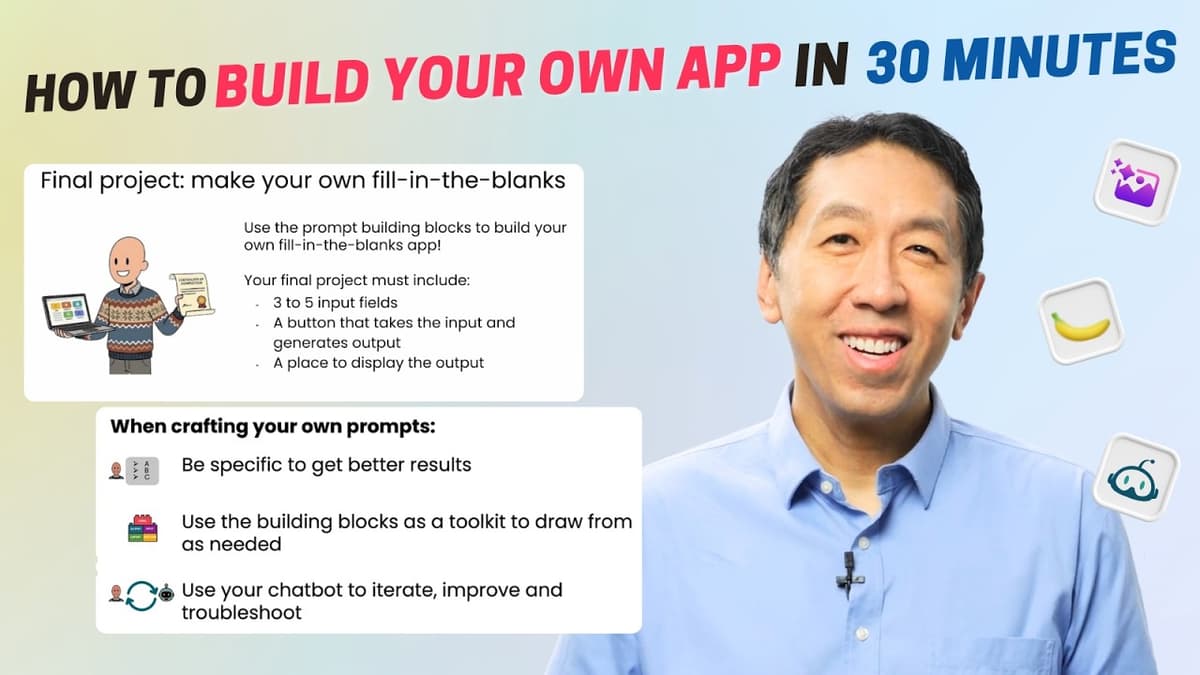
Build Your Own App In Just 30 Minutes! Full Course with Andrew Ng
Andrew Ng introduces a hands‑on course showing anyone how to create a functional web‑based birthday‑card generator in under half an hour using generative AI. He demonstrates that a simple natural‑language prompt can make the AI write complete HTML, CSS and JavaScript, then iteratively improve the UI by adding titles, colors, layout tweaks, or extra input fields. He outlines five reusable prompt components—goal, input, output, layout, special features—that guide the model toward predictable code. The tutorial walks through concrete examples: a basic card app, the “I’m feeling lucky” auto‑fill button, and successive prompts that add festive styling and a copy‑to‑clipboard feature. Ng stresses that the same workflow works across ChatGPT, Gemini, Claude, or any comparable model. By turning natural language into deployable code, the approach lowers the barrier for non‑technical founders, accelerates prototyping, and reshapes how enterprises source internal tools, signaling a shift toward prompt‑driven development.
AI Dev 26 X SF | João Moura: Building Recurring, Governed, and Embedded Enterprise Workflows
CrewAI CEO João Moura argues that modern enterprises can experiment with AI but struggle to operationalize it at scale. He describes a shift from ad‑hoc automations to recurring, governed workflows embedded in core processes. Drawing on real production deployments, he...
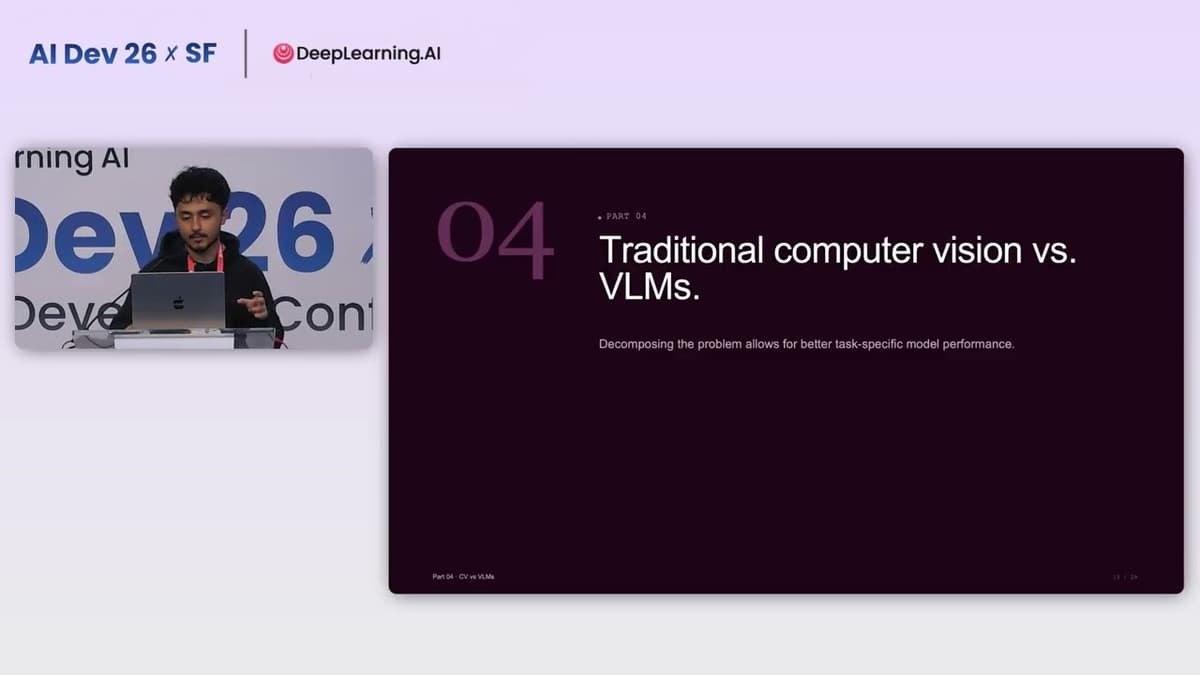
AI Dev 26 X SF | Adit Abraham: Better Agents with Better Data
In this talk Adit Abraham of Reductto outlines the company’s mission to turn raw documents into reliable inputs for next‑generation AI agents. He explains that while large language models have matured, their real‑world utility still hinges on the quality of...
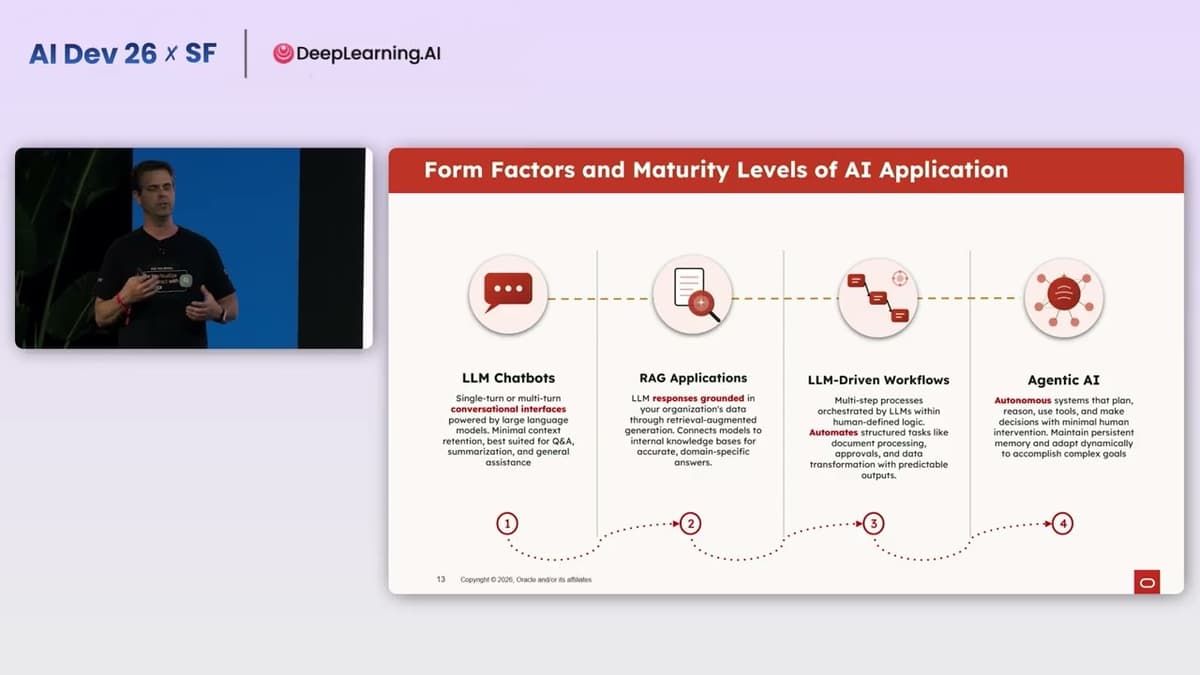
AI Dev 26 X SF | Eli Schilling: Hands On Agent Context & Memory Engineering with Oracle AI Database
Eli Schilling’s talk at AI Dev 26 focused on building robust memory architectures for autonomous agents using Oracle’s AI Database. He outlined how a unified, multi‑modal database can store relational, vector, graph, and spatial data, eliminating the need for disparate...
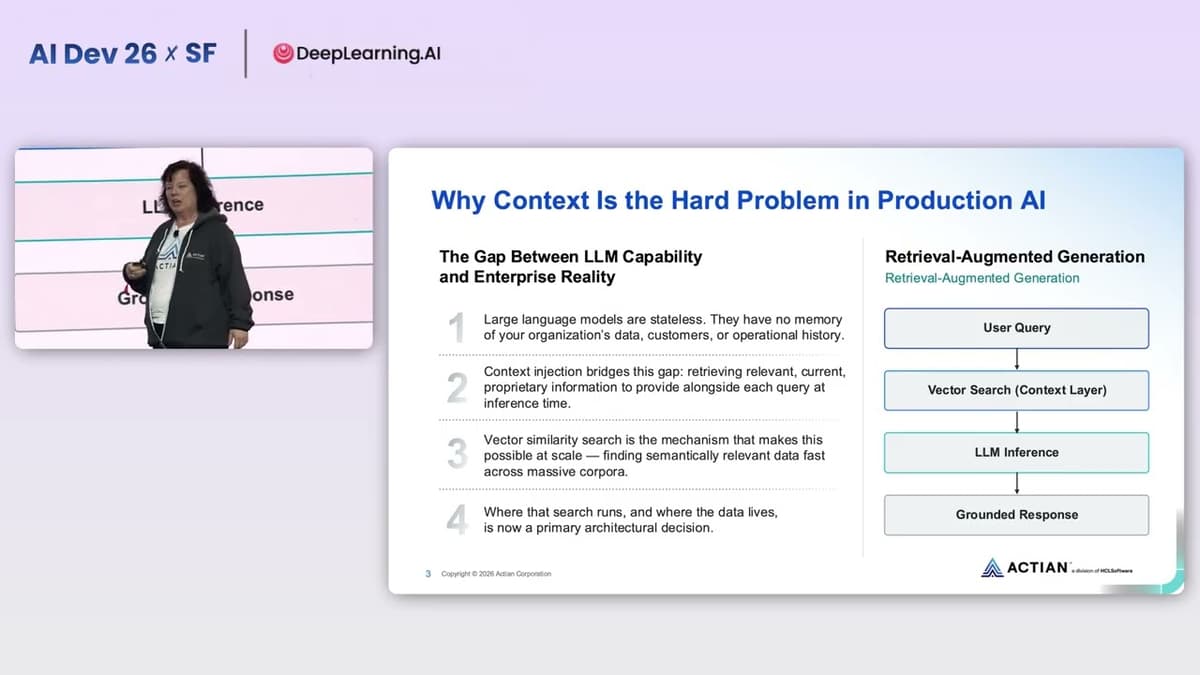
AI Dev 26 X SF: Emma McGrattan: Engineering the Context Layer
Emma McGrattan, CTO of Actian, explains that large language models (LLMs) lack any knowledge of an enterprise’s specific data, making a dedicated "context layer" essential for delivering business‑relevant answers. She frames the problem as engineering a data layer that can...
AI Dev 26 X SF | Marc Brooker: It's Time to Be Right
Marc Brooker, VP and distinguished engineer at AWS, opened the talk by framing agentic AI as the most exciting frontier in software, yet warned that its commercial potential is capped by defect rates. He outlined a four‑quadrant model of defect...
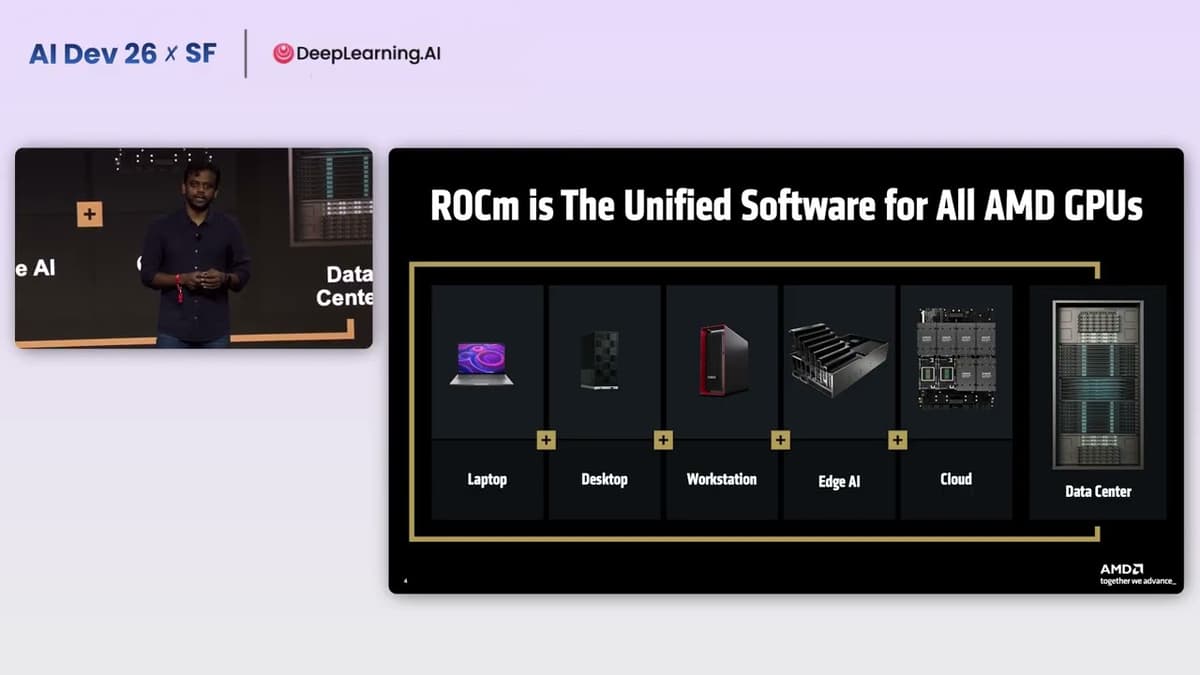
AI Dev 26 X SF | Anush Elangovan: Impact of AI on Software
Anush Elangovan opened the AI Dev 26 x San Francisco session by declaring that artificial intelligence is compressing software‑innovation timelines from decades to mere weeks. He framed the discussion around a "K‑shaped" future of engineering, where systems‑level thinking, judgment and problem...

📉 Turn Your Multimodal Data Into Something You Can Actually Query
Snowflake and AI expert Gilberto Hernandez have launched a new online course, Building Multimodal Data Pipelines, aimed at turning images, audio, and video into searchable, LLM‑ready text. The curriculum covers OCR for images, automatic speech recognition for audio, and Vision...

Use A2A to Connect Agents Across Different Frameworks and Teams
Google Cloud and IBM Research have launched a short course on the Agent2Agent (A2A) protocol, an open standard now overseen by the Linux Foundation. A2A simplifies cross‑framework agent communication by defining discovery, client‑server interactions, and lifecycle management. The hands‑on curriculum...