
Recent Posts
Video•Mar 1, 2026
Why I Trade 25 Strategies After 17 Years of Trading (Dave Mabe)
Dave Mabe, a veteran day trader with roughly two decades of experience, explains why he now operates 25 fully automated strategies every market day. After an early career of swing and discretionary trading, he transitioned to systematic approaches, recognizing that intuition often masks underlying, codifiable rules. By gradually automating components—position sizing, entry signals, and exit orders—he eliminated the human tendency to make costly split‑second decisions. Mabe emphasizes that discretionary traders are a fertile source of systematic ideas, provided they can discern which tactics are modelable. A pivotal moment came when his first backtest outperformed his manual process, proving that simple code could capture the same edge more consistently. He also highlights the importance of rigorous back‑testing, data reconciliation, and incremental live deployment, warning against over‑optimistic equity curves and premature scaling. Illustrative anecdotes include a mentor’s rule to skip low‑volume trades—an intuitive filter that became a quantifiable parameter—and the modern advantage of large language models like ChatGPT, which lower the coding barrier for aspiring systematic traders. Yet Mabe cautions that while LLMs accelerate development, disciplined paper‑trading, small‑size live trials, and continuous variance monitoring are indispensable. For the broader trading community, Mabe’s journey underscores a hybrid model: retain discretionary insight while systematically extracting repeatable patterns. The accessibility of AI‑driven coding tools democratizes algorithmic trading, but success still hinges on methodical testing, realistic expectations, and a patient, iterative rollout strategy.
By Desire To Trade (Etienne Crete)
Video•Feb 28, 2026
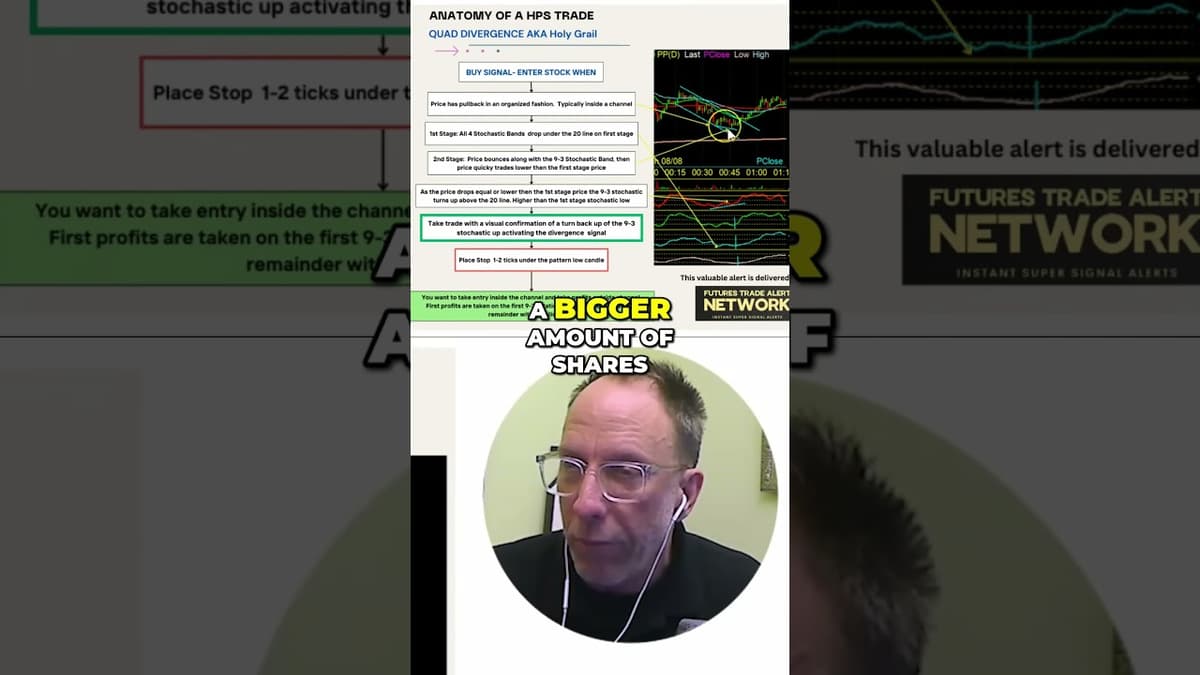
The 95% Win Rate Scalping Trade Setup
Video presenter markets a “quad divergence” scalping method as a near‑holy‑grail, promising a 95% win rate on CME futures such as MES and ES. He describes the pattern as a combination of a quad rotation on higher time frames and...
By Desire To Trade (Etienne Crete)
Video•Feb 26, 2026
My Day Trading Pre-Market Routine As A Full-Time Trader
The video walks viewers through a full‑time trader’s pre‑market routine, emphasizing a price‑action day‑trading system centered on the London and New York sessions. He explains how he prepares each Sunday, marks red‑news events on a whiteboard, and sets up a minimalist...
By Desire To Trade (Etienne Crete)
Video•Feb 22, 2026
Making A Living Trading For 30+ Years - Revealing His Secrets (Michael Martin)
Michael Martin, a veteran trader with over 30 years of experience, discusses his evolution from a working‑class background to managing institutional capital alongside Victor Spirandio. He reveals early mistakes, the mental rewiring required to survive market volatility, and how systematized...
By Desire To Trade (Etienne Crete)
Video•Feb 20, 2026
He Got Laid Off And Became A Full-Time Trader
Andrew Aziz was unexpectedly laid off, prompting him to channel his frustration into day‑trading. Within months he mastered technical analysis, built a disciplined trading routine, and launched a proprietary trading firm. His story illustrates how a career setback can be...
By Desire To Trade (Etienne Crete)
Video•Feb 17, 2026
Why I Hate Real Estate as a Full-Time Trader
The creator, a full‑time trader, reevaluates the conventional wisdom that real estate is the safest wealth‑building route. By crunching numbers, he shows rental yields typically lag behind market‑based trading returns once hidden expenses are accounted for. He also highlights the...
By Desire To Trade (Etienne Crete)
Video•Feb 15, 2026
How To Make A Living Trading With AI (Dr. Matloob Khushi)
In a candid interview, Dr. Matloob Khushi—ranked among the top 2% of AI scientists—explains why he abandoned the quest for a universal AI trading algorithm after years of research. He outlines the curriculum he teaches PhD students, emphasizing a hybrid...
By Desire To Trade (Etienne Crete)
Video•Feb 10, 2026
Stop Wasting Money On Prop Firms. Do This Instead
Prop firms market themselves as a shortcut to trading freedom, but most participants lose money on costly challenge fees and frequent resets. The video explains why a high percentage of traders fail these evaluations and how the underlying funding model...
By Desire To Trade (Etienne Crete)