Video•Mar 9, 2026
The First 3 Minutes of the Universe's Life
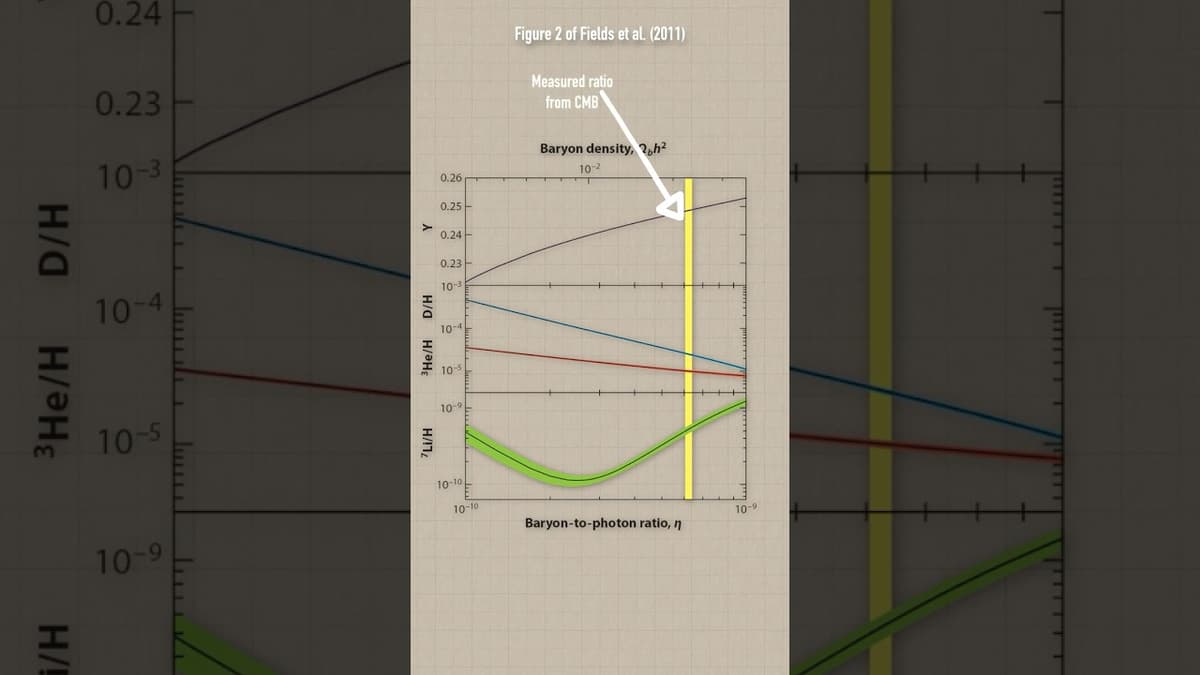
The video explains how the first three minutes after the Big Bang set the stage for all later chemistry. During this epoch, weak‑force interactions continually swapped neutrons and protons until the universe cooled enough for those reactions to freeze out, locking in a proton‑to‑neutron ratio of roughly six to one. Once the temperature fell further, the strong force could bind the remaining neutrons and protons into the light nuclei that constitute hydrogen, deuterium, helium and trace lithium. These nucleosynthesis processes are not speculative; they have been reproduced in terrestrial laboratories, allowing physicists to catalog the exact energy thresholds for each reaction. The final elemental mix depends critically on the photon‑to‑baryon ratio, a parameter measured precisely from the cosmic microwave background (CMB) radiation. With that ratio, cosmologists can predict the primordial abundances of each light element with remarkable accuracy. The presenter highlights that the observed six‑to‑one proton‑neutron ratio and the resulting element fractions match CMB‑derived predictions, confirming the standard Big Bang model. He notes that hydrogen, deuterium, helium‑4, and lithium‑7 formed in these first minutes later became the raw material for the first generation of stars a few hundred million years after the explosion. Understanding these early‑universe reactions provides a stringent test of fundamental physics and informs models of star formation, galaxy evolution, and the overall matter‑energy budget of the cosmos. Any deviation between predicted and observed abundances would signal new physics beyond the current paradigm.
By Dr. Becky
Video•Mar 5, 2026
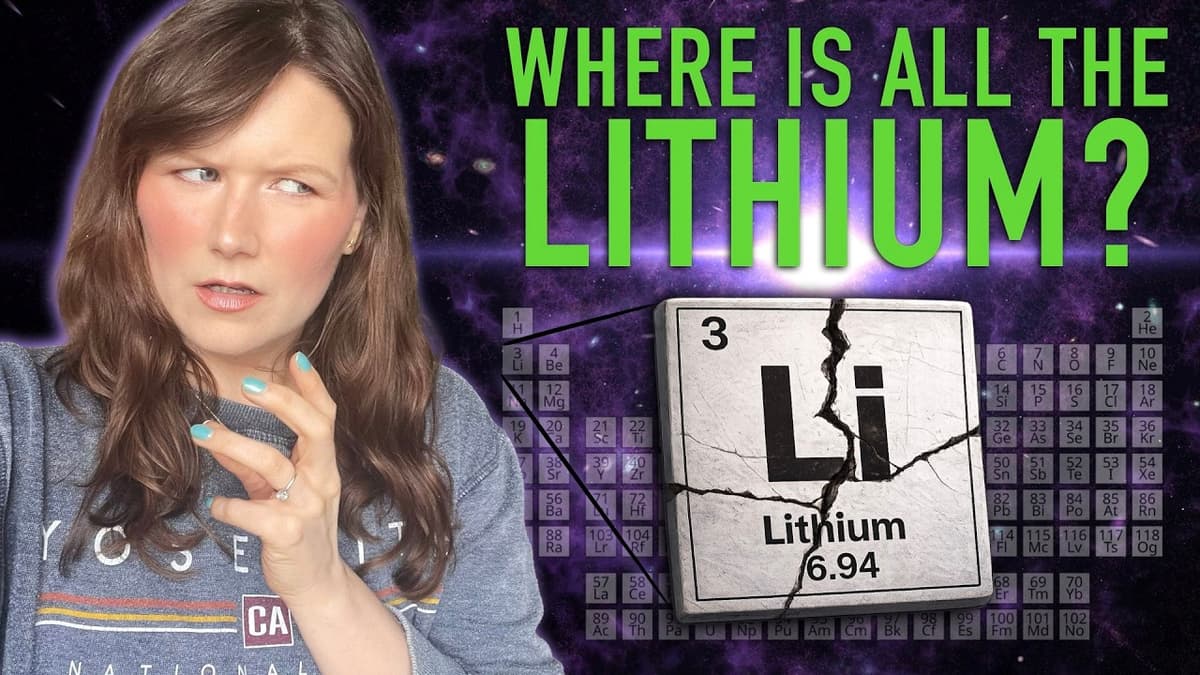
The Big Bang Has a Big Problem
The video tackles the long‑standing "lithium problem" – a discrepancy between the amount of lithium that Big Bang nucleosynthesis predicts and the far lower abundance actually measured in the cosmos. While the theory accurately forecasts hydrogen, deuterium and helium, it...
By Dr. Becky