Video•Feb 13, 2026
DiskChunGS: Large-Scale 3D Gaussian SLAM Through Chunk-Based Memory Management
DiskChunGS introduces a scalable 3D Gaussian splatting SLAM pipeline that overcomes traditional GPU memory constraints by treating scene reconstruction as a spatial streaming problem. The system partitions the environment into discrete chunks, keeping only the currently visible regions in GPU VRAM while offloading inactive chunks to disk, enabling reconstruction of extensive trajectories without hardware scaling.
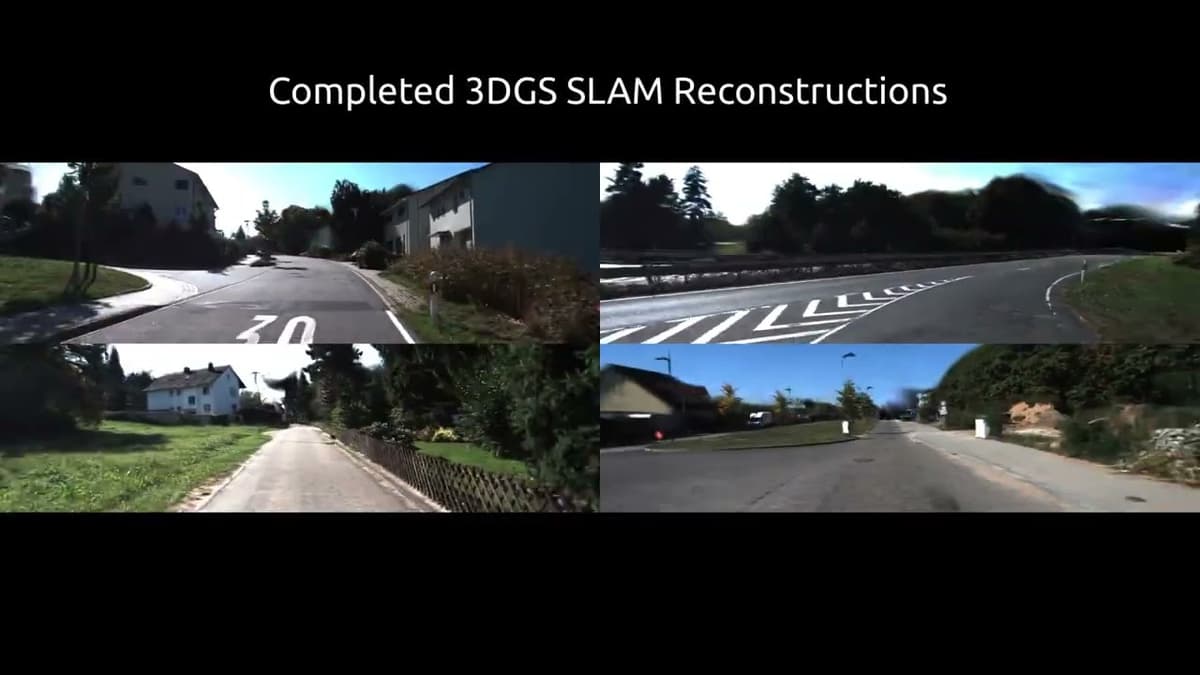
The pipeline estimates depth for each SLAM key frame and directly places Gaussian primitives based on image content. Frustum‑based color culling identifies which chunks to load, and old chunks are evicted back to disk. Visible Gaussians are rasterized, losses computed, and gradients back‑propagated to refine parameters, delivering high‑fidelity reconstructions across challenging datasets such as Kitty, Replica, and TUM, even with multiple loop closures.
Demonstrations include visual comparisons that highlight clearer detail than competing methods, and a Ross wrapper that accepts external pose inputs for seamless integration with existing SLAM systems. The authors also showcase real‑time performance on the resource‑constrained NVIDIA Jetson platform and on the Grand Tour dataset using logged onboard poses and RGB‑D data.
By decoupling scene size from GPU capacity, DiskChunGS makes large‑scale, high‑quality SLAM feasible for mobile robotics, AR/VR, and autonomous navigation, expanding the operational envelope of devices that previously struggled with memory‑bound reconstruction.
By ETH Zürich Robotic Systems Lab