Video•Apr 7, 2026
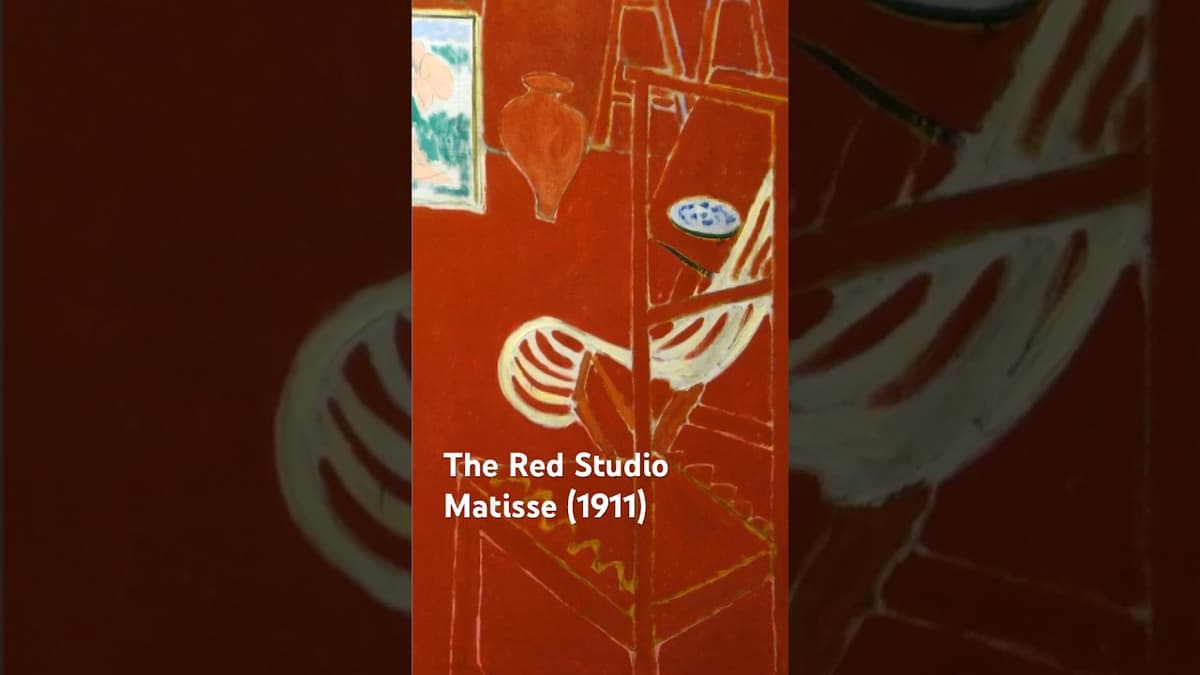
The Red Studio by Matisse (1911)
The video examines Henri Matisse’s 1911 masterpiece, The Red Studio, a work acquired by MoMA in 1948 that has become a touchstone for mid‑century American abstraction. It outlines how the painting’s stark, unmodulated Venetian red and flattened space broke from traditional representation, turning the artist’s workspace into a study of color itself.
Matisse originally painted the studio in cooler hues, reminiscent of his earlier Pink Studio, before overpainting two‑thirds of the canvas in a saturated red. The composition abandons linear perspective; furniture and objects are rendered as hesitant lines, suspended in a field that resists depth. Even the clock lacks hands, stripping time of measurable form and underscoring the work’s conceptual focus on color and surface.
The video cites Mark Rothko’s reaction—“You become that color”—and notes the painting’s influence on New York artists such as Barnett Newman, Lee Krasner, and Ellsworth Kelly. By embedding paintings and sculptures within the canvas, Matisse collapses the boundary between studio and artwork, presenting a meta‑commentary on artistic process.
The Red Studio’s legacy lies in its redefinition of painting from representation to construction, paving the way for abstract expressionism’s emphasis on color field and materiality. Its radical use of a single hue continues to inform contemporary debates about the limits and possibilities of visual art.
By Great Art Explained (James Payne)