
Harvard Voices on Climate Change: The Road Ahead for Electric Vehicles
Harvard’s final "Voices on Climate Change" session focused on electric‑vehicle (EV) charging as the critical bottleneck to broader U.S. adoption. Vice‑provost Jim Stock introduced two Harvard experts—Elaine Buckberg, senior fellow at the Salata Institute, and Harvard Business School professor Christian Caps—who presented research on consumer preferences, charging infrastructure, and policy scenarios. Buckberg highlighted that four of the top five reasons non‑EV buyers cite for not purchasing an EV are charging‑related, and that home‑charging covers about 75% of new‑vehicle owners, leaving public fast chargers essential for renters and multifamily residents. Her team’s model shows that reallocating just 15% of federal EV spending from vehicle subsidies to charger deployment could lift the 2030 EV sales share by roughly 20 percentage points and double carbon‑abatement outcomes. The analysis also quantified the impact of recent policy rollbacks, such as the One‑Big‑Beautiful‑Bill Act, which would shave 8.5 points off the projected 2030 EV share, and the loss of the California waiver, further reducing the share to the low‑30s. City‑level simulations revealed that fast chargers keep round‑trip travel time under 20 minutes, whereas Level‑2 chargers impose 30‑40‑minute trips, dramatically affecting renters in the top 25 U.S. cities. The findings suggest that fast‑charging infrastructure, especially in urban and highway corridors, is the most cost‑effective lever for accelerating EV adoption and meeting climate goals. Policymakers should prioritize charger subsidies over purchase incentives, and planners must address the needs of renters and multifamily dwellers to avoid a charging‑access gap that could stall the transition.
Harvard Voices on Climate Change: Biodiversity and Climate Resilience
Harvard’s latest Harvard Voices on Climate Change episode spotlights the university’s interdisciplinary work linking biodiversity to climate resilience. Hosted by the Salata Institute, the discussion features Janine Cavender‑Bares, director of the Harvard University Herbaria, who outlines how the world’s...
Harvard Voices on Climate Change: Measuring Forest-Based Carbon Emission Reductions
Harvard Voices on Climate Change hosted a deep dive into measuring forest‑based carbon emissions, highlighting nature‑based solutions such as deforestation avoidance and afforestation. The episode featured Harvard faculty Missy Hullbrook and Ben Taylor, who explained how forests act as a...
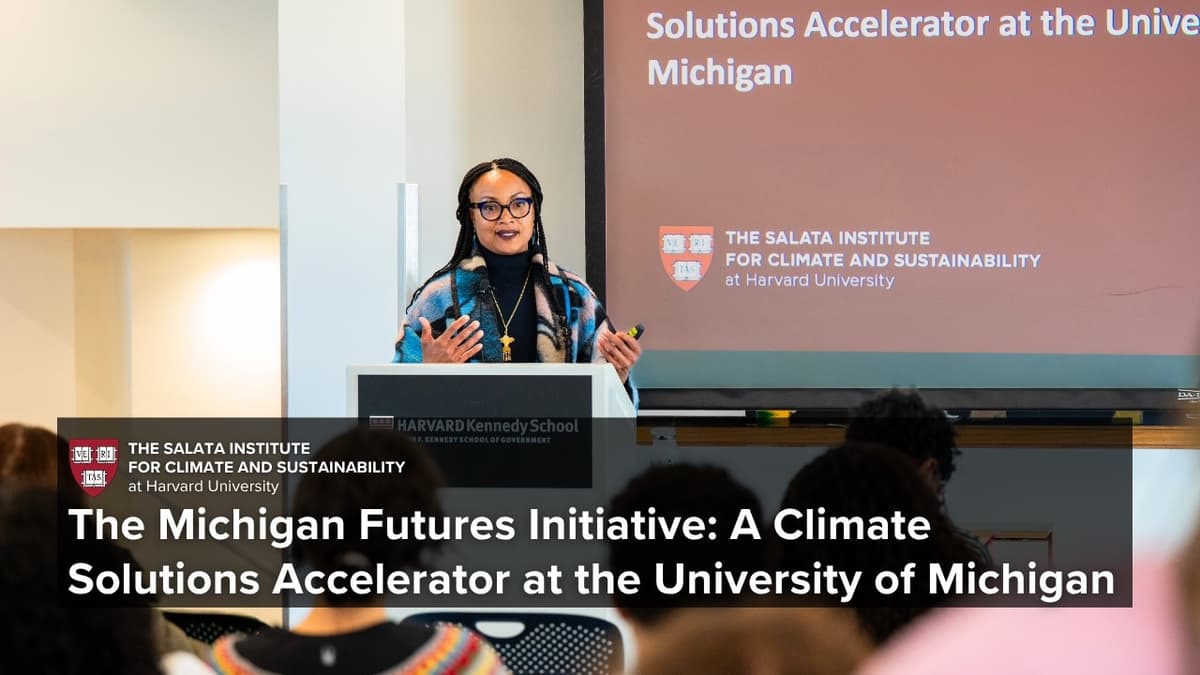
The Michigan Futures Initiative: A Climate Solutions Accelerator at the University of Michigan
The video introduces the Michigan Futures Initiative, a conceptual framework launched by University of Michigan Vice Provost Shelanda Baker to turn the campus into a climate‑solutions accelerator. Drawing on her experience at the federal Justice 40 program, Baker argues that the...

Why Biodiversity Loss Matters and What Harvard Is Doing About It
The video, presented by Harvard University Herbaria director Jeannine Cavender‑Bares, frames biodiversity as the foundation of life‑supporting services—from oxygen production and nutrient cycling to clean water and medicinal resources. It announces the launch of Harvard’s Biodiversity and Planetary Stewardship Initiative,...
Transportation Equity
The third webinar in the Salatada‑Evergreen series focused on transportation equity, featuring former U.S. Secretary of Transportation Anthony Fox, SMU professor Smith Colin, and former California deputy secretary Darwin Mousavi. Hosted by Harvard sociologist Jason Beckfield and Evergreen senior policy...
Harvard Voices on Climate Change: Mapping the Future of Renewable Energy
Harvard Voices on Climate Change hosted a session with Charles Taylor and Andrew Mergen to dissect the decision‑making process behind renewable‑energy project locations. The discussion highlighted legal, environmental, and community factors that influence where wind and solar farms are built....
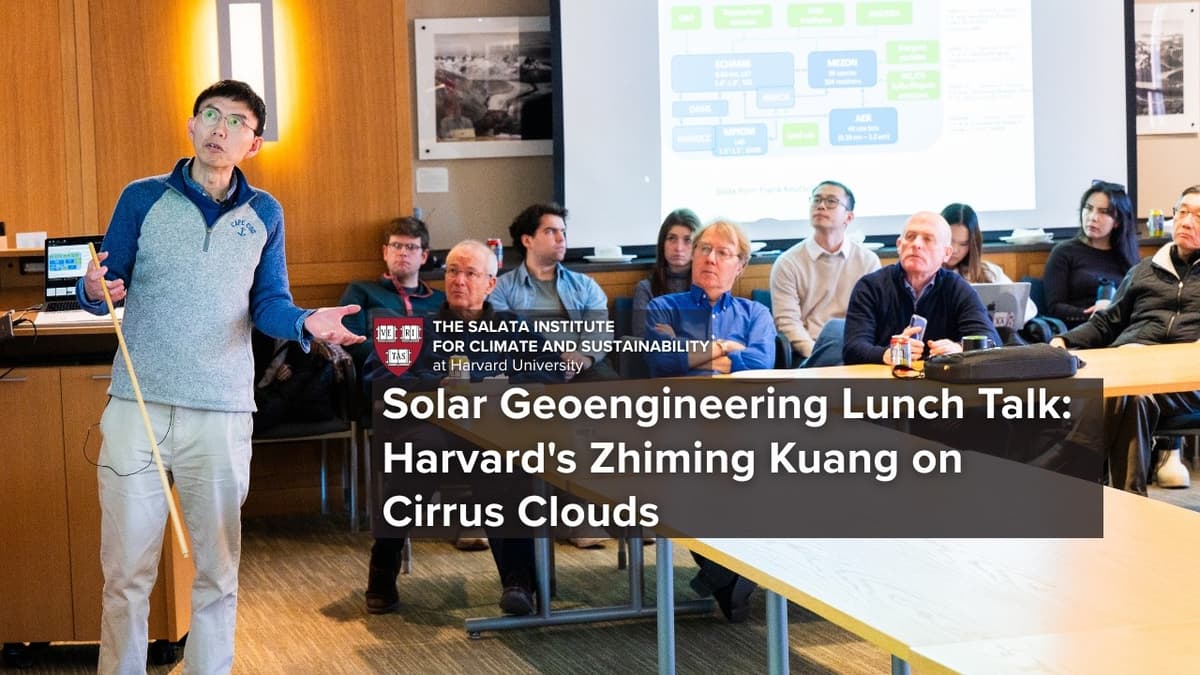
Solar Geoengineering Lunch Talk: Harvard's Zhiming Kuang on Cirrus Clouds
The talk examined solar geoengineering, focusing on stratospheric aerosol injection and its downstream impact on tropospheric cirrus clouds. Kuang outlined how injecting fine particles into the stratosphere can reflect visible sunlight, offering a rapid cooling lever, while emphasizing that this...