Video•Feb 19, 2026
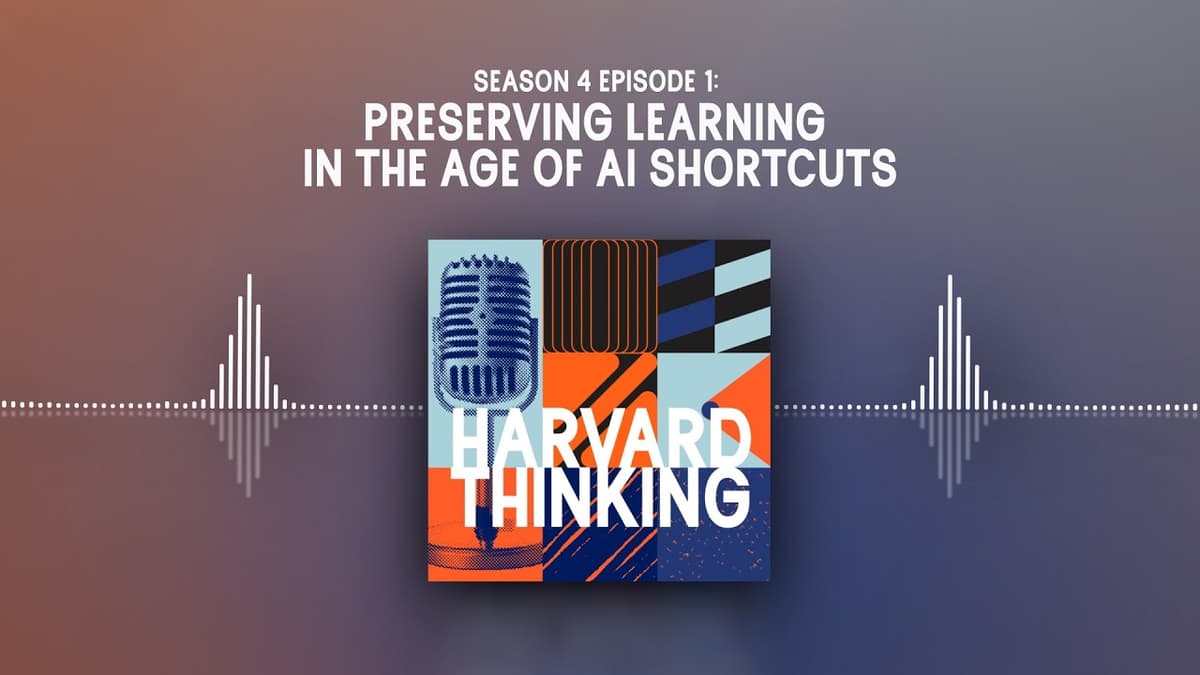
Harvard Thinking: Preserving Learning in the Age of AI Shortcuts
The Harvard Thinking podcast episode tackles the growing tension between generative AI’s convenience and the need to preserve deep learning. Host Samantha Laine Perfas convenes three Harvard scholars—Michael Brenner, Tina Grotzer and Ying Xu—to explore how AI tools are reshaping classrooms from elementary schools to graduate seminars, and why educators must decide which tasks belong to machines and which remain uniquely human.
The panel highlights several data‑driven insights. A survey of 7,000 high‑school students revealed that nearly half admit over‑reliance on AI, while 40 percent tried and failed to curb usage, underscoring a self‑regulation gap. Brenner describes a radical redesign of his graduate applied‑math course: students must invent problems that current large‑language models cannot solve, earning extra credit and culminating in oral exams that reveal deeper understanding than traditional problem sets. Grotzer stresses the importance of metacognitive exercises—Venn diagrams comparing AI capabilities to human cognition—to help learners recognize their own mental strengths.
Concrete examples illustrate the shift. In Brenner’s class, 600 AI‑resistant problems were generated, leading to a co‑authored paper and higher student engagement. Grotzer’s long‑standing assignment ballooned from 30 to 60 pages of AI‑generated text, prompting a discussion about designing instruction that pushes learners to the edge of competence rather than allowing them to coast on shortcuts. Xu notes that safe, domain‑specific AI toys can support early exploration, but general‑purpose assistants demand mature self‑regulation and purposeful scaffolding.
The implications are clear: education must evolve from transactional task completion to purposeful, metacognitive learning that leverages AI as a scaffold, not a substitute. Schools will need new curricula, assessment models, and teacher training that embed self‑regulation and critical thinking, ensuring students retain the foundational capacities—like problem‑generation and reflective reasoning—essential for future innovation and workforce resilience.