
Recent Posts

Video•Feb 26, 2026
Financial Futures: Trust, Tech & Tomorrow
The interview on Insurance Business TV spotlights Primama Life Insurance’s CEO John Adams discussing how trust, technology and personalized advice shape financial futures for middle‑income Canadians. The conversation follows Primama’s recent double win as Life and Health Insurer of the Year and for Outstanding Customer Service, underscoring its market positioning. Adams cites a company survey showing 68% of middle‑income Canadians shy away from AI‑driven financial tools, citing cyber‑security fears and a lack of trust. He notes that only 16% engage in all five core financial‑preparedness behaviors, while 87% worry about everyday costs and 71% fear insufficient retirement savings. The gap, he argues, stems from anxiety that only confidence—generated by a concrete plan—can convert into action. “Anxiety doesn’t turn into action. Confidence turns into action,” Adams emphasizes, adding that licensed advisors provide tailored, family‑focused plans covering debt, retirement, education and elder care. He points to the survey’s quote that “access to trusted financial advice is more important than ever and should be within reach of everyone,” highlighting the human element as the differentiator behind Primama’s awards. The takeaway for the industry is clear: regulators must strike a balance that protects consumers without inflating compliance costs, and firms must deliver cost‑effective, personalized advice to bridge the confidence gap. Companies that blend technology with trusted human interaction stand to capture a loyal middle‑income segment increasingly wary of impersonal AI solutions.
By Insurance Business TV World
Video•Feb 26, 2026
Cyber Market Shake-Up: Softening Trends, Rising Claims, and Broker Strategies for 2025
The panel on Insurance Business TV examined the evolving cyber‑insurance landscape, noting that the market remains soft and is further softening as insurers trim premiums and tighten risk selection. Premiums have fallen 10‑15% in the mid‑tier space, driven by new capacity...
By Insurance Business TV World

Video•Feb 26, 2026
5-Star Insurance Innovator 2025: Nearmap’s Portfolio Intelligence Redefines Risk Insight
Nearmap was highlighted as a 5‑Star Insurance Innovator for its Portfolio Intelligence platform, which fuses high‑resolution aerial imagery with AI‑driven analysis to deliver granular risk insight for Australian and New Zealand insurers. The company operates its own camera fleet, capturing centimeter‑level detail...
By Insurance Business TV World
Video•Feb 16, 2026
Showing Value and Capitalizing on Insurance Opportunities
Insurance Business TV captured insights from leading professionals at the WSIA annual marketplace conference in San Diego, focusing on how financial‑lines carriers are adapting to emerging risks. Speakers highlighted the importance of a diverse product portfolio, rapid service, and consistent...
By Insurance Business TV World
Video•Feb 16, 2026
How the Industry Needs to Adjust Its Approach to Catastrophic Events
The conference highlighted that casualty catastrophe losses, once rare, now occur almost every year, forcing insurers to rethink how they price, model, and underwrite these risks. Speakers argued that the industry must adopt a property‑catastrophe‑style framework for casualty exposures, accounting for...
By Insurance Business TV World

Video•Feb 16, 2026
Creating Opportunities in Both the Admitted and E&S Markets
The discussion at the WSIA marketplace in San Diego focused on how carriers and brokers can jointly leverage modern distribution platforms to expand both admitted and non‑admitted (ENS) insurance offerings. Panelists highlighted that AI‑powered quoting engines, property analytics and real‑time weather...
By Insurance Business TV World
Video•Feb 13, 2026
Pollution, PFAS and Property: Is Environmental Liability the Next Big Coverage Gap?
The Insurance Business TV round‑table examined whether environmental liability – especially pollution, PFAS and asbestos – is becoming the next major coverage gap in Australia and New Zealand. Participants highlighted a surge in public and regulatory pressure, illustrated by a...
By Insurance Business TV World
Video•Feb 9, 2026
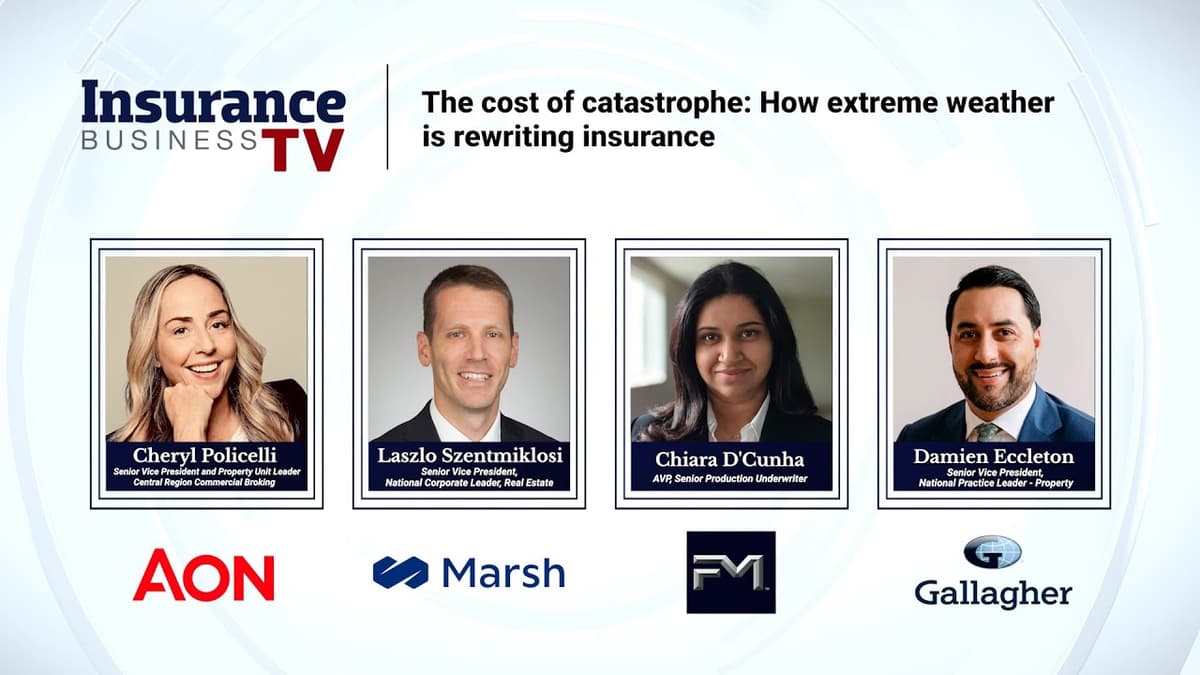
The Cost of Catastrophe
The panel titled “The Cost of Catastrophe” examined Canada’s unprecedented insured weather losses, which reached $6.29 billion in 2024 – roughly three times the 2023 figure and the highest on record. Participants from Marsh, Gallagher, FM Affiliated and AON discussed how...
By Insurance Business TV World