
Recent Posts

Social•Feb 9, 2026
Cut Unresolved Decisions, Not Output, to Accelerate Growth
You’re sitting in the meeting. Marketing is running campaigns. Sales is working deals. Product has a roadmap. Everyone is busy. And yet, growth is stalled. No one is slacking. Nothing is obviously broken. So the pressure builds. We need to move faster. We need more output. That instinct is human. It’s also where things start to unravel. Because when speed replaces clarity, activity increases — but direction doesn’t. People execute. Decisions blur. Ownership softens. Momentum keeps resetting. What’s usually happening isn’t a lack of effort. It’s too many decisions still open. Not dramatic ones, just the everyday ones: • Who are we actually building for right now? • What is truly non-negotiable this quarter? • Where does ownership stop being clear? • Which calls keep coming back to you because they were never fully settled? If you’re answering the same questions every few weeks, those decisions aren’t resolved. You don’t need more output. You need fewer unresolved decisions. When those close, speed comes back — and this time, it compounds.
By Krista Mollion

Social•Feb 8, 2026
Ambition Needs Pace: Prioritize Sustainability Over Constant Urgency
There’s a kind of pressure that sneaks up on ambitious people. High standards. Big goals. Constant forward motion. That drive is a real advantage. But it has a shadow side we don’t talk about enough. When everything becomes about winning and accelerating, pressure turns inward — and...
By Krista Mollion
Social•Feb 7, 2026
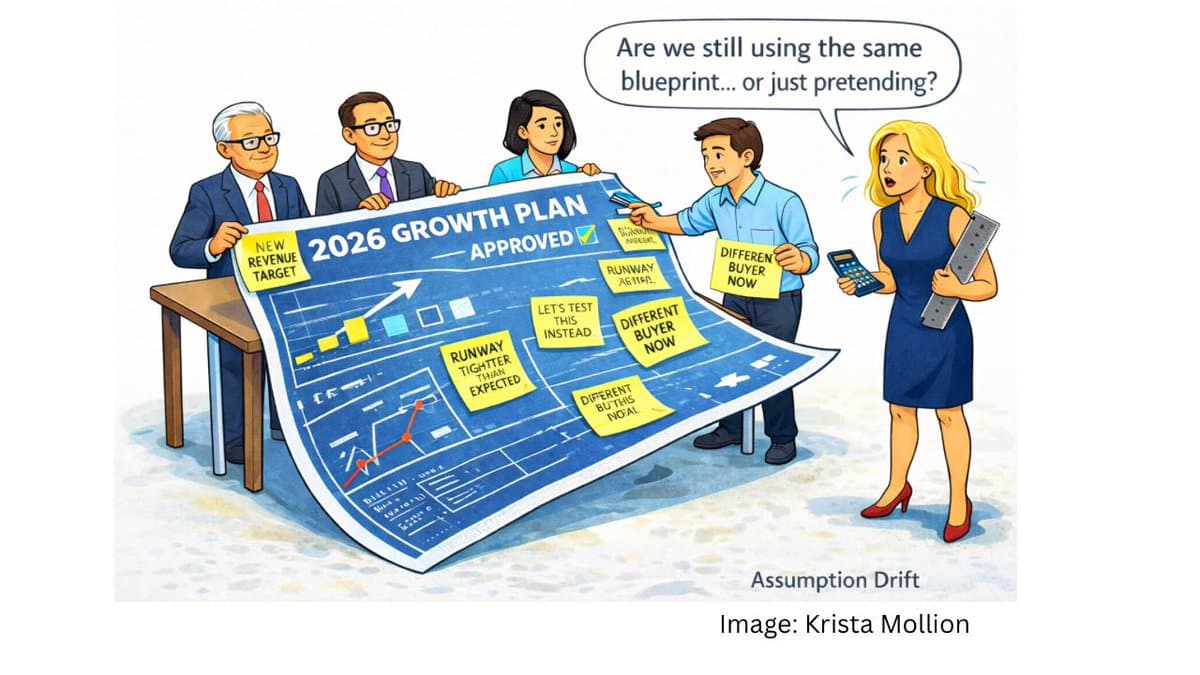
Growth Plans Falter when Assumptions Drift with Market
Most growth plans fail quietly. Not from bad execution. From assumption drift. The market changes. The plan doesn’t. Then teams pretend. https://t.co/Tyf48LHMEy
By Krista Mollion

Social•Feb 7, 2026
Performance Marketing Alone Can't Sustain Growth
Why performance marketing can’t carry the full weight of growth You don’t usually notice marketing failing all at once. You notice the noise first. More campaigns. More dashboards. More spend. And still, less confidence than you expected. Founders don’t wake up thinking they should confuse marketing with...
By Krista Mollion

Social•Jan 28, 2026
Assumption Drift, Not Execution, Undermines Growth Plans
Assumption drift kills more growth plans than bad execution. But we keep blaming execution anyway. Because assumption drift is quiet. Uncomfortable. And usually leader-owned. It looks like this: • The buyer evolves • Pricing gets “tested” • Revenue targets shift • Runway tightens And no one formally resets the math. Marketing keeps...
By Krista Mollion

Social•Jan 26, 2026
Fractional Execs: Diagnose, Design, Align, Not Just Execute
Most founders hire a fractional executive for the wrong reason. They want: • Faster execution • More output • Someone to “just run marketing” That’s not what a good fractional does. A real fractional leader: – Diagnoses before executing – Designs systems, not tactics – Aligns decisions across teams –...
By Krista Mollion

Social•Jan 19, 2026
Top Talent Laid Off—Hire Resilient Professionals Now
You can do everything right — and still be forced to downsize. Several exceptional people at Agorapulse are suddenly on the market — through no fault of their own. This wasn’t a failure of talent. This wasn’t a failure of...
By Krista Mollion

Social•Jan 15, 2026
Match GTM Playbooks to Your Revenue Stage
Good GTM isn’t about copying playbooks. It’s about knowing which playbook applies at which revenue stage. That’s why lists like this are useful if founders read them correctly: • Early stage → clarity beats scale • Mid stage → alignment...
By Krista Mollion

Social•Jan 6, 2026
Hook First, Depth Later: Win on Social
Most smart people lose on social because they start with depth. The mistake isn't being smart. It's leading with complexity before you've earned attention. Algorithms don't reward depth at the top of the funnel. They reward: • Simplicity • Repeatability...
By Krista Mollion

Social•Jan 5, 2026
Stop Blaming, Build a Consistent Revenue Engine
If you missed your 2025 targets, please don't: – Blame your team – Hire a bunch of new people or a new agency “to fix it” – Add tools you don’t fully use – Chase new tactics after watching one...
By Krista Mollion

Social•Dec 24, 2025
Plan Q1 Budget Now, Stop Reactive Marketing Chaos
December is expensive. But the real cost hits in January — when you realize you never built a real Q1 budget. Personally, December means: holidays, travel, gifts, year-end spending. In business: bonuses, taxes, renewals — and sometimes client losses or...
By Krista Mollion

Social•Dec 23, 2025
Growth Requires Founder Commitment, Not Quick Validation
Convince me this will work.” That’s the moment on a sales call when I know a founder isn’t ready. Not because they don’t believe in growth — but because they’re treating growth like a role they hire, instead of a...
By Krista Mollion