
Recent Posts
Video•Feb 17, 2026
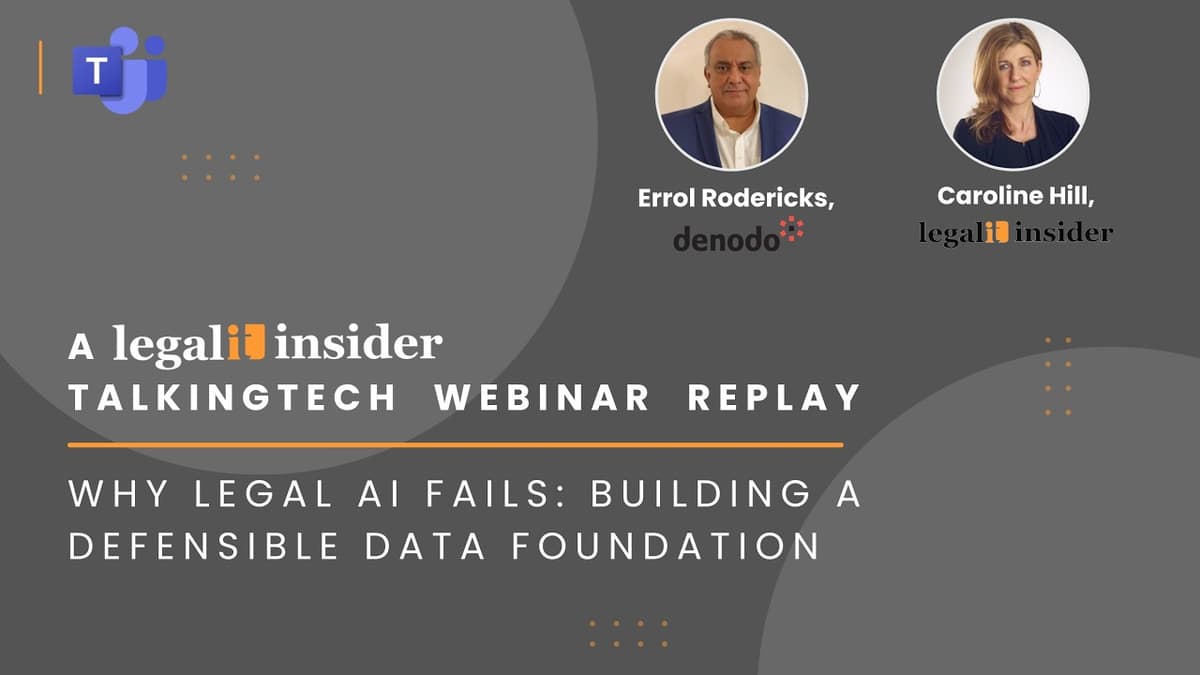
Why Legal AI Fails without Trusted Data: Key Takeaways From Our Denodo Webinar
The Denodo webinar, hosted by Legal IT Insider’s Caroline Hill, examined why legal‑focused artificial intelligence projects frequently stall despite sophisticated tools. Speakers argued that the root cause is not algorithmic weakness but the inability of law firms to rely on the data feeding those models. Participants highlighted fragmented data across core databases, legacy systems, and transient real‑time feeds, which undermines governance, confidentiality, and jurisdictional compliance. Pilot implementations succeed in sandboxed environments, yet when scaled they falter because the underlying data is incomplete, outdated, or lacks proper permission controls. The discussion also warned that emerging agentic AI will intensify these trust requirements. Errol Rodri emphasized, "Legal AI doesn’t stall because models are weak; it stalls because the data beneath them isn’t trusted," and added that legal decisions must survive both the moment of recommendation and later audit scrutiny. He cited a case where a firm spent hours reconciling billing history, matter experience, and regulatory insights spread across disparate repositories, losing responsiveness and opportunities. The takeaway for firms is clear: invest in a unified, governed data layer—such as Denodo’s integration platform—to provide explainable, permission‑aware, and traceable information. Doing so not only enables AI to move from proof‑of‑concept to production but also safeguards the profession’s core requirement for defensible advice.
By Legal IT Insider (The Orange Rag)

Video•Feb 9, 2026
The Inside View: The Growth, Benefits and Risks of Vibe Coding
The episode of Talking Tech focuses on "vibe coding," a method where users describe desired software in plain language and large language models generate the code. Helder Santos, head of legal tech at Bird & Bird, explains how the firm...
By Legal IT Insider (The Orange Rag)