
Recent Posts
Video•Feb 23, 2026
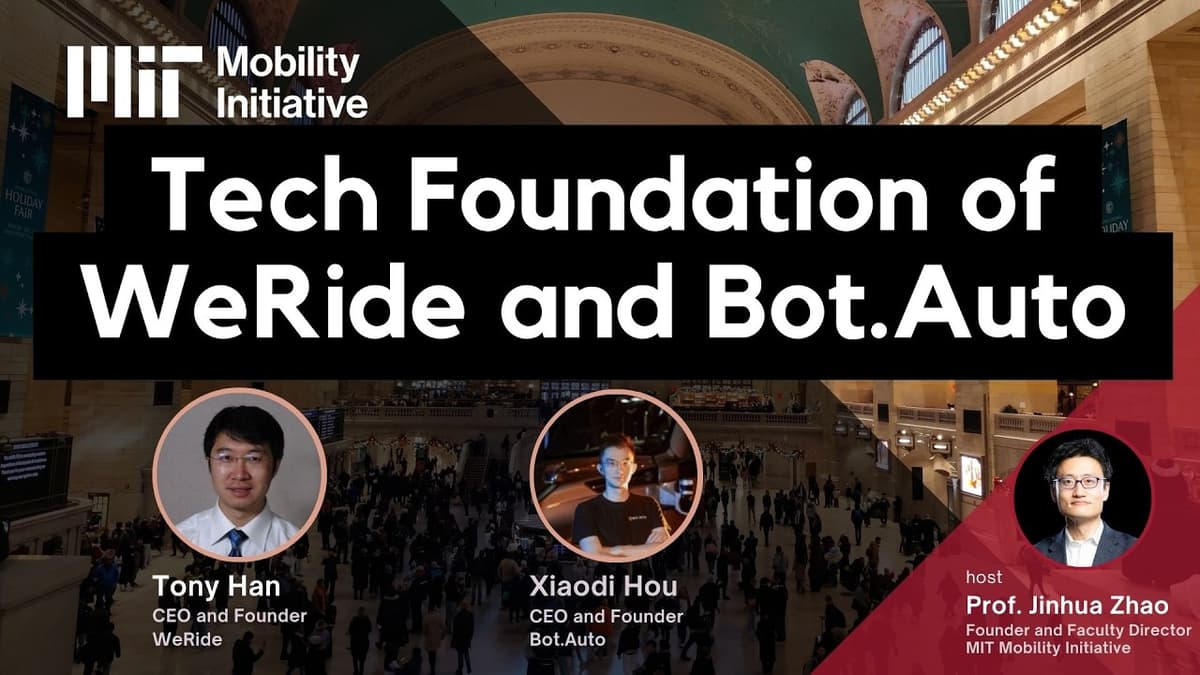
Tech Foundation of WeRide and Bot.Auto - Tony Han & Xiaodi Hou
The MIT Mobility Forum session brought together Tony Han of WeRide and Xiaodi Hou of Bot.Auto to dissect the technology backbone of today’s autonomous‑vehicle push. Their conversation centered on four pillars—simulation and world models, human‑in‑the‑loop versus full autonomy, hybrid AI‑deterministic architectures, and safety evaluation for regulators—while also touching on business trajectories. Han unveiled WeRide’s Genesis simulation platform, a generative‑AI‑powered engine that merges high‑fidelity physics with human‑like decision agents. By recreating urban environments in minutes and compressing millions of real‑world kilometers into days of virtual testing, Genesis claims to surface rare edge cases, verify code changes, and support L2++ through L4 sensor stacks. Hou countered with a cautionary tale of a sudden LiDAR blackout in Texas fog, illustrating the current limits of sensor simulation, especially for non‑visual modalities, and arguing that visual‑only synthetic data offers diminishing returns. Key moments included Han’s analogy that a good simulator should “find the theory of relativity” when data are stripped away, and Hou’s observation that behavioral simulation—modeling physical limits of driver actions—can sidestep the need for perfect sensor fidelity. Both emphasized a shift from purely data‑driven pipelines to a “computing‑driven” paradigm where synthetic feedback loops replace costly real‑world miles. The discussion signals that scalable, trustworthy AV deployment will hinge on simulators that both validate software and generate novel scenarios, while regulators will increasingly rely on such virtual evidence. Companies that master this balance stand to accelerate commercialization, reduce testing costs, and shape future policy frameworks.
By MIT Mobility Initiative
Video•Feb 18, 2026
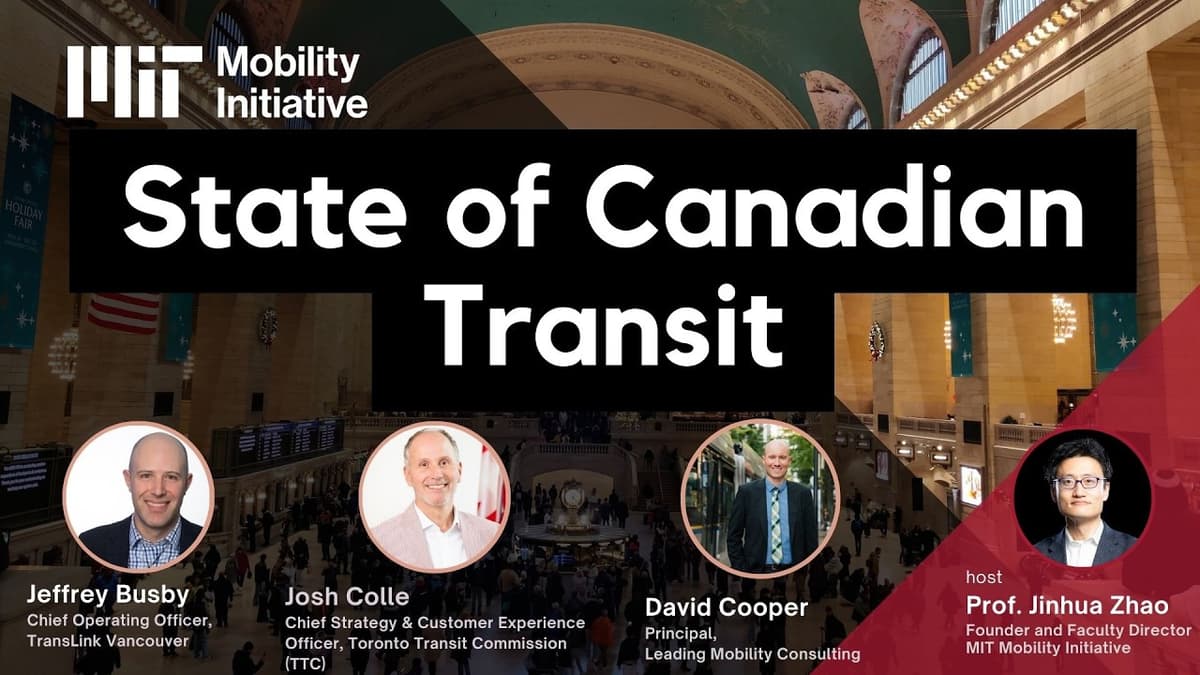
State of Canadian Transit
The MIT Mobility Forum panel examined the state of Canadian transit, contrasting it with U.S. systems and highlighting why Canada is often viewed as a model. Speakers from TransLink, the Toronto Transit Commission, and a mobility consultant discussed service levels,...
By MIT Mobility Initiative

Video•Feb 10, 2026
Oregon Road Usage Charge: Voluntary to Mandatory
The MIT Mobility Forum episode introduced Oregon's shift from the voluntary ORIGO program to a mandatory road usage charge (RUC) under House Bill 3991, signed by Gov. Tina Kotek, marking the first statewide per‑mile tax in the U.S. The charge is...
By MIT Mobility Initiative