
The Longest US Manufacturing Recession in History Is Finally Over | Chris Semenuk
The video announces that the United States has finally emerged from its longest manufacturing recession on record, with the ISM PMI climbing above the 50‑point growth threshold for the first time in three years. Analysts attribute the turnaround to a surge in industrial production, a 1.7% month‑over‑month rise, and unprecedented order backlogs at legacy manufacturers such as Caterpillar (over $60 billion) and Vernova (nearly $90 billion). Key drivers include bipartisan policy support, from the CHIPS Act to tariff strategies, and a dramatic shift in corporate capital‑allocation logic. Companies now view the U.S. as the preferred location for new capacity because of lower total cost of ownership—reduced transportation, stronger IP protection, and lower working‑capital needs—while foreign direct investment to the U.S. has risen above 20% of global flows. The discussion highlights that the re‑industrialization wave is not about repatriating low‑skill, commodity‑centric factories but about advanced manufacturing. Automation and electrification firms—Rockwell, Emerson, Cognex, and similar industrial‑tech players—stand to benefit as factories are outfitted with high‑efficiency equipment. AI accounts for 67% of U.S. electricity use, yet manufacturing consumes 26%, underscoring the broader energy and technology nexus. For investors, the implication is clear: the growth story lies in equipment, software, and services that enable U.S. factories to become more productive, not in a revival of mass‑manufacturing jobs. The sector’s momentum suggests sustained capital inflows, higher earnings for industrial‑tech companies, and a redefined landscape for U.S. manufacturing competitiveness.
Why Wall Street Is Completely Blind to AI’s Imminent Regulatory Risk | David Woo
The interview with economist David Woo centers on a paradox in the AI boom: while headline earnings from hyperscale cloud providers appear robust, underlying capital expenditures for AI data centers have actually declined in the first quarter, signaling a slowdown...
Oil Market “Comatose” As 1 Billion Barrels Are Lost | Kpler’s Matt Smith
The episode focuses on the oil market’s “comatose” state as the Strait of Hormuz remains shut, effectively removing roughly 15 million barrels of crude and an additional 5 million barrels of refined products from global flows. Matt Smith of Kpler explains that...
The AI Chip Bubble: Why South Korea & Taiwan Are In the Danger Zone
The podcast examines whether the AI‑driven surge in memory‑chip equities in South Korea and Taiwan constitutes a bubble. Host Maxy interviews analyst Michael Fritzell, who points to soaring index returns—Korea’s EWIs up roughly 255% versus Taiwan’s 112%—and profit forecasts that...

Why an AI Driven Unemployment Wave Is Real Estate’s Biggest Risk | Tom Shapiro
The interview with Tom Shapiro, president and CIO of GTIS Partners, centers on the emerging risk that AI‑driven unemployment poses to the real‑estate sector. While inflation traditionally makes property a hedge, Shapiro argues that job losses, slowed household formation, and...
The AI Cycle Will Turn This Year but First Things Get Even Crazier | Andreas Steno Larsen
The episode with Andreas Steno Larsen focuses on the coming “AI cycle” but centers on a broader macro transition. He argues the semiconductor boom will peak by year‑end, with a wave of late‑cycle IPOs signaling the final stretch of the...
A Basel III Deep Dive | What to Know About How It Will Transform Banking Globally
The video provides a deep dive into Basel III, the post‑crisis international framework that reshapes banks’ capital buffers. It traces the evolution from Basel I through the flawed Basel II models to the comprehensive Basel III package, whose final risk‑weight calibrations were agreed in...
Warning: Don’t Sell Blow-Offs in Stock Market, Veteran Macro Investor Andrew Perry Says
In this episode of Monetary Matters, veteran macro investor Andrew Perry cautions listeners against trying to sell during market "blow‑off" phases, likening such attempts to standing in front of a train. He references the 1999 Nasdaq surge and warns that...
Lyn Alden on Serious Macroeconomic Consequences of AI & Semiconductor Boom
Lyn Alden discussed the macroeconomic fallout of the AI and semiconductor boom, emphasizing that the surge in demand for GPUs, memory, and electricity is reshaping both the technology sector and the broader economy. She likened the current wave to the...

Why European Banks Are Retreating (and Private Credit Is Stepping In)
The episode examines why European banks are pulling back from lending and how private‑credit funds, especially real‑estate focused managers like Zenzit Capital, are filling the gap. Host Max Wy interviews co‑founder and CIO Thomas Lloyd Jones, who explains the structure of...
Generative AI Can’t Generate Alpha… But Machine Learning Can | Pictet’s David Wright
In a sponsored fireside chat, David Wright, co‑head of Pictet Asset Management’s quantitative franchise, explained why generative AI, despite its hype, is ill‑suited for the firm’s core alpha‑generation process. The discussion centered on the distinction between broad‑stroke generative models that...
How to Profit From Global Volatility and Commodity Chaos | Harris Kupperman
The conversation centers on extracting profit from the current commodity volatility by zeroing in on U.S. refiners. Harris Kupperman and Rodrik Vanzo argue that the decisive metric is the crack spread – the price differential between crude oil and refined...
Warren Pies: "I’m Scared Out of My Mind… But Very Bullish"
The interview with Warren Pies, founder of 314 Research, centers on why the U.S. equity market remains bullish despite a historic oil supply disruption in the Strait of Hormuz. Pies argues that two opposing forces – a tightening oil market...
Why Fundamentals Don't Work For "New Economy" Stocks | Jacob Pozharny
The video explores why classic fundamental analysis fails for "new economy" stocks—companies heavy in intangible assets such as software, biotech, and semiconductors—and how Bridgeway Capital adapts its investment process. Jacob Pozharny explains that traditional discounted cash‑flow models misprice these firms...
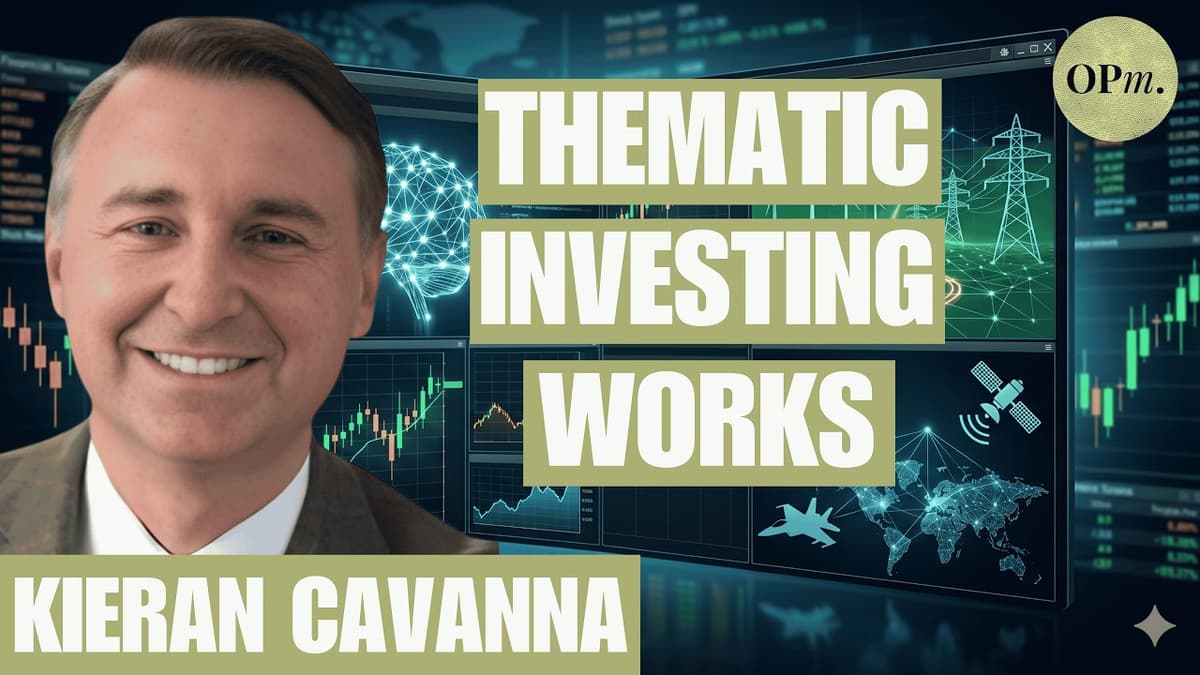
From Soros to Old Farm: How to Identify the Market’s Top Thematic Risk-Takers
The episode of "Other People’s Money" features Kieran Cavana, founder and CIO of Old Farm Partners, discussing how to pinpoint the market’s most compelling thematic risk‑takers. Drawing on his experience at Soros Fund Management and a decade of manager‑sourcing, Cavana...