
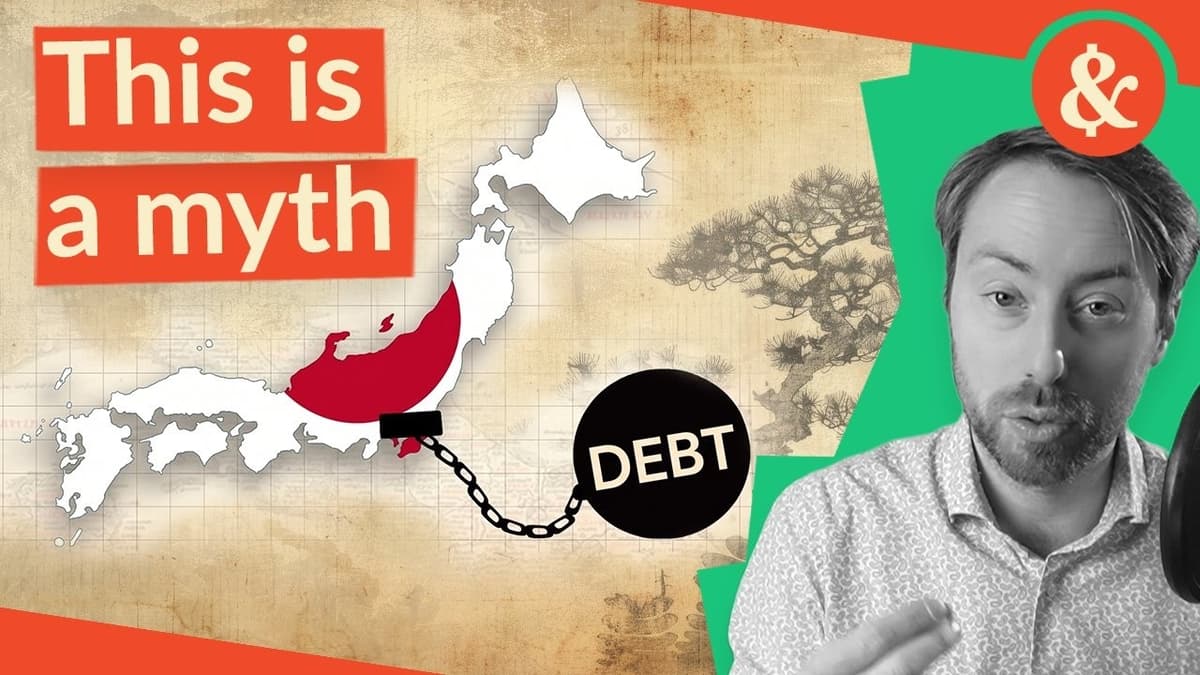
Why Japan Isn’t Broke Yet
The video explains why Japan’s headline government‑debt ratio—over 220% of GDP—doesn’t signal imminent fiscal collapse. By aggregating the balance sheets of the central bank, public‑pension funds and other state‑owned entities, Japan holds roughly 192% of GDP in financial assets, turning the entire fiscal complex into a de‑facto sovereign‑wealth fund. Netting those assets against liabilities reduces the effective debt burden to about 77% of GDP, a figure lower than that of the United States or the United Kingdom when measured on the same basis. Key data points include the official debt‑to‑GDP figure of 226% in 2023, the 192% asset‑to‑GDP valuation in 2020, and the resulting net‑debt ratio of 77% today. The analysis highlights how Japan’s government borrows cheaply in yen—thanks to ultra‑low rates set by the Bank of Japan—and redeploys those funds into higher‑yielding foreign bonds, equities and other assets. The yen’s prolonged depreciation amplifies returns, turning a 100‑dollar U.S. Treasury holding bought at ¥100 into a ¥150‑valued asset, effectively shrinking the debt burden without reducing borrowing. The presenter cites economists Tim Dou and Lustig, who label Japan a "giant sovereign wealth fund" and compare its structure to a hedge fund that leverages domestic savings for global investments. Historical context traces the evolution from the post‑war Japan Post banking model to the modern quantitative‑easing‑driven carry‑trade strategy, illustrating how policy shifts and demographic pressures reshaped the fiscal architecture. Implications are two‑fold: Japan’s current net‑debt position appears sustainable as long as foreign yields stay above domestic rates, the yen continues to weaken, and global markets remain accessible. However, geopolitical disruptions or a sudden rise in domestic inflation could reverse the advantage, potentially pushing net debt back toward 140% of GDP. Investors and policymakers must monitor currency trends, external asset exposure, and the political stability of host economies to gauge the durability of Japan’s unconventional fiscal playbook.

Can Gen-Z Afford to Pay for All Boomer Pensions?
The video examines whether Generation Z and millennials can shoulder the pension burden of retiring baby‑boomers, highlighting a looming demographic squeeze in wealthy nations. OECD forecasts show the worker‑to‑pensioner ratio falling from three today to under two by 2050, making pay‑as‑you‑go...

A Massive Food Crisis Is Coming
The video warns that the recent closure of the Strait of Hormuz – the world’s key chokepoint for oil, natural gas, sulfur and a third of global fertilizer shipments – is set to trigger a multi‑layered food crisis. With oil...

The Gulf Economies Are in BIG Trouble
The Gulf region’s economies are confronting a multi‑front crisis as the ongoing Gulf war disrupts oil exports, inflates fiscal deficits, and intensifies water scarcity. Scenario analyses show potential GDP contractions of up to 6% in Saudi Arabia and a 40%...

Is the Dollar Finally on the Way Out?
The video asks whether the U.S. dollar is finally losing its status as the world’s reserve currency, tracing the pattern that no currency stays on top forever—from the Dutch guilder to the British pound and now the dollar. It argues that...