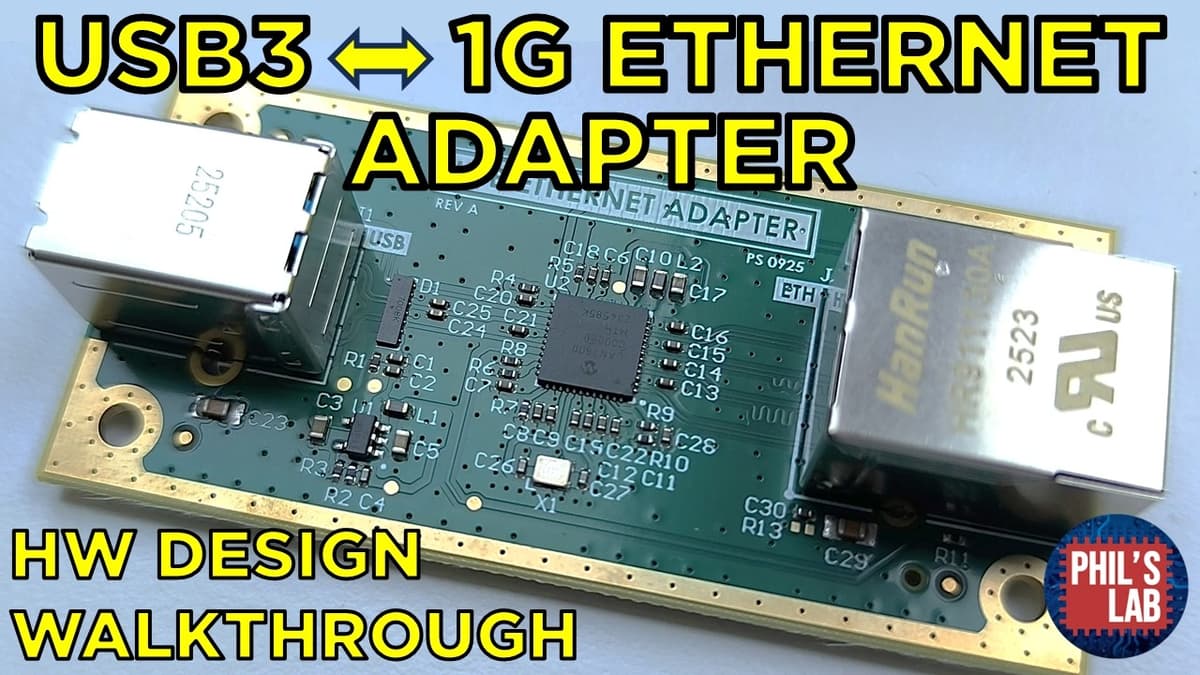
USB 3.1 to Gigabit Ethernet Adapter Hardware Design - Phil's Lab #174
The video walks through design of a USB‑3.1 to Gigabit Ethernet adapter PCB built around Microchip’s LAN780 transceiver, showing how a simple, bus‑powered board can deliver 1 Gbps Ethernet over a USB‑C/Type‑B connection. The schematic is minimal – a 5 V USB input, a buck regulator to 3.3 V, the LAN780 QFN48, and an integrated RJ45 mag‑jack with LEDs. The designer highlights power budgeting (≈256 mA at 3.3 V for full‑speed operation), decoupling (1 µF per pin, bulk caps), and the use of low‑capacitance ESD protection on USB‑3.0 lines. The board also includes a programmable OTP via MPAB configurator. Notable details include the choice of a six‑layer PCB from JLCPCB at $2 for five 50 × 50 mm boards, the integrated magnetics that remove external transformers, and cross‑platform driver availability (macOS, Windows, Linux). The presenter notes that the USB‑3.1 spec permits swapping differential pair polarity, simplifying routing, and that the design follows Microchip’s hardware checklist. For hardware developers, the example demonstrates that high‑speed USB‑3.1 to Ethernet conversion can be achieved with low component count, inexpensive prototyping, and rapid time‑to‑market. The design principles—proper power filtering, careful impedance‑controlled routing, and leveraging integrated magnetics—are directly applicable to IoT gateways, edge devices, and custom compute modules.
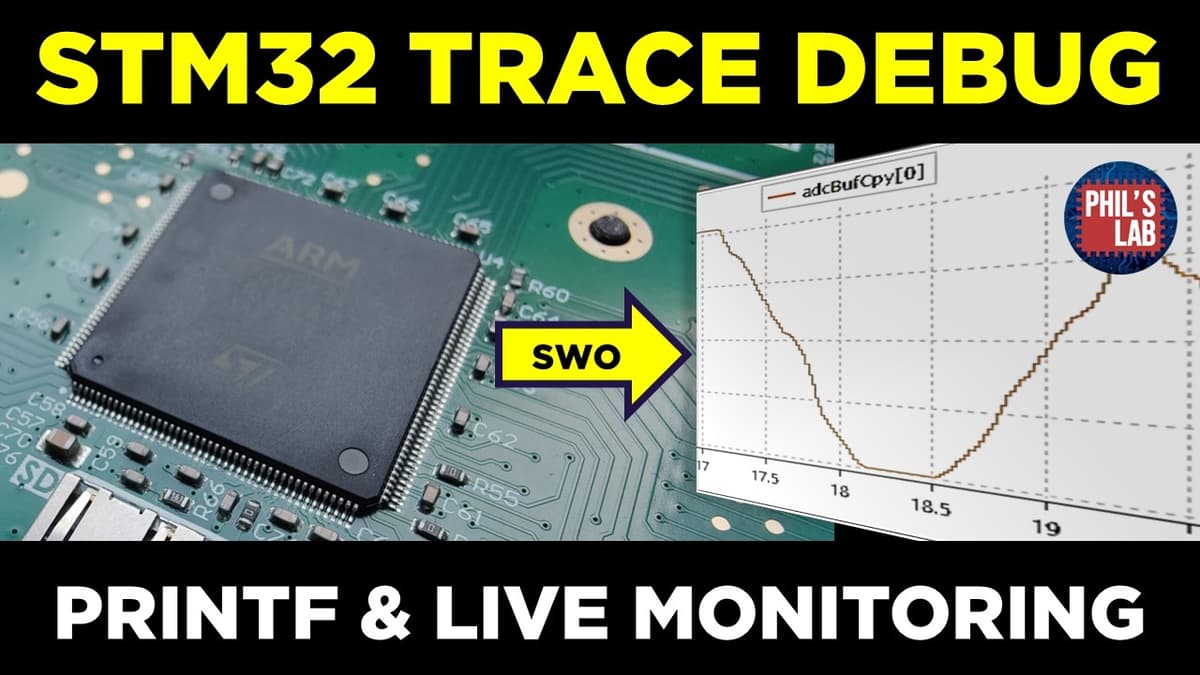
Debugging, Logging, and Monitoring via SWO Trace (STM32 ITM & DWT) - Phil's Lab #173
The video demonstrates how Serial Wire Output (SWO), together with the Instrumentation Trace Macrocell (ITM) and Data Watchpoint and Trace (DWT), can replace traditional UART or USB logging on ARM Cortex‑M microcontrollers, using an STM32H7 on a custom QueenB radio‑control...

Biquad Filters (DSP with STM32) - Phil's Lab #172
The video walks viewers through biquad filters, the second‑order IIR building blocks that underpin most digital audio processing, and shows how to move from theory to a working implementation on an STM32‑based guitar pedal. It covers block diagrams, transfer functions,...

PCB Controlled Impedance - Phil's Lab #171
The video excerpt from Phil’s Lab focuses on controlled‑impedance design, explaining when and how engineers must manage trace impedance to preserve signal integrity in advanced digital hardware such as FPGA‑based systems, DDR memory, and gigabit Ethernet. Key concepts include the maximum‑power‑transfer...
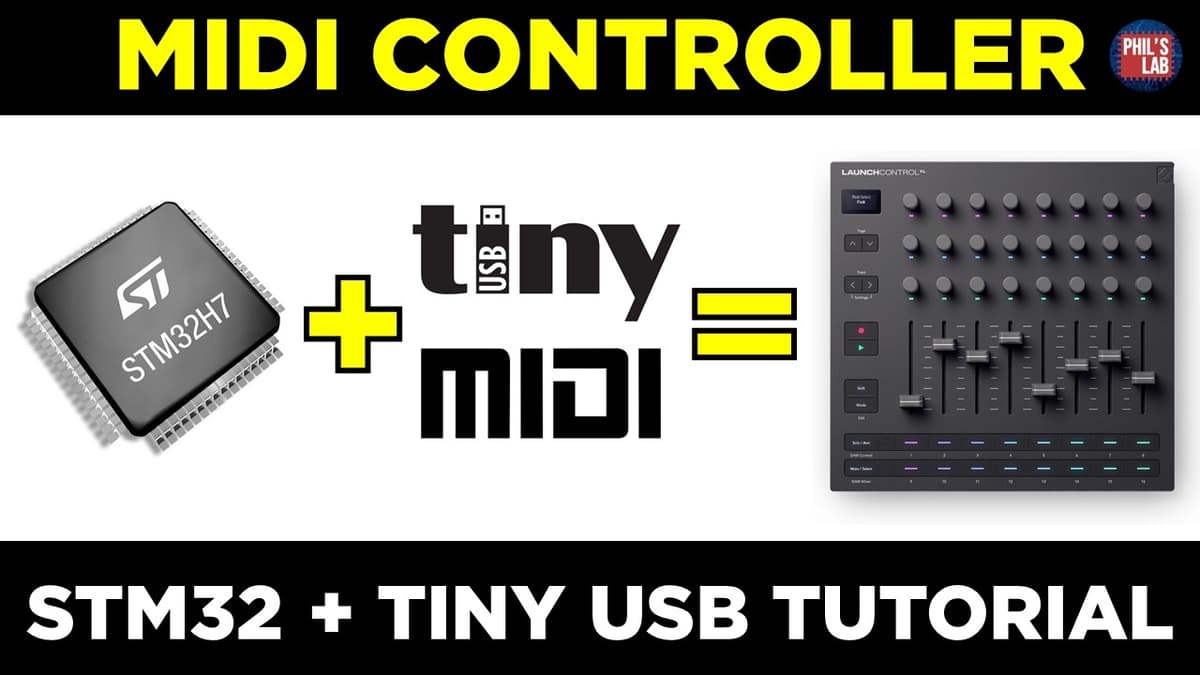
STM32 USB MIDI Controller Tutorial (TinyUSB) - Phil's Lab #169
The video walks viewers through constructing a custom USB‑MIDI controller using an STM32H7 (SM3287) MCU and the TinyUSB stack. Phil repurposes a QueenB radio‑control PCB—originally not intended for music—to host thumb‑sticks, switches, and RGB LEDs, turning them into MIDI control‑change...