Video•Mar 3, 2026
My First Science Video in 3 Years
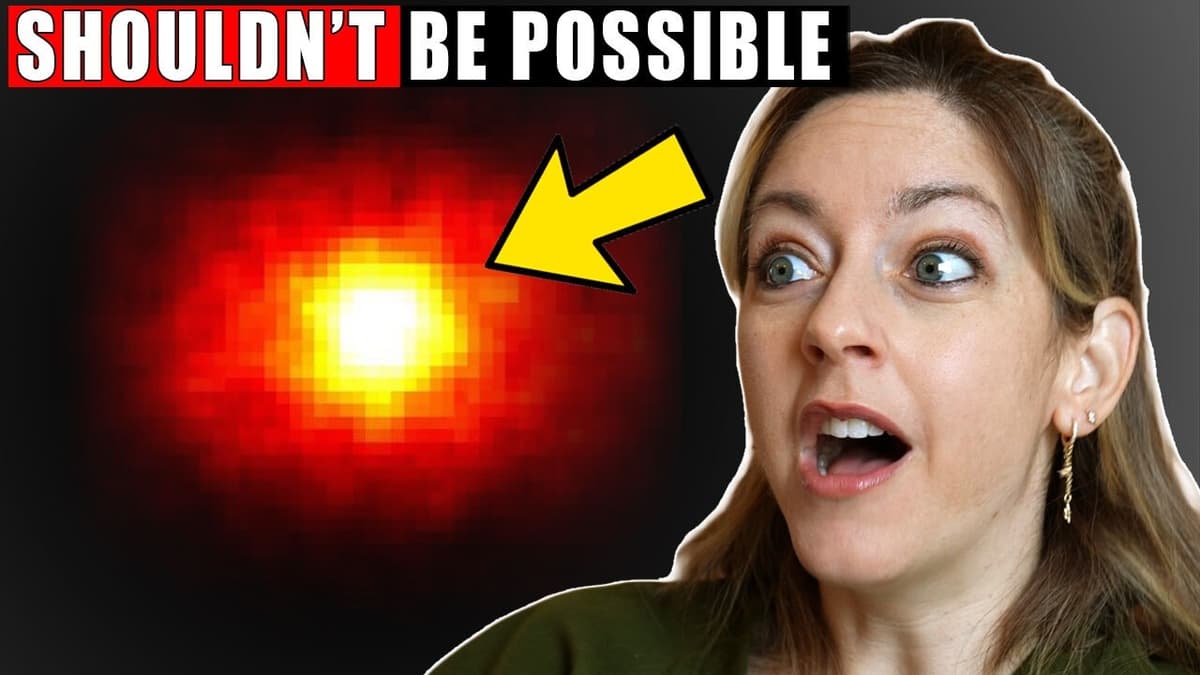
The video marks the creator’s return to physics after three years, using a striking image of the Sun assembled from solar neutrinos detected deep underground. It explains how neutrinos—tiny, nearly massless particles—stream through the Earth unimpeded, allowing a detector in Japan’s Super‑Kamiokande to capture a handful each day and reconstruct a faint solar portrait over 500 days of observation.
Key data points include the staggering flux of roughly 100 billion solar neutrinos passing through a thumbnail every second, contrasted with photons that wander for hundreds of thousands of years inside the Sun before emerging and taking eight minutes to reach Earth. The detector, a 40‑meter‑by‑40‑meter tank filled with 50,000 tons of ultra‑pure water, registers about 30 neutrino‑induced light flashes daily, each flash arising when a neutrino knocks an electron, producing a brief Cherenkov glow.
Notable moments feature the “ghost particle” analogy, the notion that neutrinos could serve as an early‑warning “blink” for a solar core catastrophe, and references to the 2015 Nobel Prize recognizing neutrino mass discovery. The host also highlights unresolved questions: the exact neutrino mass hierarchy, whether neutrinos are their own antiparticles, and the potential for discovering new forces or dimensions.
The significance lies in neutrino astronomy’s ability to probe the Sun’s interior in real time, offering a complementary view to traditional photon‑based observations. Moreover, advancing neutrino detection techniques could unlock answers to fundamental physics puzzles, driving both astrophysical insight and particle‑physics breakthroughs.