

The Future of 6G, Built on a Chip
The Engineering Innovations podcast featured Purdue PhD candidate Connor Devitt discussing his Nature paper on a world‑first on‑chip tunable spin‑wave ladder filter. The device leverages flat‑dispersion spin waves to provide frequency‑agile filtering across the newly opened 7‑24 GHz mid‑band, a spectrum critical for future 5G and 6G networks. Devitt explained that unlike conventional electromagnetic circuits, whose dimensions must be redesigned for each frequency, spin‑wave filters can be retuned simply by adjusting a magnetic field. This eliminates the need for dozens of bulky mechanical filters, offering a compact solution with lower attenuation and higher out‑of‑band rejection. The research, a five‑year partnership between Purdue and BAE Systems, culminated in a prototype radio that successfully transmitted and recovered data only when the spin‑wave filter was magnetically tuned to the carrier frequency. A vivid example from the interview showed the prototype’s binary data stream passing through the filter with the magnetic field off—resulting in complete signal loss—and then being recovered when the field was applied, confirming tunable selectivity. Devitt highlighted the hands‑on nature of the work, from lithography mask design to finite‑element simulations, underscoring the practical engineering breakthroughs achieved. If scaled to commercial devices, this technology could shrink RF front‑ends, improve power efficiency, and enable dynamic spectrum allocation in crowded environments, paving the way for more reliable, higher‑throughput 6G smartphones and other wireless applications.
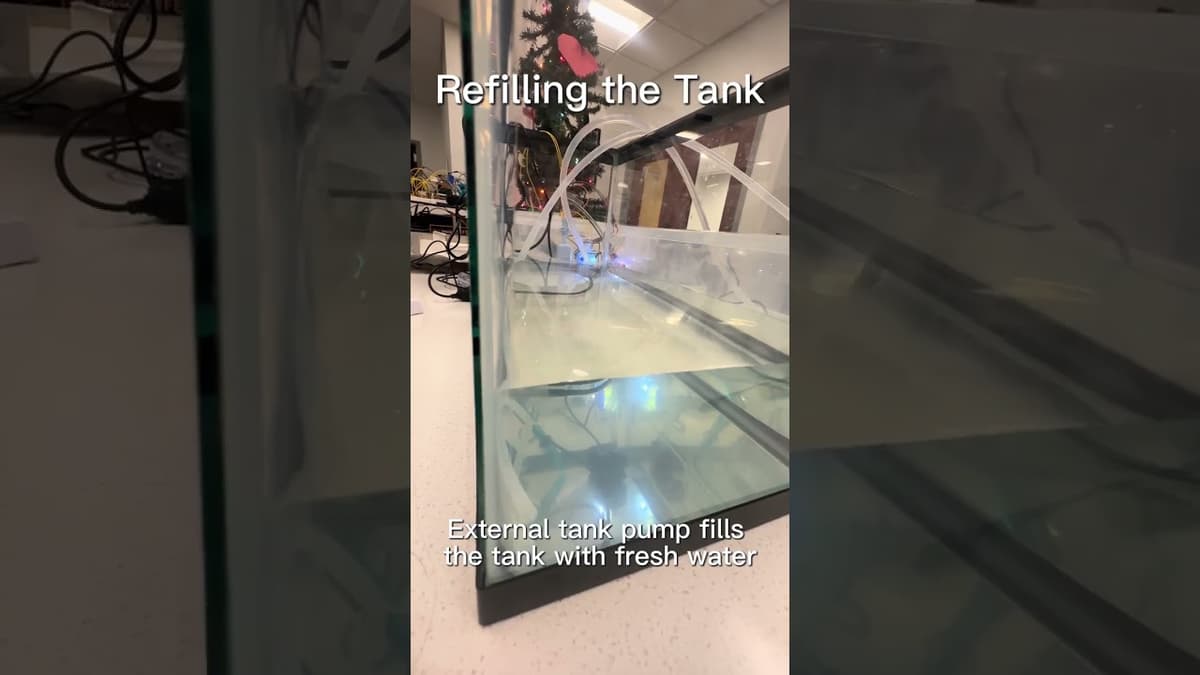
SPARK DECEMBER 2025 - Automated Aquarium Parameter Controller
The Purdue Elmore Family School of Electrical and Computer Engineering hosted the SPARK Challenge in December 2025, featuring a student‑developed automated aquarium parameter controller. The competition invites undergraduate teams to conceive, design, and build real‑world engineering solutions. This year’s entry...
Engineering Innovations: How AI Is Changing Images and Video
Engineering Innovations' podcast explores how AI is reshaping visual data compression. Professor Maggie Zu explains that traditional lossy codecs like JPEG and H.265 rely on fixed transform parameters, limiting adaptability and efficiency as video resolutions and formats proliferate. AI‑driven learned...