
Sabine Hossenfelder
Creator
0 followers
Physicist Sabine Hossenfelder delivers no-nonsense commentary on quantum physics and science news, explaining complex topics without hype or oversimplification ([larder.recruitingbrainfood.com](https://larder.recruitingbrainfood.com/item/72734/#:~:text=RBF%20Larder%3A%20Sabine%20Hossenfelder%2C%20YouTube,actually%20a%20force%20or%20not)).
Video•Mar 8, 2026
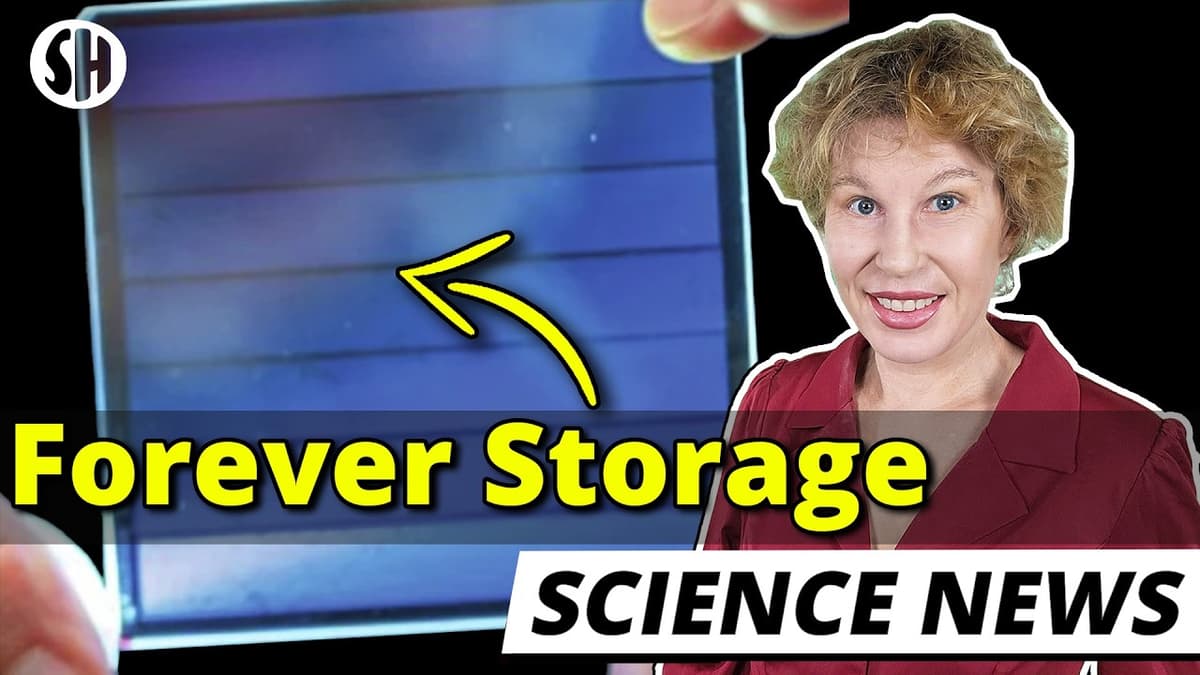
Breakthrough In Data Storage Could Store Your Photos for 10000 Years
Microsoft’s research team unveiled Project Silica, a glass‑based data storage platform that writes and reads information three‑dimensionally inside the bulk of a glass substrate. Using a focused laser to alter the material’s refractive index, the system can encode data that survives for more than 10,000 years, far outlasting magnetic disks, SSDs, or cloud services that may disappear. The prototype demonstrates a potential storage density two‑to‑four times that of conventional hard drives, but its write speed tops out at roughly 4 MB/s—about fifty times slower than modern SSDs. Reading is performed with visible‑light LEDs and a microscope that reconstructs the 3‑D pattern. While the lab demo proves durability, the equipment required remains costly and complex, suggesting an initial rollout as an archival cloud service rather than a consumer product. The announcement arrives alongside other emerging storage technologies. Seagate’s heat‑assisted magnetic recording (HAMR) drives are already shipping, offering higher areal density by briefly heating magnetic media during writes. Meanwhile, MRAM promises non‑volatile, nanosecond‑scale random‑access memory that could replace volatile DRAM in future devices. Compared with DNA‑based storage, glass offers a more practical, near‑term solution for ultra‑long‑term archiving. If the technology matures, enterprises and cultural institutions could safeguard terabytes of critical data for millennia, reducing reliance on periodic migration. For consumers, the impact will be indirect, as cloud providers adopt glass‑backed archives, ensuring personal photos and documents remain accessible for generations.
By Sabine Hossenfelder
Video•Mar 7, 2026
The Simulation Hypothesis Gets Scientific Backing
The video examines how the long‑standing simulation hypothesis is moving from philosophy toward a testable framework, spurred by a new computer‑science paper and advances in AI world‑modeling. The paper by David Wolpert treats the hypothesis as a multiverse problem, asking what...
By Sabine Hossenfelder