
Sabine Hossenfelder
Physicist Sabine Hossenfelder delivers no-nonsense commentary on quantum physics and science news, explaining complex topics without hype or oversimplification ([larder.recruitingbrainfood.com](https://larder.recruitingbrainfood.com/item/72734/#:~:text=RBF%20Larder%3A%20Sabine%20Hossenfelder%2C%20YouTube,actually%20a%20force%20or%20not)).
How Dangerous Is This Super El Niño Really?
The video explains that climate models now show a near‑certain transition into a super El Niño between May and July 2026, with the event likely persisting through early 2027. Agencies such as NOAA, the World Meteorological Organization, and the European Centre for Medium‑Range Weather Forecasts (ECMWF) all assign probabilities above 80 % for its onset and over 90 % for its continuation. The ECMWF ensemble forecast reported 100 % of its runs predicting a super‑El Niño, while other centers give a two‑thirds chance of a strong or very strong event. A super‑El Niño releases extra oceanic heat into the atmosphere, amplifying the baseline warming from anthropogenic greenhouse gases and altering global precipitation patterns. Historical precedent is the 1876‑78 super‑El Niño, which triggered widespread drought and famine across India, China, Brazil, Africa and parts of North America, killing an estimated 30‑60 million people. Today, similar climate stressors intersect with modern vulnerabilities—already‑tight food supplies in Africa, fertilizer shortages from the Iran conflict, and strained supply chains—raising the risk of severe humanitarian outcomes. For businesses and policymakers, the forecast signals heightened heat‑related energy demand, increased wildfire risk in the U.S. West Coast and Australia, and potential disruptions to agricultural yields in Africa and Southern Asia. Preparing for these impacts now can mitigate economic losses and support vulnerable populations.
I Looked at the New Cold Fusion Breakthroughs. It's Complicated.
The video surveys the recent surge in cold‑fusion activity, noting unprecedented public and private financing across the United States, Europe, Japan, Italy, India and other regions. Companies such as Japan’s Clean Planet, Italy’s Prometheus, Ireland’s ENG8 and India’s HighLena claim to...
New Theory Explains How Time Began
A recent Physical Review Letters paper from Perimeter Institute proposes that the universe began as a four‑dimensional space, with one dimension converting into time through quantum fluctuations. The authors argue that a transition from Einstein’s low‑energy gravity to a high‑energy...
Did Life Come To Earth On An Asteroid?
The video examines a recent study that subjected the extremophile bacterium Deinococcus radiodurans to pressures equivalent to those generated when an asteroid blasts rock fragments into space. By sandwiching the microbes between metal plates and firing a projectile, researchers recreated...
The Fermi Paradox Just Got Worse
The video discusses a recent paper that tackles the Fermi paradox by asking how long a technological civilization can remain detectable, rather than how many should exist. Using optimistic values for the Drake equation—millions of Earth‑like planets and a near‑unity...
Our Evolutionary Past Is Killing Us Now
The video examines the environmental mismatch hypothesis, arguing that humanity’s rapid alteration of its surroundings has outstripped the slow pace of genetic evolution, leaving modern humans poorly suited to the industrial world. Researchers cite three converging lines of evidence: a robust...
Scientists Prove That “Virtual” Particles Are Actually Real
The video discusses a recent breakthrough from the STAR collaboration at Brookhaven’s Relativistic Heavy Ion Collider (RHIC), where proton‑proton collisions were used to test whether virtual particles—fleeting entities predicted by quantum field theory—can manifest as real particles. By colliding protons...
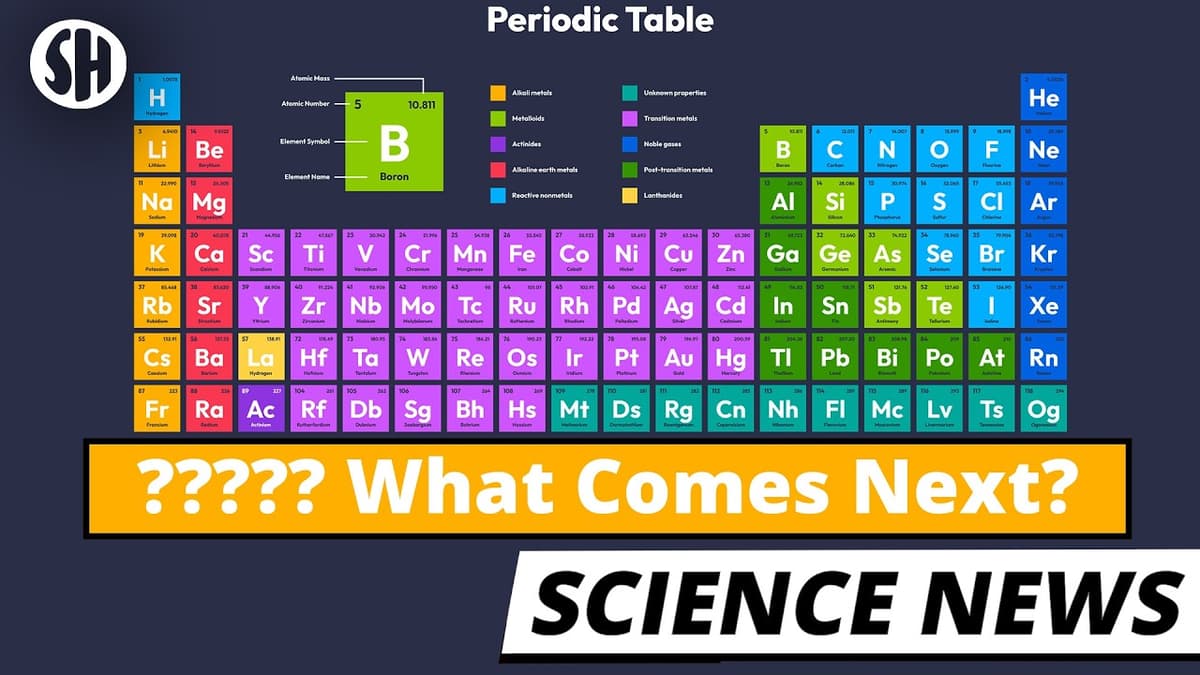
This Calculation Could Change The Periodic Table
The video examines a newly published paper that finally explains why some super‑heavy nuclei exhibit unexpected stability, bringing the long‑standing “island of stability” concept nearer to experimental reach. The authors abandon phenomenological shell models in favor of a top‑down calculation grounded...
US Military Uses “Ghost Murmurs” In Iran: What Are They?
The video dissects the sensational claim that a U.S. rescue operation in Iran relied on a “Ghost Murmur,” a purported quantum magnetometer capable of locating a soldier by his heartbeat. The story originated from a New York Post article and was amplified...

We Can Now Simulate a Human Brain, Scientists Show
The video discusses a breakthrough paper claiming that the next generation of exascale supercomputers will be capable of simulating a full human brain. By leveraging a novel parallel‑GPU architecture, researchers say they can allocate hundreds of thousands of neurons to...

We Pretty Much Have Evidence for Life in Other Solar Systems.
The video examines the growing body of tentative biosignature detections on exoplanets, centering on recent James Webb Space Telescope observations of the temperate world K2‑18b and other promising targets. JWST reported a three‑sigma detection of dimethyl sulfide on K2‑18b— a gas...

This Is How Faster than Light Signalling Could Work
The video challenges the entrenched belief that the speed of light is an absolute barrier, arguing that this dogma hampers interstellar travel and the search for extraterrestrial intelligence. The presenter contends that faster‑than‑light (FTL) signalling is not ruled out by...

The North Pole Is Moving And We Don’t Know Why
The video explains that Earth’s magnetic north pole, distinct from the geographic pole, has begun moving dramatically, now traveling as fast as 50 kilometres per year toward Siberia, and scientists lack a definitive explanation. For four centuries the pole drifted slowly...

Physicists Say They’ve Discovered A Secret About The Vacuum
The video dissects a recent Physical Review Research article that re‑imagines empty space as a material‑like medium possessing density and elasticity. Its authors, led by former NASA researcher Harold White, argue that quantum wave functions are actually disturbances propagating...

Breakthrough in Zero Friction Materials
The video explains a recent study that achieved superlubricity—near‑zero friction—on macroscopic graphite surfaces, positioning the phenomenon as a practical counterpart to superconductivity. Researchers grew ultra‑pure graphite crystals, peeled ten‑micron‑wide flakes, and demonstrated that when two such flakes slide, friction drops to...