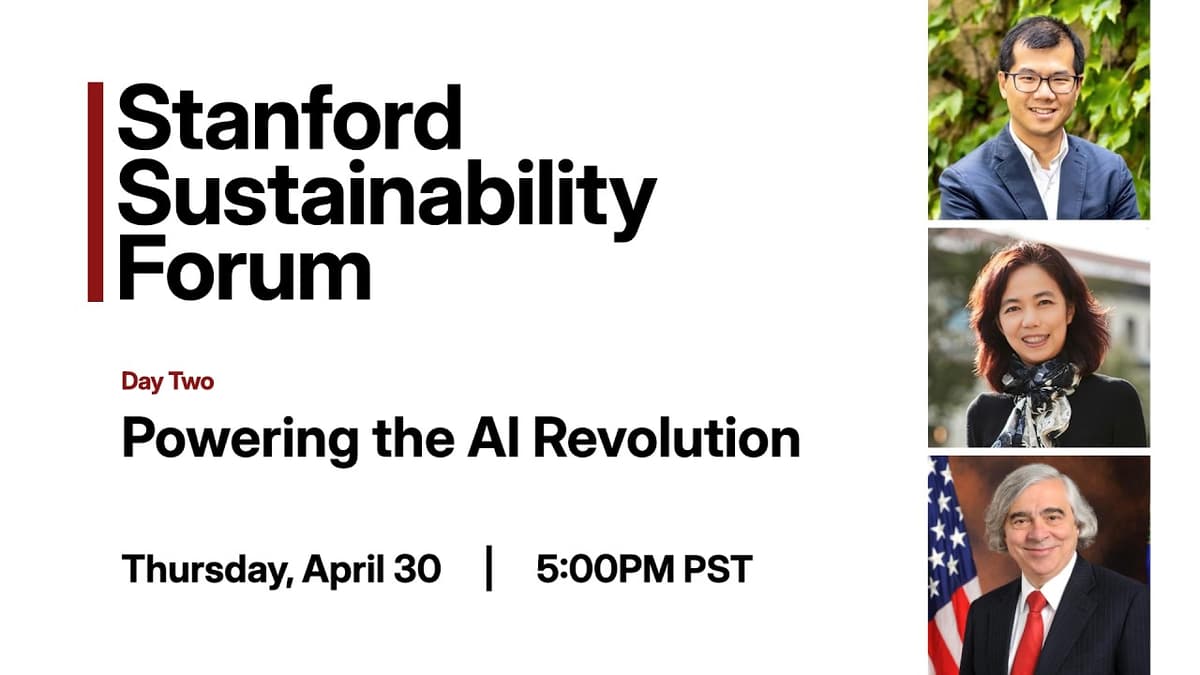
Stanford Sustainability Forum | Powering the AI Revolution
The Stanford Sustainability Forum brought together former Energy Secretary Ernest Moniz and AI pioneer Faith Bailey to examine the accelerating intersection of artificial intelligence and electricity consumption. Their discussion framed AI not just as a software challenge but as a national‑security‑level energy issue, highlighting unprecedented electricity growth in the United States driven by AI workloads, electrification, and manufacturing reshoring. Bailey outlined how AI efficiency has surged—an annual inference cost drop of roughly 280‑fold—thanks to algorithmic tricks like distillation and quantization and to successive Nvidia GPU generations that halve floating‑point precision. Yet Moniz warned that these gains are being swallowed by expanding AI use, with AI accounting for over 40% of recent load growth. The United States faces a generation gap, needing to boost annual electricity use from 4 TWh to 6 TWh by 2040, and a transmission shortfall, requiring about 5,000 miles of high‑capacity lines each year. Both speakers cited concrete examples: Bailey’s visit to a massive data center adjacent to a gigawatt‑scale solar plant in Abu Dhabi, and Moniz’s reference to the Jevons paradox—efficiency spurring higher consumption. Moniz also contrasted U.S. consumption stability with China’s rapid rise to over 10 TWh, underscoring a global competitive dimension. The panel concluded that meeting AI’s energy appetite will demand more than incremental efficiency. It calls for new generation sources—renewables, nuclear, CCS—grid modernization, and innovative business models linking utilities with hyperscalers. Moreover, as AI moves from cloud‑centric training to edge‑embedded world‑model applications, load patterns will shift, demanding flexible, localized power solutions.

Stanford Sustainability Forum | Moonshots and Manpower: The Two Fronts of the Energy Transition
The Stanford Sustainability Forum focused on the twin challenges of the energy transition: breakthrough technologies and the human workforce needed to scale the grid. Speakers Connor Galloway of Eximer Energy and Brian De of Foundry Logic highlighted that U.S. electricity...

Stanford Sustainability Forum | Powering the AI Revolution
The Stanford Sustainability Forum brought together former Energy Secretary Ernest Moniz and AI pioneer Faith Bailey to examine how the rapid rise of artificial intelligence is reshaping the global electricity landscape. Panelists framed three grand challenges: meeting a projected doubling...

Stanford Sustainability Forum | Wildfire and Air Quality Microlecture
The Stanford microlecture highlighted a growing crisis: wildfire smoke is not just a nuisance, it is a complex, highly toxic aerosol that traditional air‑quality metrics miss. Speaker Scott Fendorf argued that as climate change fuels larger, more frequent fires, the...

Stanford Sustainability Forum | Student Flashtalk on Life on the Edge
The Stanford Sustainability Forum featured a student flashtalk on the ocean’s most extreme ecosystems—deep hypersaline anoxic basins—using the Gulf of Mexico’s Orca Basin as a case study. The presenter highlighted how these brine‑filled, oxygen‑free pockets, despite salinities ten times that...

Energy Innovation with Stanford Scientists Will Chueh, Sally Benson, and Yi Cui
The video features Stanford researchers Will Chueh, Sally Benson and Yi Cui outlining a two‑pronged battery strategy: ultra‑high‑energy‑density cells for electric vehicles, aircraft and other mobile platforms, and large‑scale stationary storage to smooth solar and wind output for the grid and power AI...

Preferred Futures Conference - Session 2
The Preferred Futures Conference Session 2, organized by Stanford’s Doerr School of Sustainability Center for Just Environmental Futures, featured a rapid‑fire series of lightning lectures on cutting‑edge environmental and climate‑justice research. Speakers presented interdisciplinary findings that bridge policy, technology, and community‑driven...