Recent Posts
Video•Feb 24, 2026
A Seismic Shift in Climate Law
The episode examines the Environmental Protection Agency’s abrupt reversal of the 2009 greenhouse‑gas endangerment finding and the associated vehicle emissions standards, a move the administration touts as the largest deregulatory action in U.S. history. The discussion traces the Clean Air Act’s evolution from a 1970 focus on local pollutants to the 2009 finding that carbon dioxide, methane and other gases endanger public health, which spurred stricter fuel‑economy rules and accelerated electric‑vehicle adoption. The current administration argues that Congress never intended the Act to cover indirect climate harms, invoking the Major Questions Doctrine and the Supreme Court’s Loper Bright decision to challenge the EPA’s authority. Prof. Cus cites landmark cases—Massachusetts v. EPA, which affirmed EPA’s power to regulate greenhouse gases, and West Virginia v. EPA, where the Court applied the Major Questions Doctrine to limit agency reach—as the legal backdrop for the looming litigation. She also highlights attribution science linking intensified wildfires and other climate‑driven disasters directly to greenhouse‑gas emissions, underscoring the public‑health stakes. If courts side with the administration, decades of vehicle‑efficiency standards could be rolled back, slowing the transition to electric vehicles, raising emissions, and complicating U.S. commitments to climate mitigation. Conversely, a judicial rebuff would reaffirm the EPA’s regulatory footing, preserving market incentives for cleaner transportation and reinforcing the legal foundation for broader climate action.
By Stanford Law School

Video•Feb 20, 2026
CBC Project – February 12, 2026 Codex Group Meeting
The CBC Project, presented by Alexandre, introduces a novel analytics framework that extracts human behavioral signals from corporate litigation, board compensation, and stakeholder feedback to classify companies by sector and jurisdiction. By mapping these behavioral cues, the team seeks to...
By Stanford Law School
Video•Feb 19, 2026
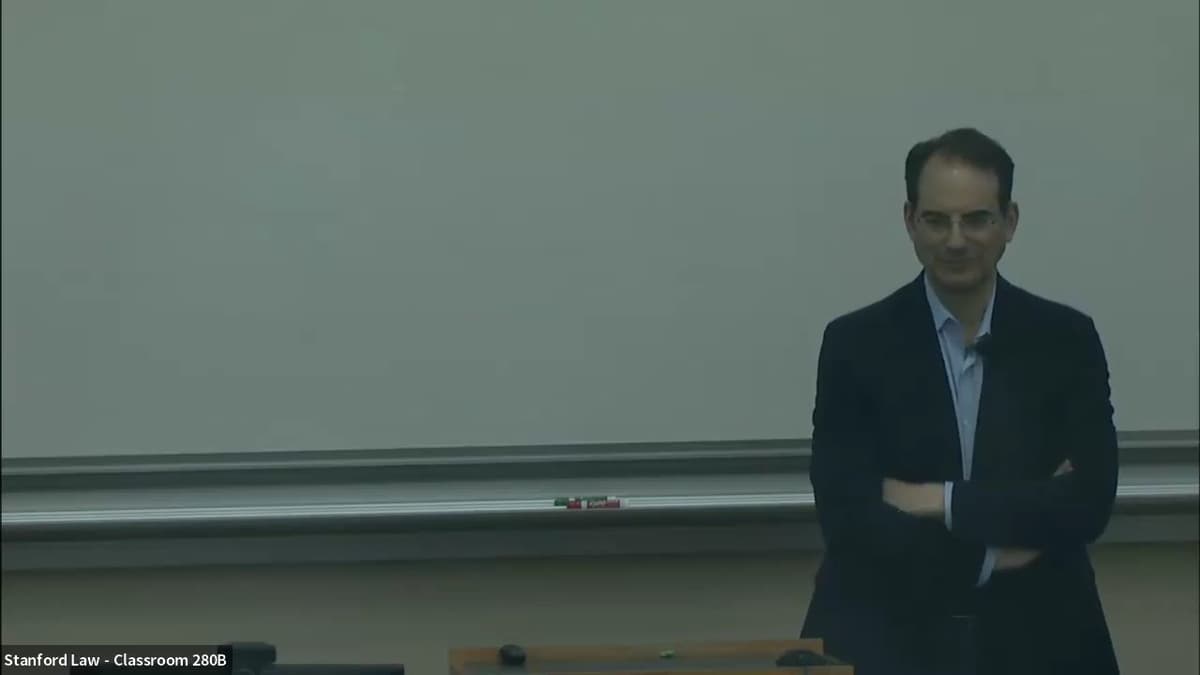
Rule of Law Speaker Series: Colorado Attorney General Phil Weiser
In a Rule of Law Speaker Series hosted by Stanford Law, Colorado Attorney General Phil Weiser outlined his office’s aggressive legal campaign against the federal government, describing a “Defend Colorado or Federal Accountability” initiative that has generated more than 50...
By Stanford Law School
Video•Feb 19, 2026
Inside the ACLU’s Docket: Anthony Romero on the Front Lines of Civil Rights
Anthony Romero, who has led the ACLU since the week before 9/11, tells Stanford Legal that the organization’s workload has surged under the Trump administration to roughly 239 legal actions, including more than 130 federal class actions spanning immigration, LGBTQ,...
By Stanford Law School
Video•Feb 18, 2026
SwiftLaw – February 12, 2026 Codex Group Meeting
At the Feb. 12 CodeX meeting, Saketh, CEO and founder of SwiftLaw, showcased a vertical AI platform that automates fund formation for emerging managers—generating term sheets, LPAs and subscription documents from a native DOCX editor and enabling client onboarding and...
By Stanford Law School
Video•Feb 18, 2026
Rule of Law Speaker Series: Hon. Mark Wolf
Retired U.S. District Judge Mark Wolf, speaking at Stanford’s Neukom Center, explained his recent resignation after four decades on the federal bench, saying he could no longer be constrained by limits on what judges may publicly say. In a widely...
By Stanford Law School
Video•Feb 14, 2026
The Venezuela Attack: Legality and Consequences
The Constitutional Law Center hosted a rapid‑response panel to dissect the Trump administration’s weekend operation to capture Venezuelan President Nicolás Maduro. Professor Jack Goldsmith framed the episode as an outright breach of Article 2(4) of the United Nations Charter, noting that...
By Stanford Law School
Video•Feb 14, 2026
Rule of Law Speaker Series: San Francisco City Attorney David Chiu on Federalism and the Rule of Law
David Chiu, San Francisco City Attorney, used the Rule of Law Speaker Series to warn that the Trump administration has turned federalism into a battlefield, repeatedly challenging state and local authority through litigation and funding conditions. He recounted the Reproductive Fact...
By Stanford Law School