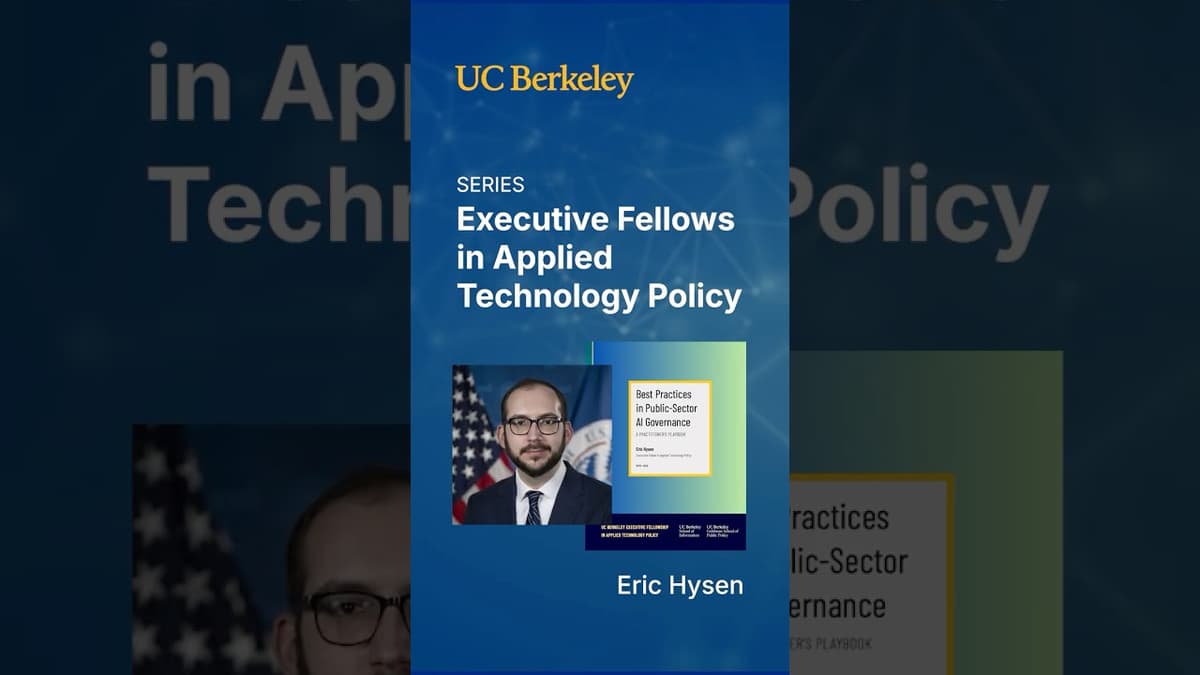
Policy in Practice: AI Governance W/ Eric Hysen | UC Berkeley Exec Fellowship in Applied Tech Policy
The video features Eric Hysen, a UC Berkeley Executive Fellowship fellow, examining how governments at all levels adopt and govern artificial intelligence. He asks whether public agencies are monitoring, governing, and evaluating AI use responsibly, and presents his research findings. Hysen’s work produced a playbook organized around five thematic pillars, each containing five concrete best practices. The core argument is that robust guardrails and responsible use do not slow progress; they actually enable faster, safer innovation within complex bureaucratic systems. He emphasizes the value of Berkeley’s interdisciplinary community, noting that pressure‑testing ideas with faculty, staff, and students sharpened his policy recommendations. A key quote: “Staying nimble, staying current, and designing flexible policy distinguishes tech policy that creates real value from policy that merely slows things down.” The takeaway for public officials is clear: adopt structured, adaptable AI governance frameworks now to keep pace with rapid technological change, avoiding regulatory lag and unlocking AI’s potential for public good.

The Hidden Governance of AI and Other Threats to Democracy — Abigail Jacobs
Abigail Jacobs' lecture frames AI governance as a hidden measurement problem, arguing that the way we quantify concepts such as fairness, safety, or intelligence effectively decides how AI shapes everyday life. She shows that most AI metrics are implicit, embedded in...

Graph Cities and Their Applications (James Abello Monedero & Haoyang Zhang)
The talk titled “Graph Cities and their Applications” introduced a method for turning massive graphs—up to billions of edges—into city‑like visualizations that can be explored interactively. The core technique iteratively removes nodes of minimum degree, generating a sequence of “waves” or...

Gesamtkunstvektoren: Perceptual Embeddings for the Performing Arts (Peter Broadwell)
Peter Broadwell, head of AI Modeling at Stanford Libraries, presented how recent multimodal embedding models—Google’s Gemini 2, Amazon’s Nova, OpenAI’s CLIP, Meta’s open‑weight model, and audio‑focused CLAP—enable unified queries across text, images, video, audio, and even PDFs. He framed the discussion...

What Dance Scholars Can Learn From Warehouse Surveillance
Miguel Escobar Varela, a computational folklorist, presented how warehouse surveillance techniques—specifically temporal action segmentation—can illuminate the evolving practice of wayang kulit, the Indonesian shadow‑puppet theater. He framed the talk in three “pathets,” mirroring the art form’s own structural divisions, and...
Computational Approaches to Pacing and Style in Television Comedy
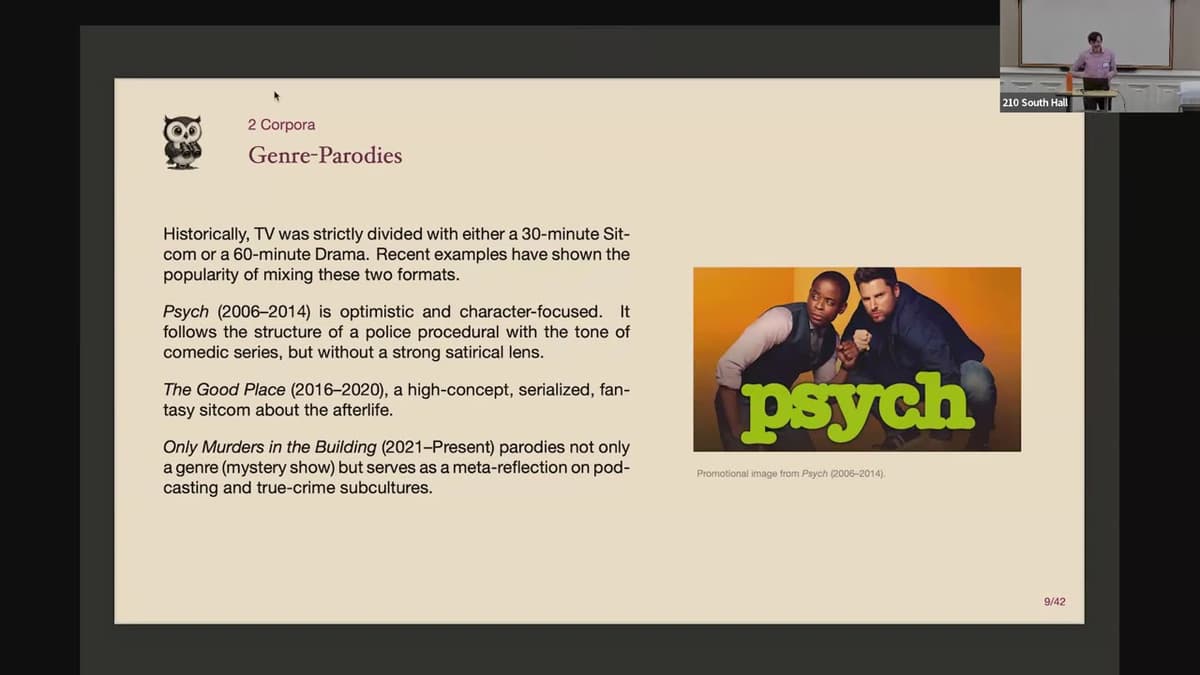
Taylor Arnold, a data‑science professor at the University of Richmond, presented a work‑in‑progress on computational methods for analyzing pacing and style across television comedy. Funded in part by a Schmidt Sciences Grant, the project expands a prior CHR2025 paper into...

Multimodal Cinemetrics
Professor Lauren Tilton opens the session by proposing a new framework called multimodal cinemetrics, which seeks to apply computational methods to the study of time‑based media such as film, television, and emerging digital formats. Drawing on her background in American...

I Am Troubled (Bob L. T. Sturm)
Bob Sturm, an associate professor at KTH, delivered a talk titled “I am Troubled,” in which he examined his personal existential crisis triggered by the rapid AI-driven transformation of music and cultural analytics. Sturm traced algorithmic composition back centuries—from medieval pegboxes...