
Recent Posts
Video•Feb 12, 2026
Are Abundant Aluminum Batteries Beating Lithium?
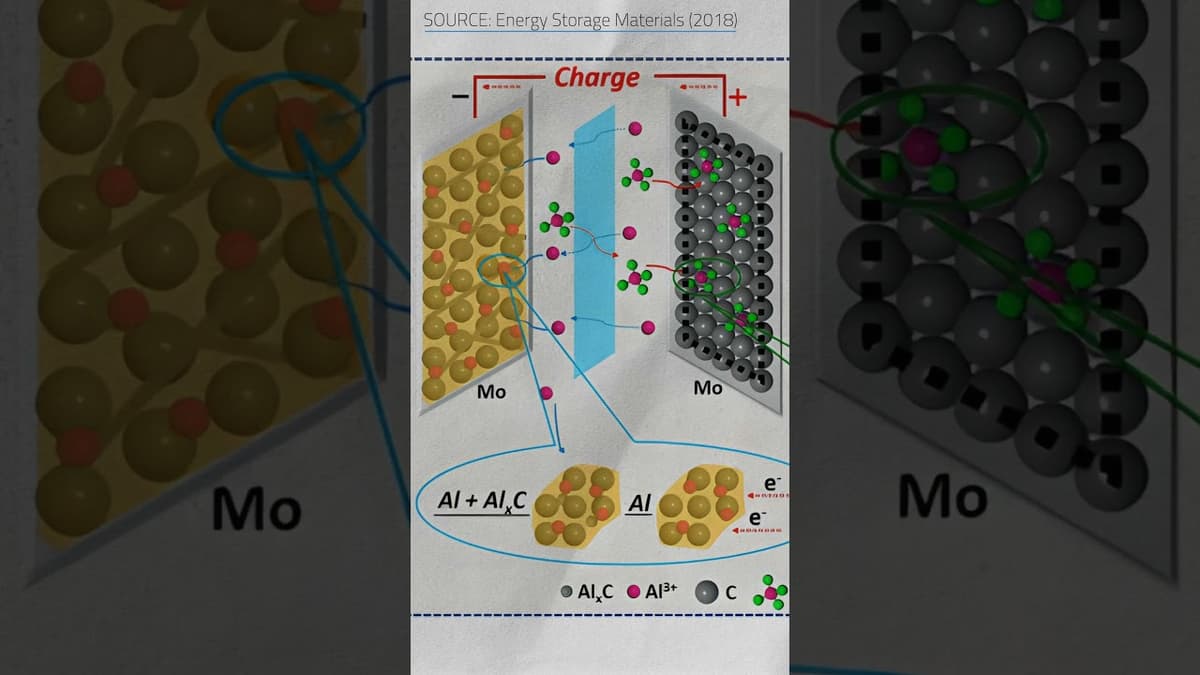
The video introduces a new aluminum‑graphite dual‑ion battery developed by Germany’s Fraunhofer Institute, positioned as a high‑power alternative to conventional lithium‑ion cells. In laboratory tests the cells achieved power densities exceeding 9 kW per kilogram—three to nine times that of typical lithium‑ion batteries—by pairing a solid aluminum anode with a natural graphite cathode and a bespoke electrolyte that transports distinct ions to each electrode. The design eliminates lithium, cobalt, and flammable electrolytes, and its modular “soda‑can” construction facilitates disassembly and recycling. A full‑scale prototype featuring pouch cells, an advanced battery‑management system and sensors has already been validated using real grid‑frequency data. The presenter highlights practical use cases: propelling a city bus from a dead stop, capturing regenerative energy from trams, powering cranes, and providing instantaneous grid‑stability when a supply trips. The team is now collaborating with industry partners to adapt the chemistry for roll‑to‑roll manufacturing. If commercialized, this low‑cost, power‑forward battery could fill a niche for heavy‑duty transport and grid‑support applications, complementing energy‑dense lithium‑ion technology while offering superior recyclability and reduced reliance on critical minerals.
By Undecided with Matt Ferrell

Video•Jan 29, 2026
The Kesterite Solution to the Perovskite Problem
The video spotlights kesterite, a low‑cost mineral poised to replace perovskite in next‑generation solar panels. While silicon remains affordable and perovskite delivers high performance, both suffer from durability challenges and, in perovskite’s case, toxic lead. Kesterite promises the best of...
By Undecided with Matt Ferrell