
Recent Posts
Video•Feb 19, 2026
Public Data Briefing: 2026 Proposed Amendment Regarding Human Smuggling Offenses
The United States Sentencing Commission released a public data briefing on Jan. 30, 2026 outlining proposed amendments to the federal sentencing guidelines for human smuggling offenses. The proposal, open for comment until March 18, seeks to refine how the guidelines account for the number of aliens smuggled, vehicle‑related risks, injury severity, sexual‑abuse conduct, and involvement of transnational criminal organizations. The Commission’s analysis shows that the current 2L1.1(b)(2) table, which adds three, six, or nine offense levels based on broad alien‑count bands, would be replaced by six narrower tiers, potentially affecting roughly ten percent of the 4,178 cases sentenced under the provision in FY‑2024. Data indicate that 41% of those cases received an alien‑count enhancement, with average guideline minima rising from 12 months (no enhancement) to 83 months for the highest tier. A new vehicle‑and‑vessel risk characteristic would impose a two‑level floor of 18, reflecting the prevalence of motor‑vehicle accidents in smuggling cases. Injury enhancements would be expanded to cover criminal sexual abuse and multiple‑victim scenarios. Under the existing injury table, only four percent of cases triggered an enhancement, but the proposed options could raise the level by one to six points in up to 64% of applicable cases. The briefing also highlights that about 5% of 2L1.1 cases involved transnational criminal organizations, which were disproportionately subject to higher alien‑count and injury enhancements. If adopted, the amendments would increase sentencing ranges for a notable subset of defendants, sharpen penalties for high‑risk conduct, and address perceived disparities linked to organized‑crime involvement. Stakeholders—including prosecutors, defense attorneys, and advocacy groups—must weigh the balance between deterrence and proportionality as the Commission solicits public input.
By United States Courts
Video•Feb 19, 2026
Public Data Briefing: 2026 Proposed Amendments on Sentencing Options
The United States Sentencing Commission released proposed amendments to the federal sentencing guidelines on Jan. 30, 2026, focusing on two parts—A and B—of a new sentencing‑options framework. Part A refines guidance on selecting sentence types, while Part B seeks to expand the...
By United States Courts
Video•Feb 19, 2026
Public Data Briefing: Sentencing Impact of 2026 Proposed Amendment Relating to Meth Offenses
The U.S. Sentencing Commission released a public data briefing on February 5, 2026, inviting comments on a proposed amendment to the federal sentencing guidelines for methamphetamine offenses. The amendment, identified as Option 1 of Part A, creates a distinct sentencing tier for meth in...
By United States Courts
Video•Feb 19, 2026
Public Data Briefing: 2026 Proposed Amendments Relating to Economic Offenses
The U.S. Sentencing Commission released a public data briefing on Jan. 8, 2026, outlining proposed amendments to the federal sentencing guidelines for economic offenses. The briefing, updated on Feb. 5, 2026, adds revised data on slide 8 and new material on slide 21 to...
By United States Courts
Video•Feb 12, 2026
Term Talk Extended (2024-2025): Mahmoud V. Taylor; Catholic Charities Bureau V. Wisconsin Labor;
The episode of Term Talk examined two recent Supreme Court opinions—Mimmude v. Taylor and Catholic Charities v. Wisconsin Labor—both reshaping the application of the First Amendment’s free‑exercise and establishment clauses for schools and religious nonprofits. In Mimmude, the Court held that...
By United States Courts
Video•Feb 10, 2026
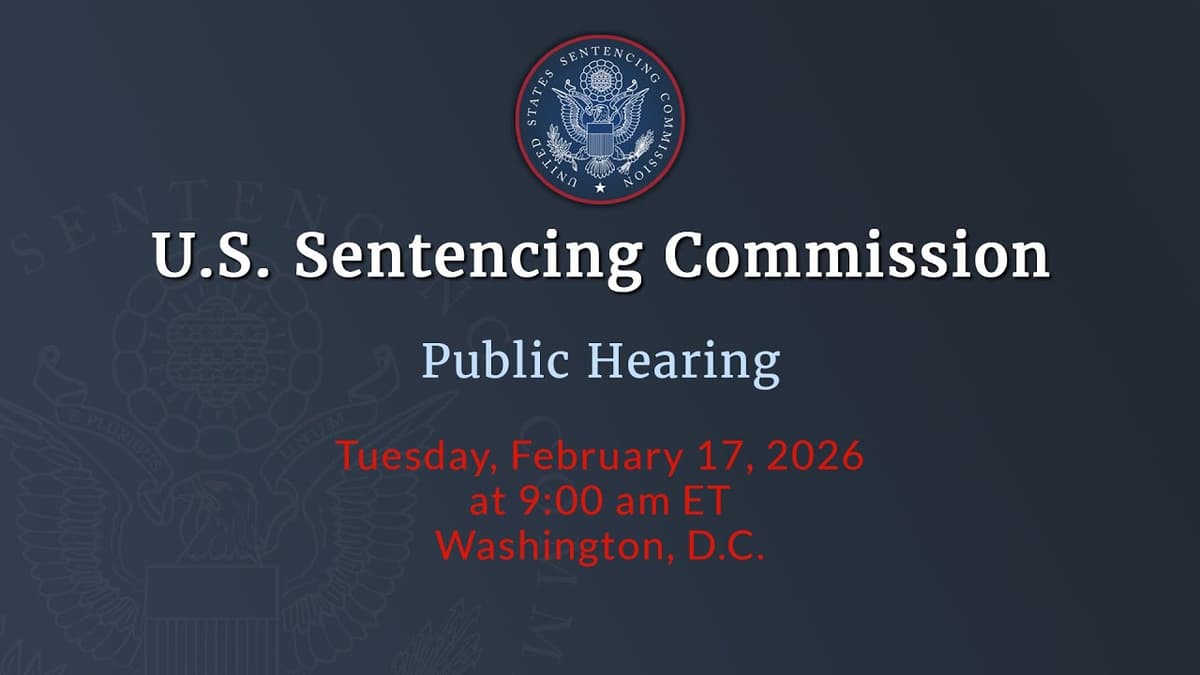
USSC Public Hearing - February 17, 2026
At a Feb. 17, 2026 public hearing, U.S. Sentencing Commission Chair Carlton W. Reeves opened proceedings by honoring the late Rev. Jesse Jackson, thanking staff, and outlining proposed guideline amendments covering drug offenses, economic crimes, sophisticated means, and post‑offense rehabilitation....
By United States Courts