
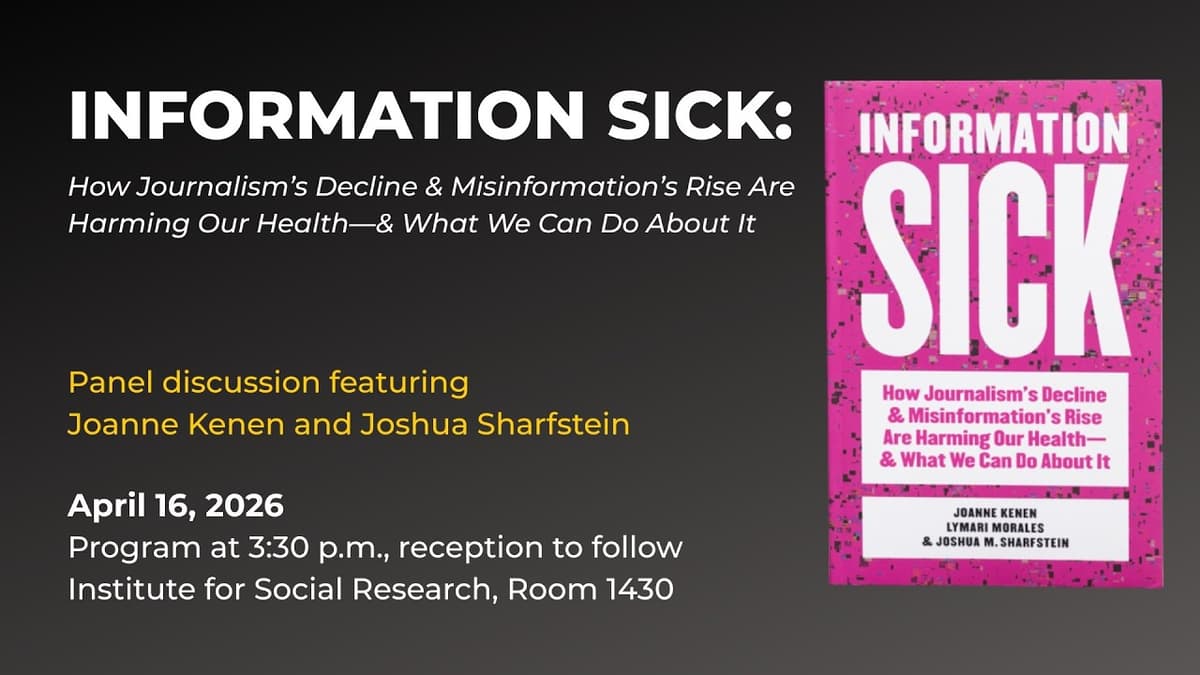
Information Sick: How Journalism’s Decline and Misinformation’s Rise Are Harming Our Health
The event centered on the newly released book *Information Sick*, which argues that the erosion of traditional journalism and the surge of health‑related misinformation are creating a public‑health crisis. Authors Joanne Cannon and Josh Sharfstein trace how dwindling local newsrooms, corporate consolidation, and algorithm‑driven social platforms leave communities without trusted sources, prompting dangerous health choices—from rejecting chemotherapy to refusing COVID‑19 vaccines. Key data points illustrate the problem: the rise of “news deserts” across counties, the Pulitzer‑winning opioid investigation that vanished when its paper was sold, and AI‑generated deepfakes like the Chuck Norris health video. The authors also cite a 2016 study showing network news devoted only minutes to policy while fixating on horse‑race coverage, underscoring how agenda‑setting has shifted away from substantive health reporting. Memorable anecdotes punctuate the analysis: Eric Iyer’s West Virginia paper exposed massive opioid dumping before its closure; Elvis Presley’s public polio shot boosted teen vaccination rates; and a student’s WhatsApp‑shared Washington Post article convinced a faith community to vaccinate. These stories highlight both the damage of misinformation and the power of trusted, community‑based messengers. The authors conclude that reviving robust, locally anchored journalism—and pairing it with credible community influencers—offers the most effective antidote to health misinformation. Policymakers, media owners, and public‑health officials must prioritize sustainable funding for investigative reporting and develop strategies to monitor and counter false health narratives online.

Introducing the Longitudinal Study of Health and Ageing in Kenya (LOSHAK) | Josh Ehrlich
The Institute for Social Research hosted Josh Ehrlich to unveil LOSHAK, the Longitudinal Study of Health and Aging in Kenya. The initiative, a partnership between the University of Michigan, Aga Khan University, and Kenyan government agencies, seeks to fill critical...

Property Tax Base Fragmentation and Metropolitan Inequality in the U.S. Robert Manduca, ISR Insights
Robert Manduca’s ISR Insights talk examined how the United States’ patchwork of local governments creates stark fiscal inequality through property‑tax base fragmentation. He outlined the outsized role of municipal property taxes—accounting for up to 80% of local revenue—and illustrated how...