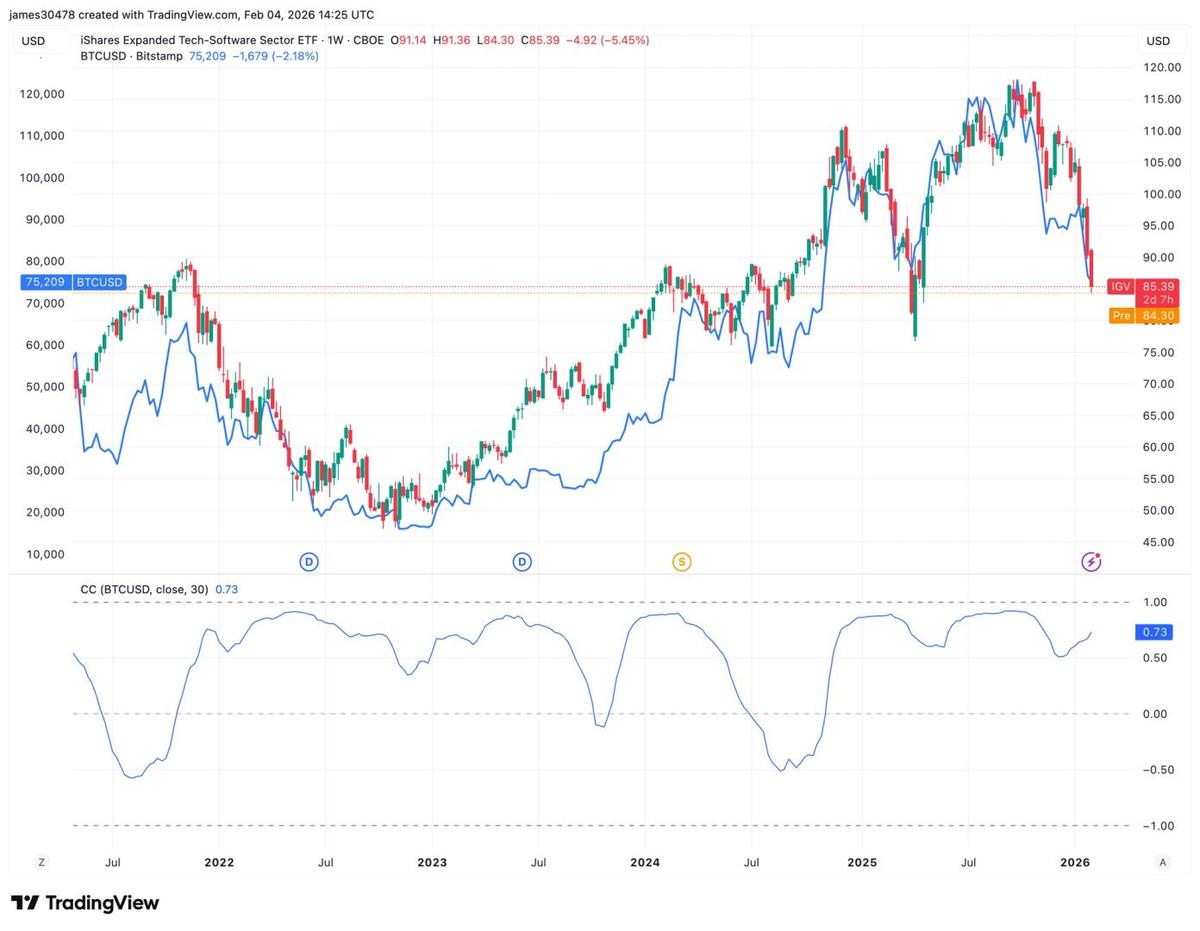
Bitcoin's Correlation with Troubled Software Stock Sector Is Growing
•February 4, 2026
0
Companies Mentioned


Why It Matters
The rising alignment ties Bitcoin’s fortunes to software market cycles, limiting its diversification benefit and signaling heightened volatility for crypto investors.
Key Takeaways
- •30‑day Bitcoin‑IGV correlation reaches 0.73.
- •IGV down 20% YTD while Bitcoin fell 16%.
- •AI hype fuels software sell‑off, dragging Bitcoin.
- •Tech bear market average lasts 14 months, ending 2026?
- •Economic resilience could provide Bitcoin support despite downturn.
Pulse Analysis
Over the past month Bitcoin’s price movements have begun to mirror those of the software‑focused iShares Expanded Tech Software ETF (IGV) more closely than any other equity group. A 30‑day rolling correlation of 0.73, reported by analytics firm ByteTree, signals that the cryptocurrency is behaving like a traditional software stock rather than a broad market asset. Both assets have underperformed this year—IGV slipping roughly 20 percent and Bitcoin about 16 percent—highlighting a shared vulnerability to sector‑specific pressures. This convergence challenges the long‑standing view of Bitcoin as a non‑correlated hedge.
The catalyst behind the software slump is the accelerating race toward artificial general intelligence, which investors see as an existential risk for legacy software business models. Companies such as Microsoft, Oracle, Salesforce, Intuit and Adobe dominate IGV’s holdings, and their valuations have been compressed by heightened AI competition and spending uncertainty. Analysts argue that Bitcoin, fundamentally an open‑source software protocol, is now caught in the same sentiment wave, with its price reacting to the same risk‑off dynamics that are penalising pure‑play software firms. This alignment reinforces the narrative of Bitcoin as an ‘internet stock.’
Looking ahead, the average technology bear market spans about fourteen months; the current downturn, which began in October, may therefore extend well into 2026. Should the broader economy remain resilient, it could provide a floor for Bitcoin, offering liquidity and risk‑premium support despite sector weakness. Conversely, prolonged pressure on software equities could keep Bitcoin’s upside limited, prompting investors to reassess diversification strategies that rely on crypto’s historic low correlation. Monitoring macro‑economic indicators and AI‑related policy developments will be crucial for gauging whether Bitcoin can decouple from its new software‑stock tether.
Bitcoin's correlation with troubled software stock sector is growing
0
Comments
Want to join the conversation?
Loading comments...