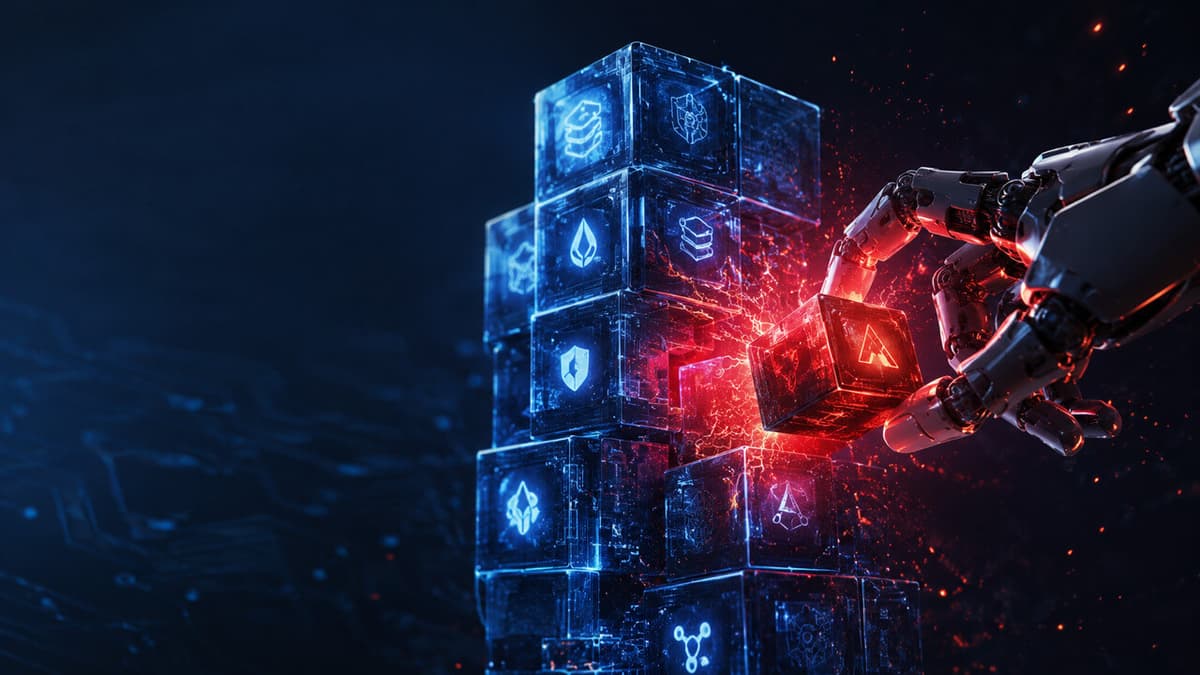
Have AI Agents Made the Entire $148 Billion DeFi Sector Unsafe?
Companies Mentioned


Why It Matters
AI lowers the cost and speed of attacks, threatening billions in user capital, so robust, AI‑enhanced defenses are critical to preserve confidence in the DeFi ecosystem.
Key Takeaways
- •AI agents find smart‑contract flaws faster than human auditors
- •April 2024 saw $635 million lost in 28 DeFi hacks
- •Most recent losses involve key theft, bridge spoofing, social engineering
- •Protocols add AI‑powered monitoring, circuit breakers, runtime protections
- •Experts advise focusing on mature, well‑audited platforms amid AI risk
Pulse Analysis
The rise of autonomous AI coding agents is reshaping the security landscape of decentralized finance. By automating vulnerability scans, exploit testing and on‑chain reconnaissance, these tools can locate weak points at near‑zero cost, a capability highlighted by OpenZeppelin’s Manuel Aráoz and backed by a16z research. The timing is stark: April alone recorded $635 million in hacks across 28 incidents, contributing to a five‑week outflow that trimmed the sector’s total value locked to roughly $148 billion. While the headline‑grabbing losses often involve stolen private keys or bridge attacks, the underlying trend is clear—AI is making the discovery phase cheaper and faster, amplifying the asymmetry between attackers who need a single exploit and defenders who must patch every flaw.
In reaction, DeFi projects are turning AI from a threat into a shield. OpenZeppelin has released tooling that guides AI agents to generate contracts using vetted security libraries, reducing the risk of unsafe code patterns. Uniswap’s new AI‑integrated developer platform and Nansen’s AI‑driven analytics aim to catch bugs before they are deployed. More importantly, firms like Cyvers are championing continuous, AI‑assisted monitoring that simulates transactions in real time, triggers circuit breakers, and enforces multisig controls when anomalous activity is detected. These dynamic defenses move beyond static audits, acknowledging that the speed of AI‑powered attacks demands equally rapid, automated responses.
The strategic implication for the broader market is a shift from trying to eliminate every vulnerability to limiting the blast radius of any breach. Protocols are tightening privileged‑role access, imposing exposure caps, and enhancing oracle designs to prevent a single compromised component from draining entire liquidity pools. For investors, the advice is to gravitate toward established platforms with proven security track records and simpler architectures, while newer, high‑yield projects may face heightened scrutiny. As AI continues to evolve, the DeFi sector’s resilience will hinge on its ability to embed adaptive, AI‑enabled safeguards that protect user capital without sacrificing the open, composable nature that defines the ecosystem.
Have AI agents made the entire $148 billion DeFi sector unsafe?
Comments
Want to join the conversation?
Loading comments...