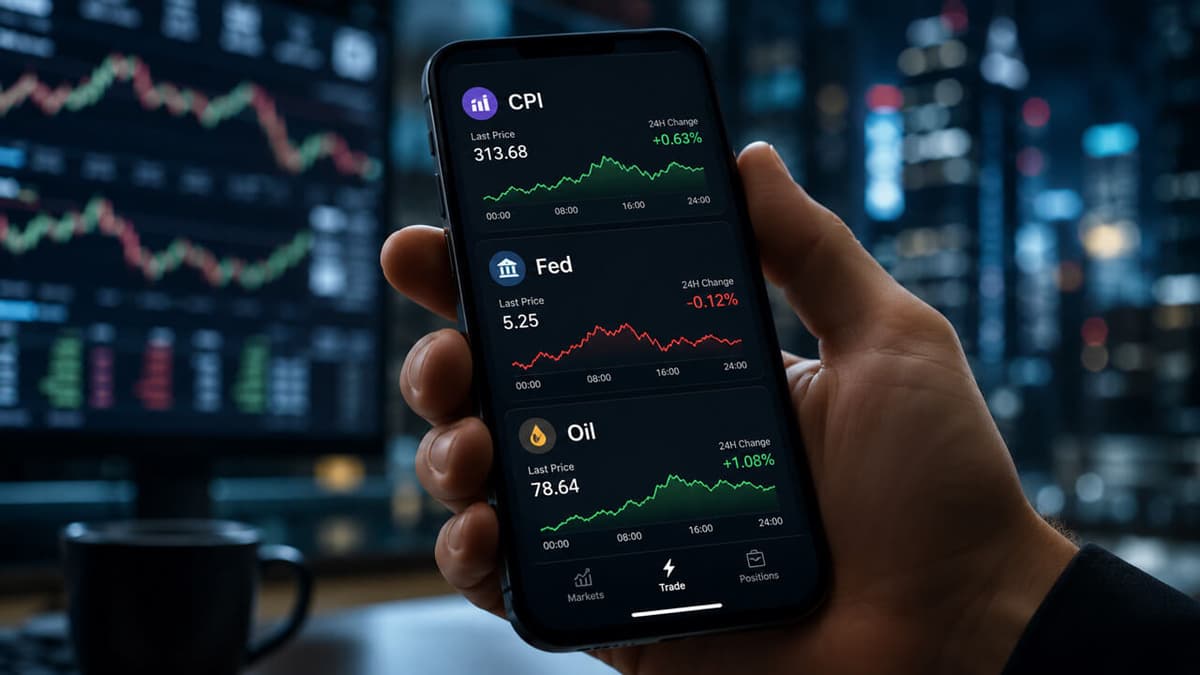
What Happens when Crypto Traders Can Bet on CPI, Fed Cuts, and Oil 24/7?
Companies Mentioned



Why It Matters
By tokenizing macro events, crypto platforms give retail traders real‑time exposure and price discovery, while forcing regulators to confront a new class of derivative‑like gambling products.
Key Takeaways
- •Hyperliquid’s CPI market trades at ~43% probability for sub‑4.3% reading
- •ICE and OKX launch never‑expiring Brent and WTI futures for 120 M traders
- •Polymarket adds 23 private‑company contracts, pricing OpenAI at 76% chance
- •Crypto perps generate $1.6 B daily, outpacing CME and ICE volumes
- •Regulators in US, EU treat prediction markets as gambling, sparking legal battles
Pulse Analysis
The emergence of crypto‑based prediction markets marks a shift from traditional, institution‑only data products to a retail‑friendly, always‑on ecosystem. Platforms like Hyperliquid are packaging official releases—such as the U.S. CPI—into binary contracts priced in stablecoins, allowing traders to express probabilistic views in seconds. This model mirrors the success of perpetual futures for Bitcoin, but now extends to macro benchmarks, creating a continuous pricing layer that can influence expectations for inflation, interest‑rate moves, and even sovereign risk.
Parallel to the CPI bets, the ICE‑OKX partnership brings the world’s most liquid oil benchmarks—Brent and WTI—into a never‑expiring perpetual format. With roughly 120 million retail users on OKX, the product bypasses the need for a commodity brokerage account, delivering near‑instant exposure to energy prices around the clock. The $1.6 billion daily volume in crypto oil and gold perps already rivals legacy exchanges, and the weekend liquidity advantage has positioned these platforms as de‑facto reference prices when traditional markets are closed.
Regulatory scrutiny is intensifying as these innovations blur the line between derivatives and gambling. U.S. states like Minnesota and European regulators in Spain are classifying prediction markets as illegal betting, while the CFTC argues they fall under federal derivatives law. The legal ambiguity raises questions about market integrity, especially when contracts rely on external data feeds that could be manipulated. As crypto firms scale these products, the industry faces a pivotal moment: secure a clear regulatory framework or risk curtailing a rapidly growing avenue for retail hedging and price discovery.
What happens when crypto traders can bet on CPI, Fed cuts, and oil 24/7?
Comments
Want to join the conversation?
Loading comments...