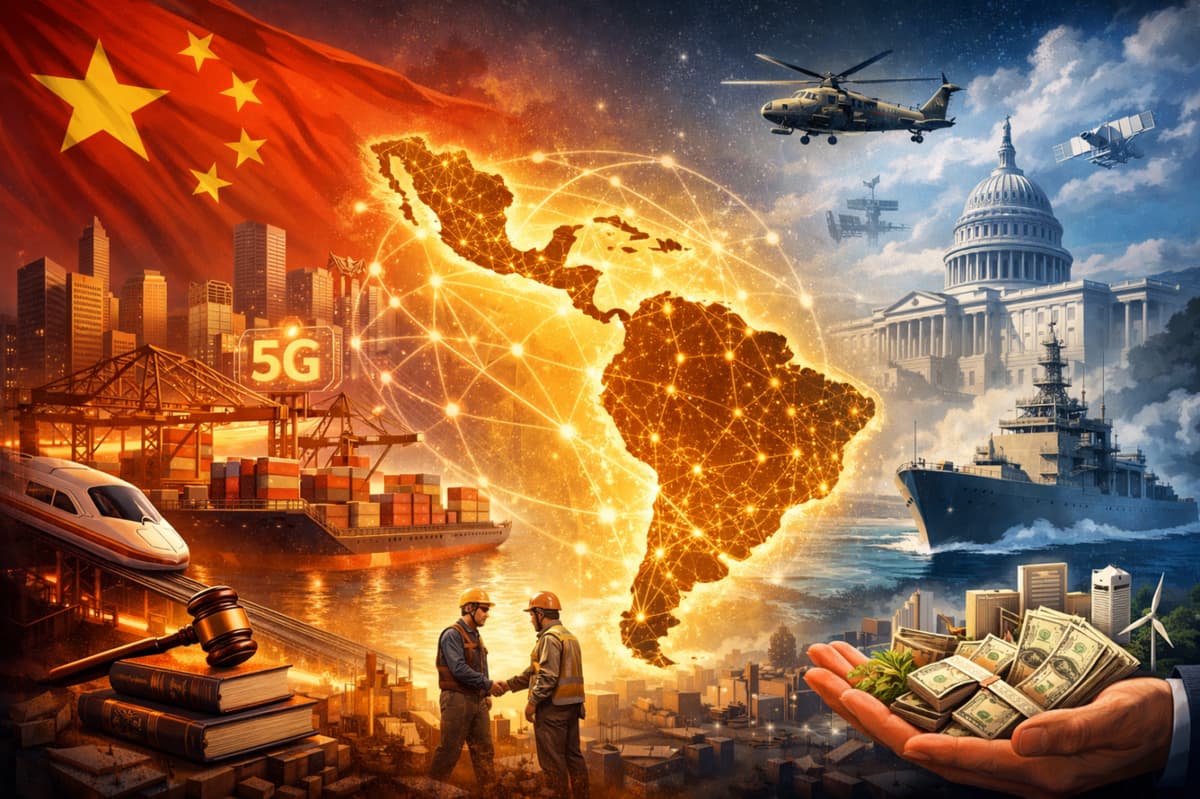
Unrestricted Warfare Without War: China’s Below-Threshold Strategy in Latin America
Key Takeaways
- •China’s trade with Latin America topped $500 B in 2024
- •Beijing invested $8.5 B in LAC OFDI and $120 B in loans
- •Chinese-owned ports in 14 LAC countries could support PLA naval ops
- •Digital Silk Road ties lock Latin America into Chinese tech standards
- •US must offer credible economic alternatives to counter China’s sub‑threshold influence
Pulse Analysis
The rise of China’s "unrestricted warfare" in Latin America reflects a sophisticated, whole‑of‑state playbook that blends economics, law, and information operations to achieve strategic goals without firing a shot. By surpassing $500 billion in trade and funneling billions in loans and direct investment, Beijing has entrenched itself as a primary market for raw materials and a financier of infrastructure projects. This financial heft is not merely commercial; it creates dependencies that can be leveraged for political influence, echoing the debt‑trap narrative seen in other regions. The acquisition of ports across fourteen countries, including the deep‑water Chancay Megaport in Peru, adds a maritime dimension that could support People’s Liberation Army Navy logistics and intelligence gathering, blurring the line between civilian trade hubs and potential military footholds.
Beyond bricks and mortar, China is exporting its digital ecosystem through the Digital Silk Road, embedding Huawei‑built telecom networks, cloud platforms, and data‑governance models into Latin American societies. These systems are bundled with proprietary standards that raise switching costs and create long‑term regulatory dependence, effectively turning technology into a strategic lever. Simultaneously, Beijing’s legal and institutional outreach—via the China‑CELAC Forum, free‑trade agreements, and standards harmonisation—shapes regional regulatory landscapes, while sharp‑power media initiatives and elite‑capture programs subtly steer public discourse and policy preferences toward Beijing’s worldview.
For U.S. policymakers, the challenge is twofold: counteract the economic allure of Chinese financing while offering viable alternatives that respect Latin American autonomy. Initiatives that secure critical‑mineral supply chains, invest in resilient infrastructure, and promote transparent digital standards can blunt Beijing’s influence. Moreover, a coordinated diplomatic effort that highlights the hidden costs of Chinese engagement—such as potential espionage, debt vulnerability, and loss of strategic flexibility—will be essential to re‑asserting the United States’ historic role in the Western Hemisphere. Failure to act risks a gradual erosion of U.S. leverage in a region increasingly pivotal to global supply chains and geopolitical balance.
Unrestricted Warfare Without War: China’s Below-Threshold Strategy in Latin America
Comments
Want to join the conversation?