Why It Matters
Domestic HALEU production and fuel‑cycle recycling lower reliance on foreign supply, cut high‑level waste, and accelerate deployment of advanced nuclear reactors essential for clean‑energy goals.
Key Takeaways
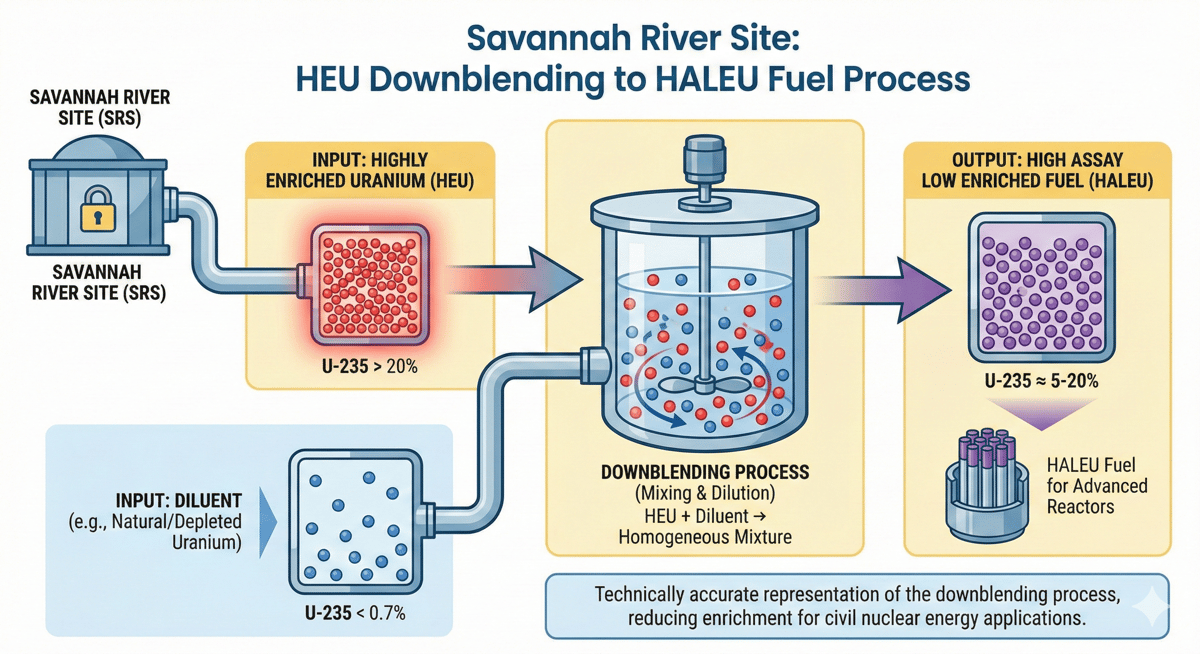
- •SRS H‑Canyon to down‑blend HEU into 19 t HALEU
- •$19 M grants target closed‑fuel‑cycle technologies
- •Hanford FMEF repurposing could revive domestic enrichment capacity
- •Isotope recovery supports medical and industrial applications
- •HALEU supply critical for SMRs and advanced reactors
Pulse Analysis
The renewed operation of H‑Canyon marks a strategic shift from treating surplus weapons material as waste to viewing it as a resource. By converting legacy HEU stocks into HALEU, the DOE not only creates a domestic feedstock for next‑generation reactors but also reduces the volume of high‑level waste destined for long‑term storage. This dual benefit aligns with the broader environmental remediation mission of the Office of Environmental Management while addressing the supply bottleneck that has constrained small modular reactor (SMR) roll‑out.
Funding the five private‑sector projects underscores a policy pivot toward a closed nuclear fuel cycle. The awarded $19 million will accelerate technologies such as electro‑chemical processing, pyro‑processing, and UF₆ recovery, each promising to extract the remaining 95% of usable energy from spent fuel. Successful commercialization could slash the need for fresh uranium mining, lower the radiotoxicity and heat load of waste, and create a domestic market for valuable isotopes used in medicine and industry.
The Hanford FMEF feasibility study adds another layer to the supply‑chain renaissance. If the 190,000‑square‑foot facility can be retrofitted for enrichment and fuel‑fabrication, it would complement General Matter’s plans to re‑enrich depleted uranium tails, further diversifying the United States’ enrichment capabilities. Together, these initiatives form a cohesive ecosystem that strengthens energy independence, supports the AI‑driven economy’s baseload needs, and positions the U.S. as a leader in advanced nuclear technology.
DOE Launches Initiatives to Produce Uranium Fuel
0
Comments
Want to join the conversation?
Loading comments...