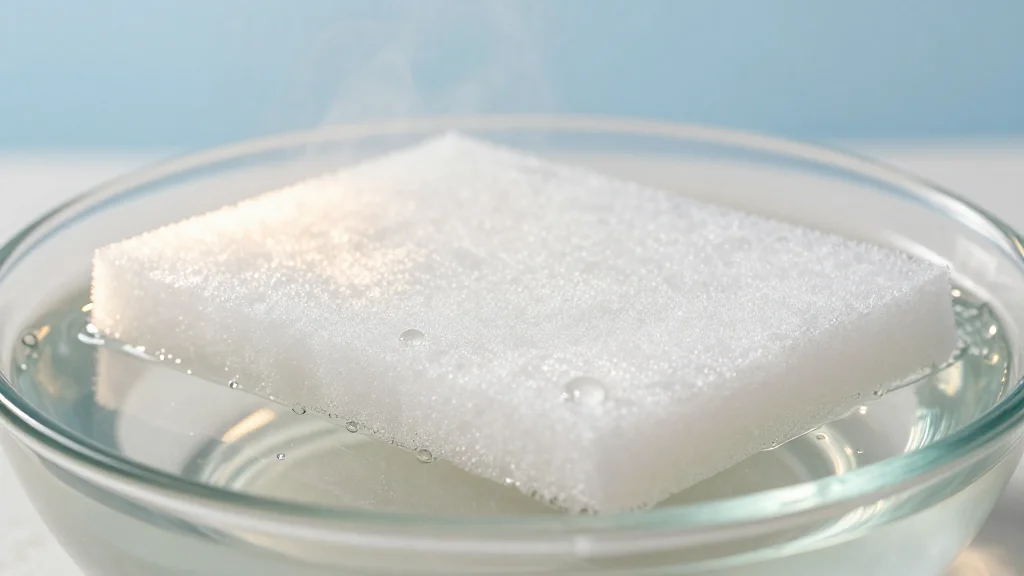
Heat-Storing Solar Foam Enables Continuous Desalination After Sunlight Fades
Key Takeaways
- •Foam stores solar heat, enabling evaporation after light stops
- •Generates 9.23 kg fresh water per m² in 10 hours
- •Material cost only $0.54 per m², supporting low‑cost deployment
- •Meets WHO drinking‑water standards, removing salts by 2‑3 orders
- •Durable through repeated light‑dark cycles without performance loss
Pulse Analysis
The phase‑change photothermal foam merges three functions—solar absorption, heat storage, and salt resistance—into a single, porous matrix. Polypyrrole coats a chitosan‑phenolic resin scaffold to capture sunlight, while embedded dodecylamine acts as a low‑melting phase‑change material that stores excess heat during peak irradiance. When clouds roll in or night falls, the stored thermal energy is released gradually, sustaining interfacial evaporation without the need for auxiliary power. This design overcomes the long‑standing hurdle of solar desalination’s dependence on uninterrupted sunlight.
Performance data from real‑world outdoor trials underscore the foam’s practicality. Over a ten‑hour window, the device yielded 9.229 kg of potable water per square metre, translating to roughly 0.92 L m⁻² h⁻¹, while maintaining ion concentrations two to three orders of magnitude below seawater levels. At a material cost of just $0.54 per square metre, the system rivals conventional membrane desalination in economics, especially when factoring in the eliminated energy bill. Moreover, the foam’s resilience to repeated heating‑cooling cycles and its ability to strip heavy metals and dyes broaden its utility beyond seawater, positioning it as a versatile tool for zero‑liquid‑discharge and industrial wastewater streams.
For investors and policymakers, the foam signals a shift toward decentralized, renewable‑driven water infrastructure. Its low capital outlay and minimal maintenance requirements make it attractive for remote communities, disaster‑relief zones, and arid regions where grid power is unreliable. Scaling the fabrication process—already described as simple and roll‑to‑roll compatible—could unlock gigalitre‑scale deployments, reducing pressure on freshwater sources and mitigating the environmental burden of brine disposal. As climate change intensifies water scarcity, technologies that deliver continuous, affordable desalination are poised to become strategic assets in global water security strategies.
Heat-storing solar foam enables continuous desalination after sunlight fades
Comments
Want to join the conversation?