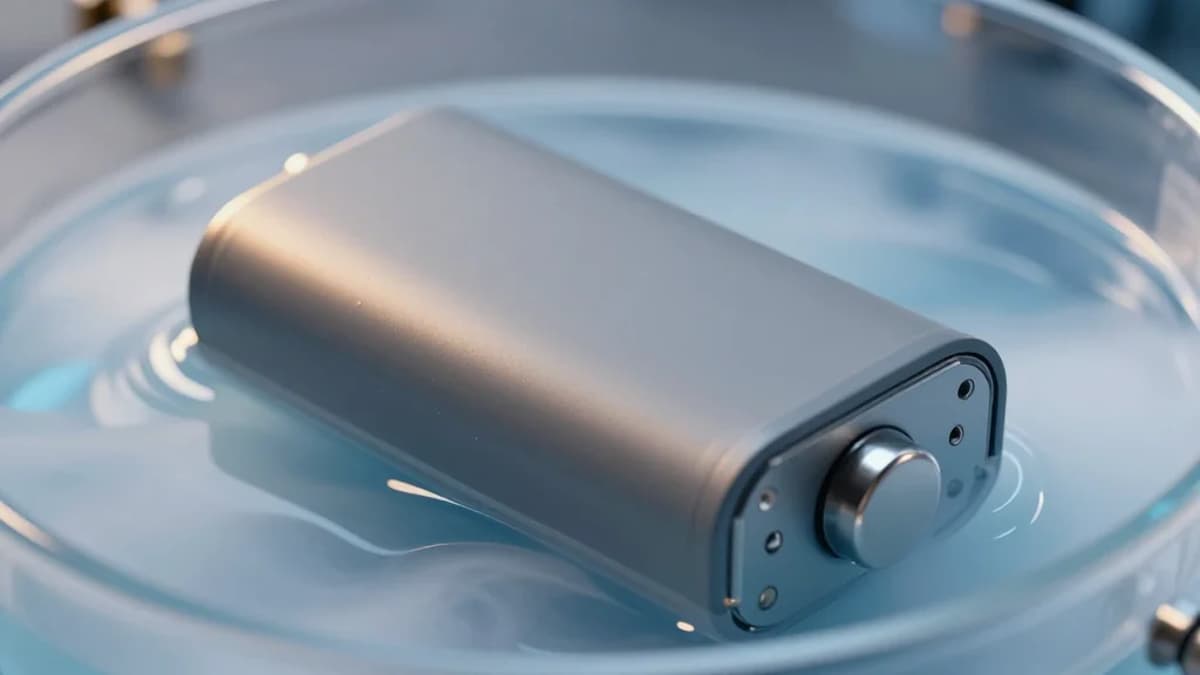
Intrinsic safety measures like immersion cooling and proven fire containment reduce operational risk and lower costs, accelerating BESS adoption in high‑risk, long‑duration applications.
The battery industry is reaching a pivotal moment as manufacturers move beyond reactive fire‑suppression toward built‑in safety architectures. A123’s semi‑solid‑state chemistry blends solid electrolytes with liquid components, curbing dendrite growth while delivering higher energy density. Coupled with immersion cooling—where cells sit in a dielectric fluid—the system maintains tight temperature control, a critical factor for extending cycle life and reducing the levelised cost of energy. This combination positions A123 to serve high‑risk grid applications where reliability is non‑negotiable.
Hithium’s recent large‑scale fire testing (LSFT) provides a practical benchmark for safety compliance under the NFPA 855 standard. By disabling fire‑detection systems and exposing a fully charged 6.25 MWh unit to open‑door conditions, the test proved that fire remained isolated, thanks to a steel frame, dual‑layer partitions, and directional airflow channels. The successful outcome not only validates Hithium’s engineering approach but also eases regulatory hurdles for U.S. projects, where NFPA certification is increasingly mandatory.
Together, these developments signal a broader industry trend toward intrinsic thermal management and fire‑resistant design, especially for long‑duration energy storage (LDES) deployments. As utilities and developers prioritize safety, cost, and performance, technologies like semi‑solid cells and immersion cooling will likely become differentiators in competitive bidding processes. Investors and policymakers should watch how these safety innovations influence market dynamics, potentially reshaping supply chains and accelerating the rollout of resilient, low‑cost grid storage solutions.
By Andy Colthorpe · February 10 2026
Wanxiang A123 Systems launched its range at Wanxiang Innovation Energy City in Hangzhou, China.
With battery storage safety under increasing scrutiny, Wanxiang A123 Systems and Hithium have unveiled new products and large‑scale fire testing (LSFT), respectively.
Wanxiang A123 Systems (A123) unveiled a new battery energy storage system (BESS) solution on 7 February, featuring semi‑solid‑state battery technology integrated with immersion cooling. A123 says this marks a shift toward intrinsic, system‑level protection, moving away from the industry’s reliance on reactive fire‑suppression systems.
The new Star Series semi‑solid‑state battery cells and Star River complete BESS solution are aimed at what the company describes as “high‑risk applications.”
The Star Series cells join A123’s product range of 300 Ah lithium‑iron‑phosphate (LFP) cells for grid‑scale and industrial applications. While the release gave few technical details, A123 claims the Star Series is equipped with proprietary technologies that could mitigate electrolyte‑leakage issues and thermal instability.
Semi‑solid‑state cells use a portion of solid electrolytes instead of the all‑liquid or gel electrolytes found in conventional lithium‑ion (Li‑ion) batteries. This promises reduced dendrite formation, enhanced thermal stability and increased cell capacity. Semi‑solid is considered a stepping‑stone to fully solid‑state batteries, which many companies are working to commercialise but which remain challenging to manufacture and will require new production techniques. Although sodium‑ion (Na‑ion) is often seen as a potential drop‑in replacement for Li‑ion, solid‑state is viewed as a longer‑term successor.
The Star River BESS features full immersion cooling, which A123 says maintains cell‑temperature variance within 2 °C even under demanding operating conditions. Liquid‑cooled systems are becoming more common, but immersion cooling—where battery cells are submerged in a dielectric liquid when temperature issues are detected—is currently offered only by a few providers, notably US manufacturer Etica AG (a joint venture between Taiwan’s Etica Battery and Pennsylvania‑based Asset Genie). Etica claims immersion cooling eliminates thermal runaway.
A123 makes similar claims with its dual‑layer safety protection in the Star River BESS, stating it offers 10 000 cycle life at room temperature and 7 000 cycles at 45 °C—a 40 % improvement over industry averages. The company says this temperature performance reduces the levelised cost of energy (LCOE) by around 15 %.
Hithium recently completed large‑scale fire testing (LSFT) of its ∞Power 6.25 MWh BESS solution under open‑door conditions, the first such test worldwide of a system equipped with 1 000 + Ah cells. The testing was overseen by representatives from UL, various US authorities having jurisdiction (AHJs) and fire‑protection engineers.
In LSFT, a complete BESS unit is set on fire with its fire‑detection and suppression systems disabled, and the results are observed. Manufacturers aim to demonstrate that, in a worst‑case scenario, fire will be contained to a single unit and will not propagate to adjacent units, equipment, or buildings.
The ∞Power 6.25 MWh BESS is a 4‑hour duration system featuring Hithium’s 1175 Ah ∞Cell, one of a growing number of large‑format LFP cells designed to increase energy density and capacity. According to a release on 8 February, during the LSFT the container doors were left open to maximise oxygen supply and flame impact. Three other BESS containers were placed adjacent to the test unit (back‑to‑back and side‑to‑side with 15 cm spacing) while the test unit operated at 100 % state of charge (SoC).
Set‑up of Hithium’s LSFT. Doors of the BESS unit to be set on fire can be seen opened.
The fire was contained to the test system; no thermal propagation was observed, and cells in adjacent containers remained below safety thresholds. Hithium attributes this to system‑level safety features: a high‑strength steel frame, dual‑layer partitions, modules sheathed in fire‑resistant covers, and a three‑dimensional airflow channel that provides directional venting of energy released during thermal runaway of the 1175 Ah cells.
This follows an earlier test of Hithium’s 5 MWh product. The test method, developed by Canada’s CSA Group, is mandatory under the US National Fire Protection Agency (NFPA) standard 855 (2026 edition). Compliance with NFPA 855 is a common requirement for US projects and is increasingly adopted elsewhere.
The two Chinese companies have backstories that come from opposite ends of the energy‑storage timeline.
Wanxiang A123 Systems (A123) was founded in 2001 in Massachusetts, USA, by a team that included MIT battery scientist Yet‑Ming Chiang. A pioneer in commercialising Li‑ion batteries for electric‑vehicle (EV) and BESS applications, A123 received extensive US government support but entered both sectors early. Its battery division was acquired by Chinese automotive group Wanxiang in 2012, while its grid‑storage business was bought by NEC in 2014. Chiang later launched other battery ventures, notably 24M, which has developed a semi‑solid lithium‑battery manufacturing platform. A123 has recently re‑entered the North‑American grid‑scale BESS market; the system‑integrator arm acquired by NEC was later bought by Korea’s LG Energy Solution (LG ES) in a deal completed in 2022.
Hithium was launched in 2019 in Xiamen, China, and has since expanded rapidly in manufacturing capacity, product range and global sales. In the past year the vertically integrated company opened new production lines in the US, signed deals in Eastern Europe and the Middle East, and unveiled larger 1300 Ah cells (designed for 8‑hour long‑duration energy‑storage applications) in December. Hithium is currently seeking an IPO on the Hong Kong Stock Exchange (HKEX), joining a wave of Chinese energy‑storage firms pursuing foreign investment via H‑shares (HKEX) and A‑shares (Shanghai/Shenzhen).
Keywords: A123, fire safety, Hithium, immersion cooling, large format, LSFT, semi‑solid, solid‑state, thermal management, thermal runaway
Comments
Want to join the conversation?
Loading comments...