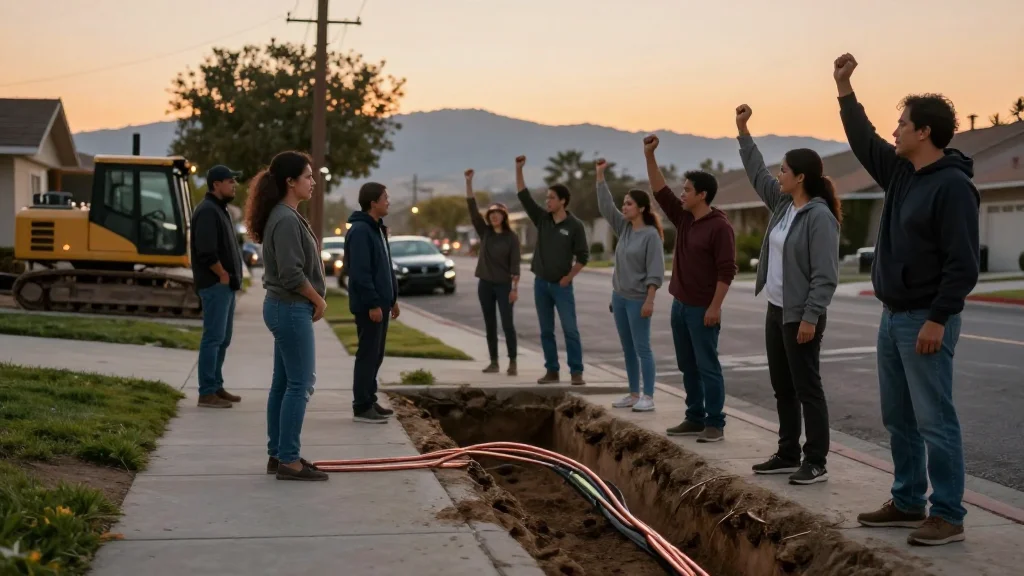
Angry Altadena Residents Ask Officials to Halt Edison’s Undergrounding Work
Companies Mentioned
Why It Matters
The dispute underscores the tension between utility grid hardening for fire resilience and the financial and environmental burdens placed on homeowners, potentially shaping future regulatory and community‑engagement approaches for undergrounding projects.
Key Takeaways
- •Over 120 Altadena residents petition to pause SCE undergrounding
- •Homeowners may face $8,000‑$10,000 plus extra trenching costs
- •Tree preservation concerns as crews dig near surviving oaks and pines
- •Telecom wires stay overhead, undermining visual benefits of undergrounding
- •Edison allocated up to $925 million for undergrounding in Altadena and Malibu
Pulse Analysis
Utility companies across California have accelerated undergrounding programs after a string of devastating wildfires, positioning buried lines as a cornerstone of grid resilience. Southern California Edison’s $925 million investment in Altadena and Malibu reflects industry confidence that subterranean infrastructure reduces outage risk and fire ignition points. However, the high capital cost—roughly $4 million per mile—translates into sizable fees for homeowners, a model that shifts long‑term maintenance expenses onto ratepayers while promising decades of profit for the utility.
In Altadena, the rollout has sparked fierce community pushback. Residents, still rebuilding after the Eaton Fire, argue that the projected $8,000‑$10,000 connection fee underestimates actual expenses, especially where deep trenches intersect mature oak and pine canopies protected by local ordinances. Arborists warn that root disruption could decimate the town’s remaining heritage trees, eroding both ecological value and neighborhood character. Adding to the frustration, telecom providers such as Spectrum and AT&T have declined to share the underground corridors, leaving aerial lines that clash with the aesthetic goals of the project.
The controversy may prompt regulators and utilities to rethink coordination and cost‑allocation strategies. Greater transparency, municipal oversight, and financing mechanisms—such as state‑backed grants or low‑interest loans—could alleviate homeowner strain while preserving environmental assets. As California refines its utility‑hardening policies, the Altadena case could serve as a benchmark for balancing safety upgrades with community equity, influencing how future undergrounding initiatives are designed, funded, and communicated.
Angry Altadena residents ask officials to halt Edison’s undergrounding work
Comments
Want to join the conversation?
Loading comments...