Anonymous Donor Helps Philadelphia Habitat for Humanity Homes Go Solar Solar Power World’s Projects of Impact.
•February 11, 2026
0
Companies Mentioned
Why It Matters
The initiative proves that donor‑backed residential solar can deliver substantial cost savings and energy equity for low‑income families while respecting historic preservation constraints.
Key Takeaways
- •Anonymous donor funds solar on five Habitat homes
- •Exact Solar navigated historic zoning with concealed equipment
- •Homeowners contributed sweat equity during installation
- •Systems expected to save over $40,000 each lifetime
- •Project highlights social impact of residential photovoltaic installations
Pulse Analysis
Donor‑driven solar projects are gaining traction as a pragmatic way to bridge the energy‑affordability gap for low‑income households. By channeling philanthropic capital into photovoltaic installations, organizations like Habitat for Humanity can offer reduced‑cost homeownership alongside tangible utility savings. The Strawberry Mansion effort showcases how a single anonymous contribution can catalyze multiple installations, creating a replicable model for other nonprofits seeking to embed clean energy into affordable‑housing programs.
From a technical standpoint, Exact Solar’s deployment of VSUN 400‑W modules paired with Enphase IQ8 microinverters delivers both high efficiency and granular monitoring for each home. The historic district’s strict visual guidelines forced the team to paint conduit and conceal inverters behind mesh, illustrating how aesthetic compliance can coexist with modern solar design. Such solutions demonstrate that even heritage‑rich neighborhoods can adopt cutting‑edge renewable technology without compromising architectural integrity.
Economically, the projected $40,000 lifetime savings per residence translates to roughly $1,000 a year—an amount that can significantly improve household budgets in a region where energy costs often strain limited incomes. This financial relief not only reduces monthly utility bills but also frees capital for other essential needs, reinforcing the broader concept of energy equity. As municipalities and policymakers observe these outcomes, the case strengthens for incentives, streamlined permitting, and public‑private partnerships that scale similar projects nationwide, accelerating both climate goals and social welfare.
Anonymous donor helps Philadelphia Habitat for Humanity homes go solar Solar Power World’s Projects of Impact.
By Billy Ludt
Solar Power World’s project coverage usually focuses on arrays just starting development or construction, or on systems that have received permission to operate. However, the real effects on a community are seen during a solar project’s 25‑year or longer lifespan. In reaction to this, Solar Power World has started Projects of Impact, a series highlighting the effects that existing PV arrays have post‑installation.
This first Project of Impact is several solar systems built with the help of East Coast PV contractor Exact Solar and Habitat for Humanity, a longstanding American nonprofit organization that lowers the barrier to homeownership for people with low incomes.
SPW: Who all was involved in the development and construction of this project?

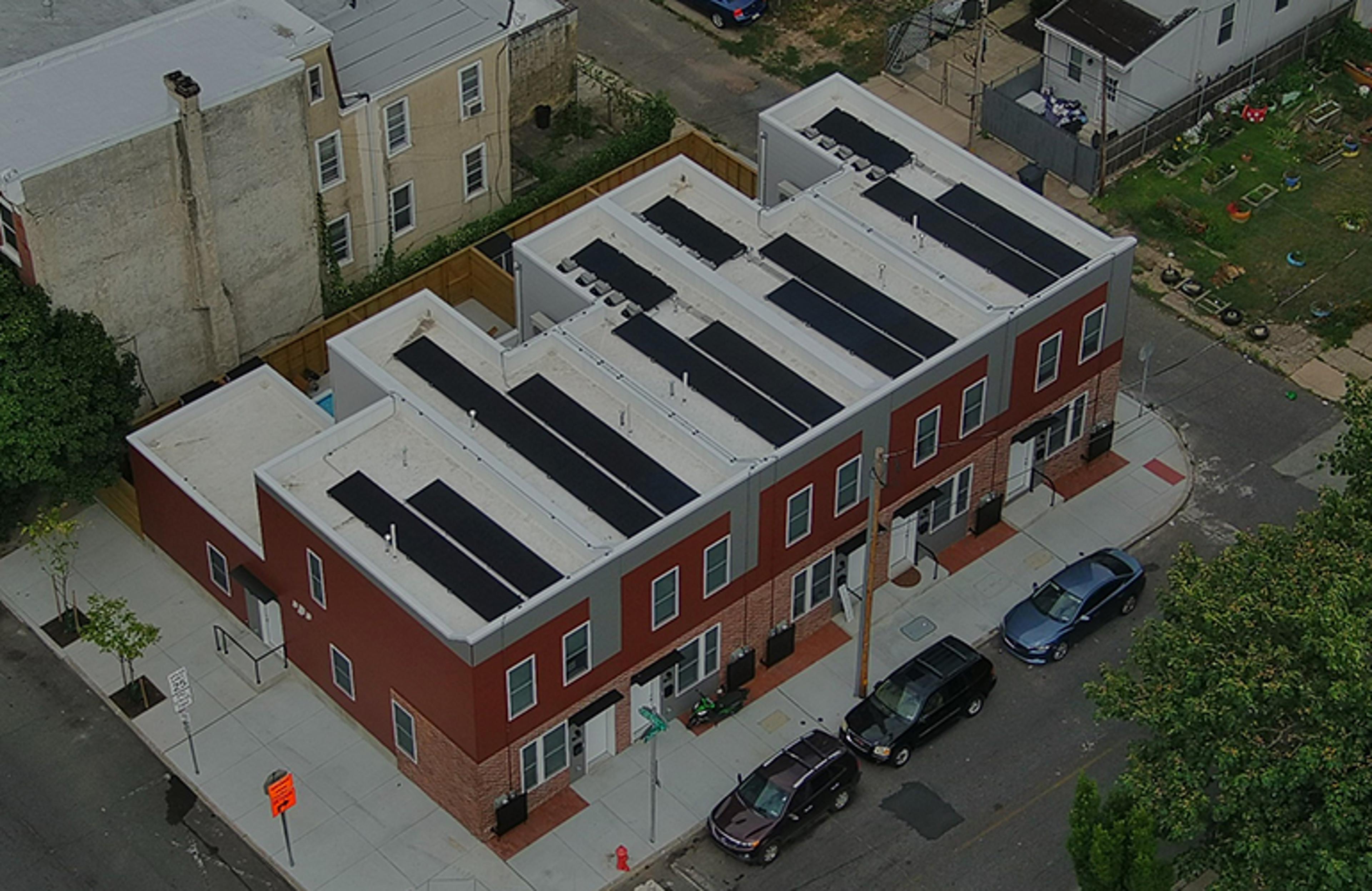
Exact Solar worked alongside the Habitat for Humanity homeowners to build solar projects across five rooftops in the historic neighborhood of Strawberry Mansion in Philadelphia.
Aaron Nichols, solar policy and research specialist, Exact Solar: “Ed McColly, who’s the director of real estate development for Habitat for Humanity Philadelphia; and then there’s Dave Hammes, who was our sales engineer on the project.
The project came from an anonymous donor. His stipulation was that he wanted to donate money for solar projects on Habitat for Humanity homes. Ed knew that he wanted to engage a local solar installer. He first saw our billboard but then reached out to Solarize Philly (Solarize Greater Philadelphia). We’re a Solarize Philly installer, and so all of those organizations were involved and interfaced to get this going.
What’s really cool about this project is that the homeowners themselves were very involved. Habitat for Humanity has that term, “sweat equity.” These are homes that are designed for low‑income people that they buy at greatly reduced rates, but they also help build them. Our crews got to work alongside the homeowners who were finishing the inside of the houses while we were putting solar on the roofs.
SPW: What challenges did this project pose, and how did Exact Solar solve them?
Nichols: “Being in a historic neighborhood was a big one. The Strawberry Mansion neighborhood of Philadelphia has some historic zoning codes that we had to work around. We had to paint all of the conduit and inverters a certain color and put a mesh over them so they wouldn’t be visible from the street.”
SPW: What makes this project unique out of Exact Solar’s breadth of installations?
Nichols: “We’ve done a lot of cool projects, but this is one of the few that has had massive social impact locally. The fact that homeowners worked on the houses alongside the crews, it’s pretty amazing. And the amount of money that these families are going to save is more than the average person is going to save going solar, because the homes are also ENERGY STAR certified.
But being that these are local low‑income families who have gone on this program, it frees up more of their budget that can go to so much more than just wasting money on rising power costs every month. Each one of the systems is going to save each home more than $40,000 over time. That’s more than $1,000 a year, which is so big for families in that situation.”
Project Information
-
Name: Habitat for Humanity Strawberry Mansion solar project
-
Location: Strawberry Mansion, Philadelphia, Pennsylvania
-
Project timeline: Early to late 2024
-
System size: 17.6 kW
Components
-
Modules: VSUN 400‑W modules
-
Inverters: Enphase IQ8 Microinverters
-
Mounts: Unirac RM5 south‑facing ballasted racking

Billy Ludt
Billy Ludt is managing editor of Solar Power World and currently covers topics on mounting, inverters, installation and operations.
0
Comments
Want to join the conversation?
Loading comments...