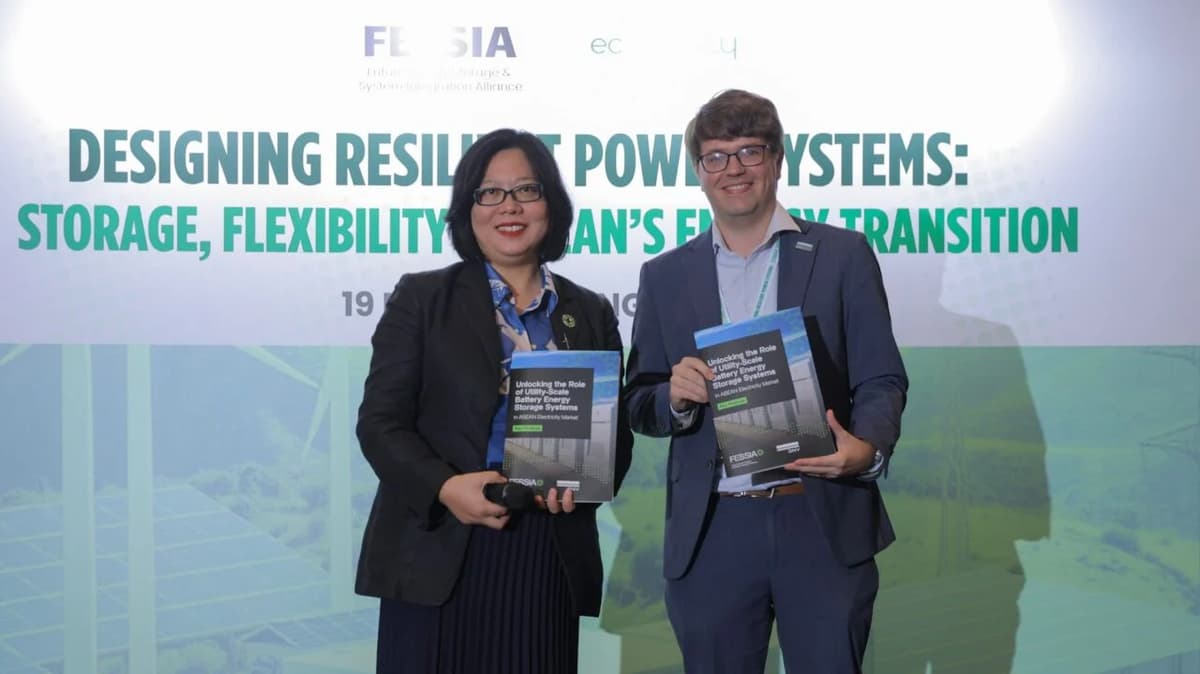
ASEAN Regulatory Frameworks ‘Must Evolve’ to Capture Full Value of Battery Storage
Why It Matters
Evolving market rules will unlock billions in investment and operational savings, accelerating ASEAN’s renewable energy transition and grid reliability.
Key Takeaways
- •ASEAN BESS capacity totals only 1.4 GW, far below global potential
- •Philippines could earn $2.25 bn annually from solar‑BESS combos by 2030
- •Vietnam may attract $750 mn this year, scaling to $5.7 bn by 2030
- •Revenue stacking is essential but hampered by current ASEAN regulations
- •Policy reforms needed to recognise batteries as bi‑directional grid assets
Pulse Analysis
The FESSIA report arrives at a pivotal moment for Southeast Asia’s power sector. With renewable generation surging and battery costs slashing by roughly 90 % since 2013, the technical case for large‑scale storage is clear. Yet the region’s installed BESS capacity – just 1.4 GW across eleven nations – lags dramatically behind global trends, underscoring a regulatory bottleneck rather than a technology gap. By mapping each market’s readiness, the study provides a roadmap for policymakers to transform storage from a niche asset into a core grid resource.
In the Philippines, a nascent wholesale market coupled with supportive legislation has already unlocked ancillary‑service revenues, projecting $2.25 bn in yearly earnings from co‑located solar‑BESS projects by 2030. Vietnam follows a similar trajectory, with a new decree that defines BESS applications and pricing, attracting $750 mn of investment this year and potentially $5.7 bn by the decade’s end. Both cases illustrate the power of revenue stacking – combining ancillary services, energy shifting, and T&D deferral – to improve project economics and reduce investment risk. However, existing rules still prevent full stacking, limiting the financial upside for developers.
The broader implication for ASEAN is clear: without regulatory reforms that recognise batteries as bi‑directional, fast‑response assets, the region will miss out on billions of dollars in economic and system benefits. Mature markets demonstrate that flexible market designs, clear valuation of grid services, and incentives for revenue stacking drive rapid storage deployment. As ASEAN nations draft next‑generation energy policies, aligning them with these best practices will be essential to meet rising demand, integrate higher shares of renewables, and achieve net‑zero ambitions.
ASEAN regulatory frameworks ‘must evolve’ to capture full value of battery storage
Comments
Want to join the conversation?
Loading comments...