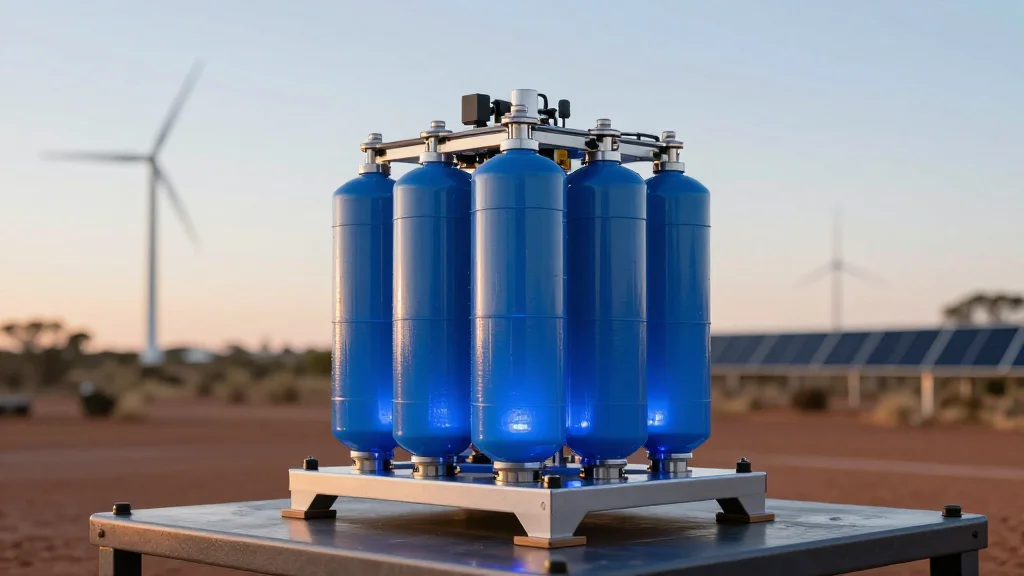
Australian Developer Moves Ahead with Modular Green Hydrogen Production Plant
Why It Matters
The licensing milestone and digital‑twin funding give developers a standardized, cost‑effective blueprint for building massive green‑hydrogen hubs, accelerating commercial rollout and supporting export markets.
Key Takeaways
- •ICE secured up to $1.14 million federal funding for a digital twin.
- •First licence signed for P2(H2)Node, enabling real‑world deployment.
- •Modular architecture could cut capex and opex by up to 10 % each.
- •Node integrates directly with 70 GW Western Green Energy Hub solar‑wind farms.
- •Green ammonia offtake from Japan and Korea supports 1.4 Mt/yr by 2033.
Pulse Analysis
The push for modular green‑hydrogen production reflects a broader industry need for repeatable, low‑risk designs. ICE’s P2(H2)Node, now backed by a $1.14 million digital‑twin grant from ARENA, offers a standardized engineering package that can be simulated across diverse site conditions. By creating a virtual replica of the node, developers can forecast cost, performance and schedule with greater certainty, reducing the engineering overhead that traditionally slows large‑scale projects.
At the heart of Australia’s ambition is the 70 GW Western Green Energy Hub, a sprawling solar‑wind complex slated to generate up to 3.5 million tonnes of green hydrogen annually. The P2(H2)Node’s ability to plug directly into such renewables eliminates long‑distance electricity transmission, shaving up to 10 % off capital expenditures and delivering comparable operational savings. Early licensing provides a reference model for future developers, while secured green‑ammonia offtake from Japan and South Korea underpins a clear export pathway, targeting 1.4 million tonnes per year by 2033.
Globally, the race to commercialise green hydrogen is intensifying, with investors seeking projects that combine scale, cost‑competitiveness and regulatory certainty. Australia’s abundant renewable resources and supportive policy framework position it as a potential export hub, but success hinges on replicable technology like ICE’s node. Standardised designs and digital twins lower entry barriers, attract international capital, and accelerate the timeline to market, helping the sector meet rising demand for clean fuel in shipping, industry and power generation.
Australian developer moves ahead with modular green hydrogen production plant
Comments
Want to join the conversation?
Loading comments...